Who were the Twelve?

Jesus attracted a wide range of Jewish followers, both men and women. Inasmuch as he was trying to get all Israel to turn away from foreign influences and back to the Mosaic Law, he was talking to all parts of Jewish society.

It would be reasonable, then, for his closest followers to include representatives of the various philosophies and social classes, and to be a cross-section of Jewish male society. When Jesus debated with “the Pharisees”, for example, there is no reason to think that they weren’t members of the Twelve.
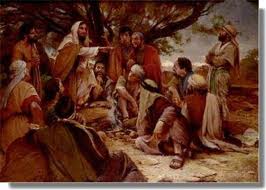
Jesus and the Twelve

In “The Gospel According to the Romans” I identify the Twelve in this way:

    • The fishermen James and John, and Andrew and Simon Peter – illiterate, unaffiliated with a particular philosophy, but anti-Roman
    • Judas Iscariot (or “the Sicariot”) and Simon Zealotes (“the Zealot”) as Zealots – part of the armed resistance to the Romans
    • Little James and his brother Judas Thaddeus as Essenes who avoided Romans
    • Philip and Bartholomew, Pharisees who argued about correct attitudes regarding the Law and the Romans
    • Thomas, a Sadducee willing to make allowances for the Romans
    • Matthew, a foreign-born Greek-educated Jew who had worked for the Romans – a lost sheep who was returned to the flock

This covers the range of Jewish men. Jesus also had a diversity of  women among his followers, such as the three who lived in Tiberias at Herod Antipas’ court: Mary Magdalene; Joanna the wife of Herod’s steward Chuza; and Susanna. A couple more, Mary and Martha, were sisters of Lazarus, close associates of Jesus, and assistants at the resurrection of Lazarus.
Using current events for historical fiction

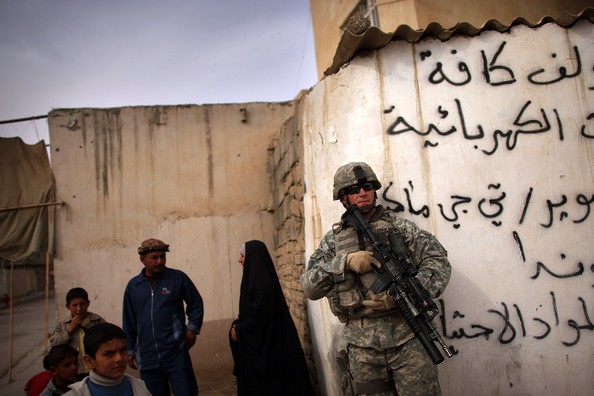
Current events are excellent for giving fresh insights into a pre-existing area of interest. I had long wanted to write a non-believer’s novel about Jesus, and it was the Western invasion and occupation of Iraq that triggered the idea of writing about Jesus from the point of view of the Romans occupying Palestine.

What would a local religious funamentalist preach, if his land was occupied by heavily armed Westerners who trampled on the religion and culture?

Six years later, THE GOSPEL ACCORDING TO THE ROMANS is in proof and should be out in a couple of weeks (CreateSpace and Amazon). If you’re interested in the different take, and the use of current events in historical fiction, the first chapter can be accessed from the top of this page.

The premise of the novel

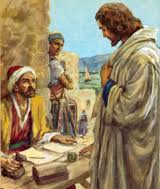
The man we call Saint Matthew, being the tax collector “sitting at the receipt of custom” in Capernaum, is by definition a Roman agent appointed by Pontius Pilate. As such, he has the additional function of keeping an eye on the Zealots and other religious fanatics who head the insurgency against the Roman occupation. ‘Ragheads’, the Romans call them. After Jesus recruits Matthew to help purify Israel and overthrow the Romans – ‘Pigs’, the Jews call them –  Matthew continues to feed information to Pilate.

The local tax collector in Capernaum was - by definition - a Roman agent

Matthew himself tells the story. He is a Greek-speaking Jew, born and educated in Damascus, with a skeptical fascination for religion and politics. He is an irreligious opportunist and has friends on both sides in the conflict. He dines with the Roman military, spies for them, and wants Roman citizenship. But he also lives with Jesus, preaches for him, and falls in love with Mary of Bethany. Whichever way he turns he will cause the death of people he likes, and, in either camp, whoever suspects him will kill him.

By contextualizing the words and actions of Jesus within the Roman Occupation of Palestine and the repeated Jewish insurrections, a strangely modern picture emerges in ‘The Gospel According to the Romans’: a charismatic religious fundamentalist, opposing an occupying superpower.

Why a Menorah?

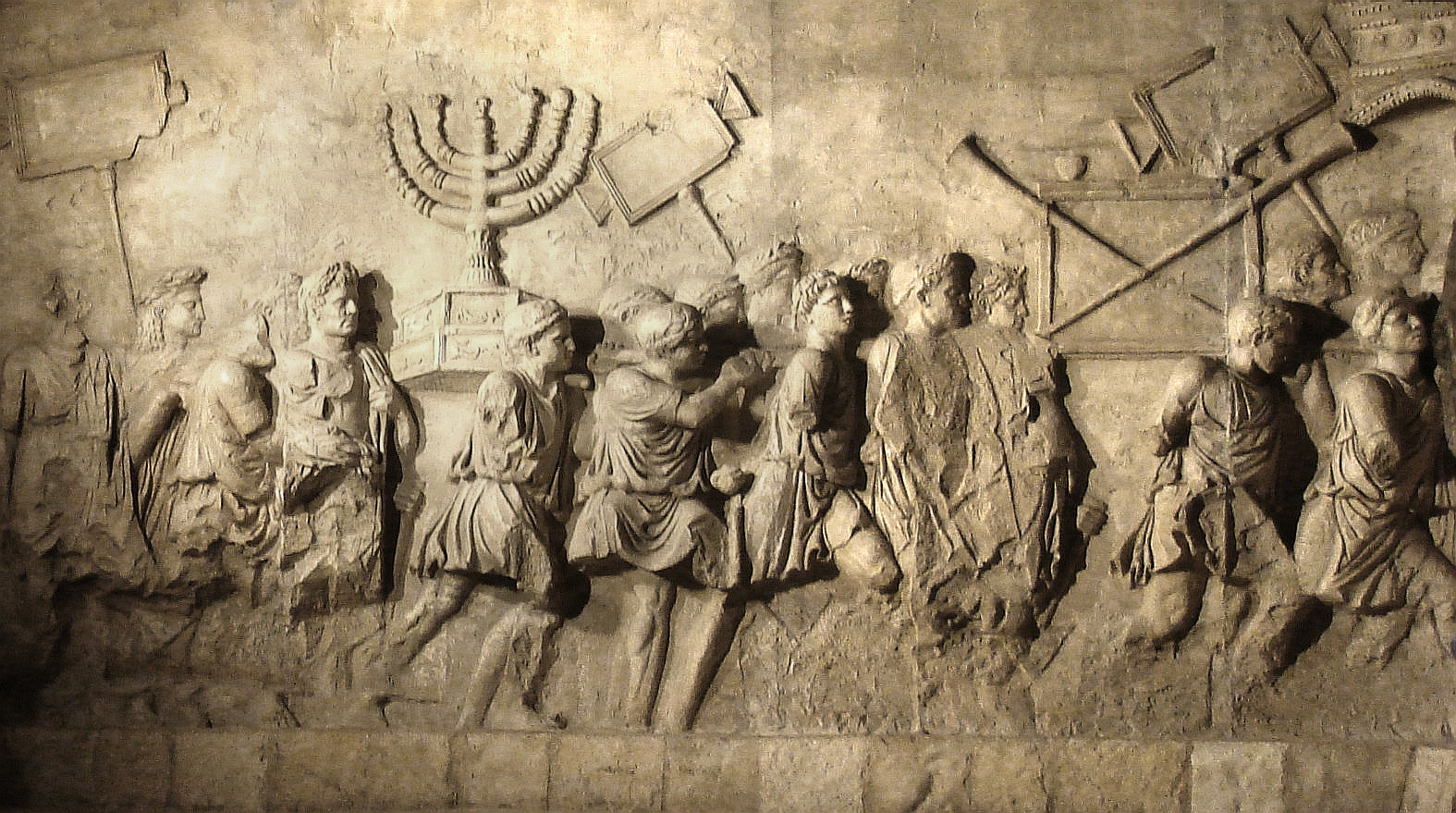
The cover illustration for “The Gospel According to the Romans” comes from the Arch of Titus in Rome. (Actually, it comes from a Tel Aviv museum’s reconstruction of that part of the Arch.)

The Arch of Titus commemorates the destruction of the Temple in Jerusalem and the looting of its treasures in 70 CE, during the Great Revolt that ended with Masada. This was 35-40 years after the death of Jesus, but part of the pattern of a major uprising against the Roman Occupation once a generation or so, and the Legions crushing it.

Treasures from the Temple in Jerusalem being looted by the Legio X Fretensis under Titus

The Roman attitude towards Palestine was that it was a strategically important province: not just at the crossroads of Mesopotamia and Egypt, not just part of the trade routes with India, but essential to prevent piracy and lawlessness in the eastern Mediterranean. So the Romans were there to stay. If the Jews were going to be quiet, the Empire would farm them for taxes while providing commerce and growth and infrastructure. If the Jews were going to be troublesome, the Legions would loot and pillage while suppressing uprisings. Standard Roman practice.

“The Gospel According to the Romans” puts Jesus into this context of Roman occupation and constant Jewish resistance. You’d be surprised how different that makes the Gospels look!

Contextualizing Jesus

Churches and Sunday Schools teach the Old Testament, the New Testament, the description of the Temple, the differences between Sadducees and Pharisees, food, clothing, etc. But no mention of the Romans.

Jesus opposed those who didn't follow the Jewish Law, and the Romans executed him

High school Ancient History teaches the rise of the Roman Empire and its acquisition of all the provinces around the Mediterranean. But no mention of Jesus.

This is like telling the story of Osama Bin Laden without mentioning the Americans – and then telling the story of the Western occupation of Iraq and Afghanistan without mentioning Islam or religious insurgents!

Historians are apparently scared of dealing with historical realities that bear upon the creation of religions; the talking snakes and virgin births and going up to heaven in chariots don’t mesh coherently with the sociopolitical narrative, so historians ignore them.

And priests and theologians are equally scared of contextualizing their stories, because the stories only make sense if they exist as detached fairytale bubbles. Their stories are self-referential, detached from reality, about a preliterate world where gods and angels walk the earth and perform magic, where demons are the cause of illness or misfortune, and where life will somehow continue after the body wears out and dies.

But Jesus was a person in a particular time and place. He was a religious Jew, an acknowledged rabbi, living under the military occupation of an idolatrous, pig-eating Western superpower – the Roman Empire. The Romans had been controlling, taxing (and sometimes looting) Palestine for a hundred years, in the face of major uprisings once a generation. When you view the words and actions of Jesus in this light, a fresh and powerful picture appears, clearly hostile to the Romans.

THE GOSPEL ACCORDING TO THE ROMANS explores the life of Jesus within this historical context.