Why a Menorah?

The cover illustration for “The Gospel According to the Romans” comes from the Arch of Titus in Rome. (Actually, it comes from a Tel Aviv museum’s reconstruction of that part of the Arch.)

The Arch of Titus commemorates the destruction of the Temple in Jerusalem and the looting of its treasures in 70 CE, during the Great Revolt that ended with Masada. This was 35-40 years after the death of Jesus, but part of the pattern of a major uprising against the Roman Occupation once a generation or so, and the Legions crushing it.
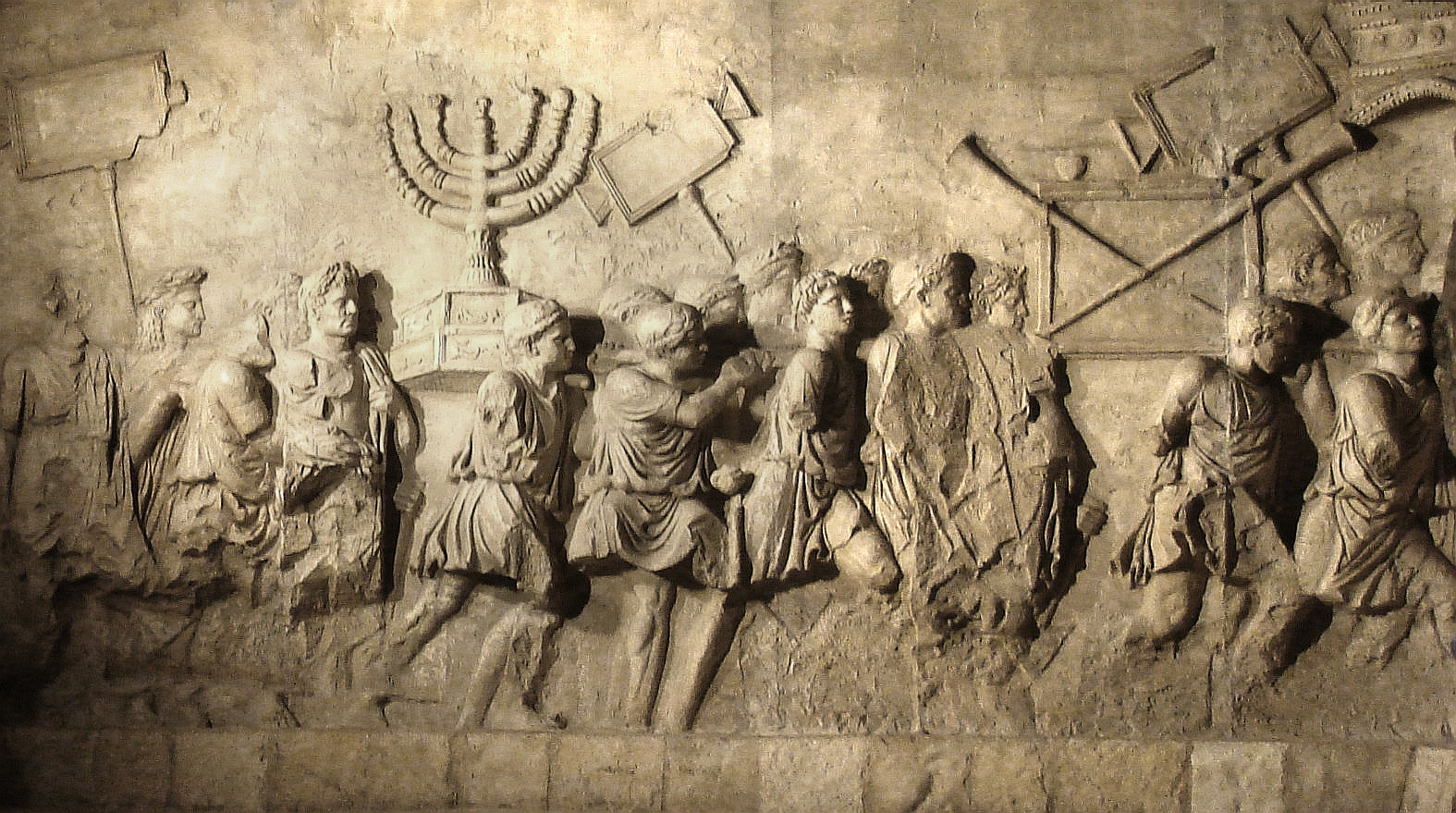
Treasures from the Temple in Jerusalem being looted by the Legio X Fretensis under Titus

The Roman attitude towards Palestine was that it was a strategically important province: not just at the crossroads of Mesopotamia and Egypt, not just part of the trade routes with India, but essential to prevent piracy and lawlessness in the eastern Mediterranean. So the Romans were there to stay. If the Jews were going to be quiet, the Empire would farm them for taxes while providing commerce and growth and infrastructure. If the Jews were going to be troublesome, the Legions would loot and pillage while suppressing uprisings. Standard Roman practice.

“The Gospel According to the Romans” puts Jesus into this context of Roman occupation and constant Jewish resistance. You’d be surprised how different that makes the Gospels look!


Jewish Monotheism, Roman Polytheism. Atheism.

It is amusing to think that many religious Jews and Romans saw each other as atheists.

The Jews felt that polytheism showed that Romans had no concept of the supreme Creator, and were therefore atheists.

The Romans felt that Jews acknowledging only their one tribal god showed that Jews had no concept of the rich and diverse spiritual nature of the universe, and were therefore atheists.

So it goes.

Socrates - bearded old dude who lives on in libraries and T-shirts

The Jews had a point: the Roman gods didn’t look like they were capable of creating a planet, yet alone an entire Universe. They weren’t an orderly or spiritually uplifting bunch.

The Romans had a point: the Jews were claiming that there was only one God, and that He was their tribal god, and no one else’s counted. That’s a no-win situation for anyone but Jews.

Presumably a real atheist, whether Roman or Jew, didn’t give a damn either way.

Contextualizing Jesus

Churches and Sunday Schools teach the Old Testament, the New Testament, the description of the Temple, the differences between Sadducees and Pharisees, food, clothing, etc. But no mention of the Romans.

Jesus opposed those who didn't follow the Jewish Law, and the Romans executed him

High school Ancient History teaches the rise of the Roman Empire and its acquisition of all the provinces around the Mediterranean. But no mention of Jesus.

This is like telling the story of Osama Bin Laden without mentioning the Americans – and then telling the story of the Western occupation of Iraq and Afghanistan without mentioning Islam or religious insurgents!

Historians are apparently scared of dealing with historical realities that bear upon the creation of religions; the talking snakes and virgin births and going up to heaven in chariots don’t mesh coherently with the sociopolitical narrative, so historians ignore them.

And priests and theologians are equally scared of contextualizing their stories, because the stories only make sense if they exist as detached fairytale bubbles. Their stories are self-referential, detached from reality, about a preliterate world where gods and angels walk the earth and perform magic, where demons are the cause of illness or misfortune, and where life will somehow continue after the body wears out and dies.

But Jesus was a person in a particular time and place. He was a religious Jew, an acknowledged rabbi, living under the military occupation of an idolatrous, pig-eating Western superpower – the Roman Empire. The Romans had been controlling, taxing (and sometimes looting) Palestine for a hundred years, in the face of major uprisings once a generation. When you view the words and actions of Jesus in this light, a fresh and powerful picture appears, clearly hostile to the Romans.

THE GOSPEL ACCORDING TO THE ROMANS explores the life of Jesus within this historical context.