Atheist or agnostic?

Am I an atheist, or not? It depends on the definition of “atheist”, and on the mindset of the person asking. In Europe I label myself agnostic, because I have no understanding of why there is a Universe. But in the United States it’s easiest to say I’m an atheist, because anything short of that implies support for the idea of a personal God.

God watching TV

I find offensive the idea of a personal God who, swayed by the emotional appeal of prayers from the devout, favors one person over another. I don’t care whether they’re praying about healing an illness, or winning a ballgame, or picking the right lottery ticket – what morality is there in an omnipotent deity who would intervene in that, and not intervene in the most extreme situations of human suffering?

I find illogical the idea of a God who creates individuals and then punishes them for acting according to the nature they were given.

I find simplistic the idea that God’s Universe is focused on Earth (let alone on one particular tribe, or sect, or individual), when the Earth is only a small planet of a small star, and there could be more stars in the Universe than there are grains of sand on all the beaches of the whole world.

So I’m certain that the personal God of the average American believer doesn’t exist, and couldn’t possibly exist.

But as for exactly what force is the wellspring of the Universe, and what qualities it has, that’s where I’m a militant agnostic:

“I don’t know, and you don’t know either.”
Rome, Israel, and the Christian compromise

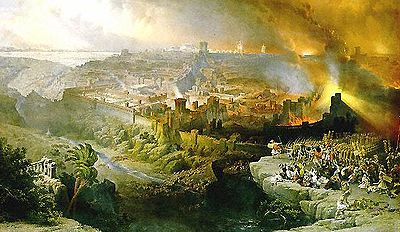
Rome and Israel were in constant conflict for the first 200 years of Rome’s occupation of Palestine. Jesus, as a highly religious Jew, was part of that conflict and was executed for it. Jerusalem was besieged and the Temple destroyed in 70. After the umpteenth uprising, the Romans finally kicked the Jews out of Palestine in 135.

Siege and Destruction of Jerusalem, 70 AD, by David Roberts

When Paul came along, he had the bizarre idea that he could meld his Jewishness and his Roman citizenship, and create a universally applicable religion. It was all done by blending and compromising, and it proved to be very successful. Here are some examples:

Israel: only one God, and no prayers or worship of anyone or anything else. Rome: thousands of gods, worship your own and those of other religions. Christian compromise: only one God… except He has three “persons”, one of which is Jesus… so it’s OK to pray to any of them… also to Jesus’ mother… well, and to any other of God’s angels, saints, etc… but it still counts as only one God.

Israel: God only cares about Israel, God’s Chosen People – ignore everyone else. Rome: local gods care about local people, so the bigger the Empire gets, the more gods care for it. Christian compromise: God cares for everyone who believes in Him, so keep making His empire bigger.

Israel: love Jerusalem, hate Rome. Rome: destroy Jerusalem, Rome is the center of power. Christian compromise: make Rome the center of the Jerusalem-focused religion.

Israel: 7-day week. Rome: 8-day week called “nine days” (inclusive reckoning). Christian compromise: 7-day week called “eight days” or “Octave” (inclusive reckoning).

Israel: Passover. Rome: Saturnalia. Christian compromise: Saturnalia traditions at Saturnalia to celebrate Jesus’ birth, Passover-type traditions at Passover to celebrate Jesus’ death.

Israel: circumcision of males mandatory. Rome: are you crazy? Christian compromise: circumcision of males voluntary.

Israel: detailed dietary and food preparation laws. Rome: eat anything. Christian compromise: no prohibitions most of the time, except Fridays and Lent.

And so on. It’s fascinating. And for a long time, it worked.

Scientologists and Mormons in the news

On the one hand, Scientologist Tom Cruise and Katie Holmes split up. On the other, Mormon Mitt Romney heads for the Republican nomination for President. Money shows up in both stories (and as it does in all organized religions), but there are vast differences.

The Mormons have taken their beehive symbol to heart, work hard, and have a centralized bureaucratic government. They tax their people 10%. Mr Romney is in the news for hiding a lot of his fortune in tax-avoidance jurisdictions overseas (Bermuda, the Caymans, etc). Hm. I wonder if he pays his religious tax the way his church wants…?

The other ones, the Scientologists, were established by Science Fiction writer L. Ron Hubbard a couple of years after he famously said that there was no money in writing SF – the way to make money was to start your own religion. Scientologists suck their adherents dry of their entire wealth, and do it on the basis of the most preposterous “bad SF” cosmology that you can imagine, involving an evil overlord from the Andromeda Galaxy imprisoning his people in volcanoes on Earth and blowing them up with Hydrogen Bombs.

(Somewhat in connection with this, Microsoft researcher Cormac Herley has just published a paper showing that Nigerian email scammers make deliberately ludicrous propositions to their targets, as a way of quickly identifying the most stupid and gullible people.)

But the real reason that Katie Holmes is leaving Tom Cruise may have less to do with money than with the upbringing of their 6-year-old daughter Suri. Suri is now reaching the age when she starts getting “security-checked” by the Scientologists. This is their method of simultaneous indoctrination of the child and spying on her family. It is so unsavory that even that unscrupulous media mogul Rupert Murdoch is outspoken about it.

Rupert Murdoch tweets about Scientology


You can read some of his tweets here. And not only about Scientology. He was also asked about Mormons, and gave an answer that – from the ones I’ve met – I have to agree with:  “Mormonism a mystery to me, but Mormons certainly not evil.”

As for how much sense there is either of these religions compared with longer-established ones… or compared with a modern scientific view of the universe… well, that can be either a very long discussion, or a very short one. But many people find it endlessly fascinating.

The Reasons for Militant Secularism

There is nothing wrong with people speculating about the nature of the universe, their own existence, and the powerful archetypal imagery that can occur in dreams and waking visions.

Meditation

Follow your bliss. BUT DON’T IMPOSE IT!

There is nothing wrong with people following spiritual or psychological disciplines as part of their personal exploration, or as mandated by a belief system that they have chosen to adhere to – unless like Anders Breivik they use their discipline to turn themselves into psychopathic killers, or in other ways harm others.

But the problem is that there is a natural tendency to spill over from personal spirituality to social action, based on non-physical premises.

  • Then you get children being raised to believe themselves or others to be evil.
  • You get schools failing to educate children with science, but instead teaching the Iron Age myths of our tribal ancestors as fact.
  • You get miseducated adults trying to cure physical diseases by chanting incantations while swinging live chickens over their heads instead of going to a doctor.
  • You get government policies that deny harmless activities and productive relationships to groups and individuals, even if those things are accepted in other societies which are richer and happier.
  • You get scientific research held back on non-scientific grounds.
  • You even get massacres, civil wars, terrorism, international wars. As the saying goes, “Science flies you to the moon, religion flies you into buildings.”

Therefore the US needs to return to the secular origins of its Constitution. And the world’s religious nations should emulate Norway, which recently renounced its centuries-old state religion as no longer an appropriate concern of the state.

Churches are money-making concerns, and of far less social value than retirement homes, private hospitals, bookstores, coffee shops, theaters or cinemas.

Tax them.

Pornography for priests

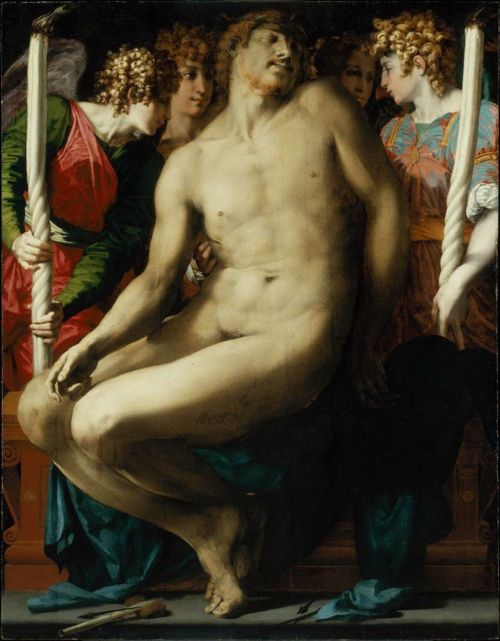
Naked, smiling and being touched by curious young boys.

Dead Christ with Angels

Dead sexy

Rosso Fiorentino painted his “Dead Christ with Angels” as “a work for private devotion” for Bishop Tornabuoni around 1526 (phrase from the Courtauld’s John Shearman).

No blood, no pain, no suffering, just a relaxed body being inspected by inquisitive little angels looking like altar boys grasping enormous phallic candles. What a treat for a bishop!

And a complete disconnect from Jesus’ message of the need to purify Israel, and return to the Shema (“Hear, O Israel…”). But then again, this is Paul’s Christianity, not Jesus’ Judaism.

The logic of the painting is baffling. With Jesus dead (and his spirit having left the body and gone somewhere else?), why would angels put on clothes to look at his naked corpse? What world are we looking at, the spiritual world but with a physical corpse? Or the physical world, with physical fully-clothed angels such as we rarely see these days? And what does an angel need a candle for anyway? It is a work of deliberate fantasy, with no attempt at fact or logic.

There was a time when angels were considered to be terrifying powerful manifestations of divine power. Here they’re just something for the priesthood to salivate over, and to look and see what kind of reaction the painting gets from other viewers. “Come up to my room and let me show you my work for private devotion…”

Of course, if you want the traditional view, you can just listen to a couple of Khan Academy art critics talking about “elements that are hard to figure out” and “heightening the spirituality” and so on.

Religion, or pornography?

A lot of religious art has a pornographic quality to it. Baby Moses in the bulrushes, with various naked females. Jesus being taken down from the cross, naked and very languid. And, of course, the activities of the Greek and Roman gods…

Derek Santini's "Leda and the Swan"

Santini layers a series of still photos onto ribbed plastic sheeting that creates a hologram-like effect as the viewer passes.

Photographer Derek Santini’s studies of Leda and the Swan made news recently when a London bobby on a bus spotted obscenity inside the Scream art gallery and had the offending work taken down on the spot.

But the problem here was that the policeman wasn’t educated enough to recognize the classical religious reference. Better to stay with the stories that even the cops know.

Next up for Santini… how about that story of the Virgin Mary getting pregnant?

Did the religious founders even exist?

Start with Muhammad who lived from 570 to 632 AD. There is extensive proof of his existence, but he’s relatively recent, from the early medieval period.

Before him, Jesus. There are strong indications that a Jewish rabbi of that named lived from about 6 BC – 34 AD, and was executed by the Romans. But those were turbulent times in that part of the world, with insurrections and sieges and the destruction of cities. Certainly the stories told about Jesus were reshaped by Paul with a pro-Roman bias, and some people claim there was no Jesus at all, just an amalgam of Mithraic and other myths.

Moses parting the Red Sea

Some of the religious back stories have always been really, really unlikely.

And now Moses, purported to have been the Jews tribal leader around 1500 BC, is under increasing scrutiny. His existence is questioned on the basis of the entire Jewish-Exodus-from-Egypt story being likely mythical, because there is no trace of any of it in the detailed Egyptian records we have today.

The further back in time, the more dubious the founder looks.

What about Odin? He could have been a tribal leader, bringing the Aesir through Germany into Scandinavia around 300 AD. A trickster, a shaman, a warrior, and perhaps a man who had half-learned to write on the fringes of the Roman Empire, and created a runic alphabet for his own people. Archeology will have to devise fresh tricks before we have more answers.

And Gilgamesh, searching for the secret of immortality, journeying to Dilmun to meet Utnapishtim the Faraway, the survivor of the Flood. The Persian Gulf used to be dry land right out to the Straits of Hormuz during the last Ice Age. If the land flooded by cataclysm rather than gradually, whatever proto-civilizations there were on that fertile plain would have been wiped out. Perhaps a man named Utnapishtim survived, and lived out his days in Dilmun, which the Bahrainis think is the place now known as Bahrain.

And coming back to our own time, we have to consider the new religions of Mormonism and Scientology. Clearly, Joseph Smith and L. Ron Hubbard existed. And equally clearly, the back stories to their religions were made up out of whole cloth, shared with a couple of close associates, and then used to gain access to the wealth and women among the gullible.

And they’ve grown! Mormonism has gone from zero to 14 million since 1830, and Scientology from zero to maybe 200,000 since the early 50s.

So the old religions may have come about in the same way. Yes, there was a founder. Yes, he had visions, or claimed to have visions, or just preached a good story. And a lot of what he preached, even if he made it up out of whole cloth, was believed because it proved to be something that a lot of people were comfortable believing.

And that’s how we got where we are.

Right hand, left hand. At last, Romans and Jews agree!

Genetically, many more humans are right handed than left handed. When everything needs to be done the same way, therefore, there is a natural tendency to require that the procedure favor the right handed.

For example the Roman army required all foot soldiers to hold the shield with the same hand, for the sake of tight formations such as the Tortoise or the Shield.

Shield formation

The Shield formation was designed to be impenetrable by cavalry – at least from the front…

Formal Roman meals were taken reclining on one elbow. You reclined to the left, and ate with the right hand. Jews also celebrated feasts including Passover this way (as in the Last Supper, despite later European depictions). In Judaism left handedness is accepted, but only as an unfortunate imperfection along with blindness, lameness or a lisp. Any of those imperfections disqualified a priest from serving in the Temple in Jerusalem.

In the Arab world today there is still a heavy emphasis on right handedness. People often pick food from a common dish at mealtimes, and the right hand is the “clean” hand for shaking hands, for writing, and for eating with. The left hand is used for wiping yourself at the toilet. Imagine the personal embarrassment and the social stigma of the thief who has had a hand cut off, and must do everything with the same hand, and dip into the common pot with his “dirty” hand…

The left hand ends up with all kinds of negative connotations, now built directly into many languages. And so the final word has to go to the trilingual quip by Canadian socialist Tommy Douglas: “The left in Canada is more gauche than sinister.”

Unasked questions: Who *was* buried 3 days and 3 nights?

Before Jesus went up to Jerusalem to have himself proclaimed King of Israel, he prophesied that he would show off his powers by having “a son of man” brought back to life after “three days and three nights in the heart of the earth”.

The magic trick might have been more credible if it hadn’t been performed by Jesus on his best friend.

Luckily his best friend Lazarus was reported to have died as Jesus and the disciples were headed towards Jerusalem. Lazarus lived four miles south of the city at Bethany, with his sisters Mary and Martha. Jesus delayed his journey for a couple of days, while the disciples urged him to hurry. When Jesus got to Bethany, Mary and Martha met him near Lazarus’ tomb and made a theatrical production of grief. Jesus dramatically called for the stone to be rolled away and called Lazarus to come out, even though he was four days dead. Lazarus came out.

“Therefore many of the Jews who had come to visit Mary, and had seen what Jesus did, put their faith in him.” (John 11:45) The wording suggests that many others were unimpressed with the show, and didn’t believe it.

So the “three days and three nights” prophecy was fulfilled even before Jesus rode into Jerusalem with the crowd calling him King and God’s Anointed. He had no reason to think he himself was going to be the object of the prophecy.

Lazarus fulfills Jesus’ prophecy. Which is more than can be said for Jesus, who was only buried for some 36 hours before his corpse disappeared.

And no, “son of man” had no meaning of “Godlike” attached to it by Jews at that time. The most detailed exposition of its use in the Old Testament is in http://en.wikipedia.org/wiki/Son_of_man. It has the connotation of “mere human”. Redacted excerpt:

“Within the Hebrew Bible, the first place one comes across the phrase son of man is in Book of Numbers 23:19:

God is not a human being (איש : [‘iysh]), that he should lie,
or a son of man (בן–אדם : [ben-‘adam]), that he should change his mind.”

Got that? God is not a Son of Man. (That Mithraist God-incarnate idea is Paul’s great innovation, and the beginning of Christianity.)