Unasked questions: Is God male or female or what?

Both men and women are made in God’s image, according to the Bible. The God of monotheism is usually thought of a man (well, usually an angry old man with a white beard). But if people (not just males) were created in his image, should it be “in her image”? “In its image”? Or what?

Hermaprodite lifts its nightie

Genesis 1: 27 “So God created man in his own image, in the image of God created he him; male and female created he them.”

Some religious apologists say that this doesn’t refer to physical attributes, but to mental or spiritual attributes. Oh, right, like that makes more sense! Now you’re saying that humans are created omnipotent, omniscient, etc.

But let’s stay with the sex issue. Is God like that child of Hermes and Aphrodite, Hermaphroditus? Does God have two fully formed sets of sex organs, or one set that is an amalgam like some humans have? If the latter, does that make hermaphrodites more godlike than the rest of us?

And while we’re at it, does God have a belly button like the rest of us? And if so, why? Is God just a blueprint for creating humans? Is that what God’s sex organs are for? And the big white beard, too? Just so He would know what He was trying to create?

So, um, what race is He? What kind of hair does he have, what color skin? Is His DNA pure homo sapiens, like Africans, or is it 4% Neanderthal like all non-Africans?

In other words, give me a break! “God created man in his own image”? Seriously? It must have meant something thousands of years ago to illiterate herders in the desert. But we’ve moved on since then. Some of us.

Is this what God's sex organs look like?

Unasked questions: Is God circumcised?

Genesis 1: 26-27 “And God said, Let us make man in our image, after our likeness: (…) So God created man in his own image, in the image of God created he him.”

Circumcision. Making yourself less like God.

Men are created with foreskins. Therefore God has a foreskin. Therefore God is uncircumcised. Therefore God is not a Jew or a Muslim. (Christians haven’t been required to be circumcised since Paul hijacked Jesus’ movement and turned it into something for Gentiles.)

So why do Jews and Muslims (and others) vandalize their likeness to God? It seems irreligious. But maybe it’s just a very small kind of self-sacrifice; God required it of Abraham’s people as a sign of the Covenant – something very personal, and less drastic than killing your own son. In which case, Halleluia!

Scientology’s wacky SciFi “creation myth”

L. Ron Hubbard roughed out the story that became Scientology’s equivalent of the Garden of Eden narrative: how evil came to the Earth, and what we have to do to become pure. Read about it here.

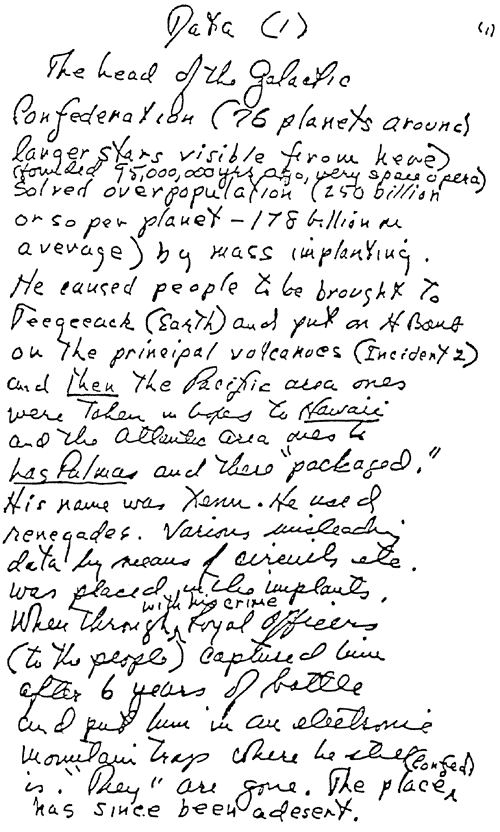
Hubbard's notes for the oddball story that now underpins Scientology

Xenu, the Head of the Galactic Confederation, solved a massive overpopulation problem on his 75 planets some 95 million years ago by bringing people to Earth, putting them in volcanoes, and detonating H Bombs in the volcanoes. (How very 1950s!) This has emotionally scarred us (even if don’t remember it) throughout all our subsequent reincarnations, and only by remembering the details (including time and place) of traumatic events (including in past lives) can we cleanse ourselves of the trauma and return to being spiritual creatures who can control the physical world around us…

Other traumatic experiences, according to this page on The Beliefs and Teachings of Scientology, include “attempted abortions and other fetal traumas, acts of torture and violence experienced both as victim and as perpetrator, encounters with the Marcab Confederacy and various Invader Forces from spacefaring Galactic civilizations, life on earth as a clam,” etc.

Your past goes back billions of years. The cost of having Scientology help you clean it up, all the way back to the clams, may well be $500,000 or so.

Good luck.

Unasked questions: Sunlight

Creates Light, and Day and Night, in Day 1... doesn't create Sun and Moon until Day 4.

How can I have been in and around the Bible for decades, and never noticed the totally bizarre concepts in the first chapter of Genesis?

I don’t mean the impossible ideas of later chapters – not the talking snake, not the angels having sex with “the daughters of men”, not the assumption that every animal species on earth lived within walking distance of Noah’s ark… those ideas may be unscientific, preliterate, and so on, but they’re not as mind-bogglingly irrational as this:

“And God said, Let there be light… and God divided the light from the darkness. And God called the light Day, and the darkness he called Night. And the evening and the morning were the first day.” Genesis 1: 3-5.

“And God said, Let there be lights in the firmament of the heaven to divide the day from the night… And God made two great lights; the greater light to rule the day, and the lesser light to rule the night: he made the stars also… And the evening and the morning were the fourth day.” Genesis 1: 14-19.

I’m still pondering this! Day 1: he makes Light, and Day and Night, and morning and evening. (Day 2, he makes heaven and sea and earth. Day 3, he makes grasses and fruit trees.) Then, on Day 4, he makes the sun, moon and stars…?!?

How could even an unscientific, preliterate, myth-creating narrator come up with something as nonsensical as that? (If Day and daylight are independent of the Sun, does the author of Genesis think that it is purely coincidental that daylight and the appearance of the Sun occur together?) Or how could even the worst story-reteller garble a narrative that badly in writing it down? And how the hell can ultra-Orthodox Jews and fundamentalist Christians believe that every word of the Bible as we have it today is literal fact?

(And how could I have created a skeptical protagonist like Matthew in ‘The Gospel According to the Romans’, and omitted to have him question Jesus on the believability of Genesis? No wonder there are no surviving dialogues of Jesus with Greek philosophers, they would have destroyed him! I may have to add a couple of sentences to the novel.)

Scientology clergy member attacks church leader’s ‘obsession’ with money. Ha!

"Make money. Make more money."

An email on New Year’s Day to 12,000 Scientologists headlined “Keep Scientology Working” according to the British newspaper The Independent, “argues that many of the policies pursued (by) Mr Miscavige are in direct conflict to the principles laid down by (founder and science fiction writer L.Ron) Hubbard when he created the movement in the 1960s and 1970s. In particular (the writer, Debbie Cook) claims that ‘extreme’ fundraising activities are now being ‘driven from within the very highest echelons of the Scientology structure’, in a way that is at odds with the organisation’s founding scriptures. Although many current members have donated vast portions of their net worth to the church, Ms Cook claims that Hubbard never endorsed individual donations of over $75 for lifetime membership.” (See: http://www.independent.co.uk/news/world/americas/conflict-at-the-heart-of-scientology-is-exposed-in-bitter-email-outburst-6284546.html

This claim about L. Ron Hubbard’s gentle intentions is contradicted by the exhortation by Hubbard in a bulletin to his church officials: “Make money. Make more money. Make others produce so as to make money . . . However you get them in or why, just do it.”  (Quoted in http://www.cs.cmu.edu/~dst/Fishman/time-behar.html)

It all comes back to Hubbard’s often-quoted pre-Scientology statement: “You don’t get rich writing science fiction. If you want to get rich, you start a religion.” (For a full discussion, see this start-a-religion-faq)

But then, perhaps L. Ron Hubbard’s science fiction simply isn’t all that good…

Dissing various religions

Each of the major monotheistic religions appears to have had the intent of the founder overturned by his “followers”. Judaism began as a polytheistic religion, where Abraham allied himself with Yahweh against other gods like Baal, but it evolved into monotheism. Both Buddhism and Islam began with the founder attempting to prevent the worship of a human individual, but have ended with the founder himself being given quasi-divine status. Christianity began with Jesus preaching a rejection of the Roman occupation of Palestine and a restoration of Judaic monotheism, and developed into the rejection of Judaism and the embrace of Rome, and even the worship of Jesus as God.

Beware the wrath of god(s)/goddess(es)

More recent religions appear fraudulent from the beginning. Mormonism begins with a 14-year-old con artist writing a ludicrous (and completely impossible) account of the settling of North America by the Lost Tribes of Israel. Scientology was created by science fiction author L. Ron Hubbard some time after he wrote “If you want to make a little money, write a book. If you want to make a lot of money, create a religion.” Kwanzaa has been labeled “a hoax built around fake history and pseudohistorical delusions”, and its lack of historical roots lays it open to ridicule.

The polytheistic religions look cleaner: partly because their origins are lost in the mists of time, partly because their nature allows different worship for different gods and goddesses – whether Hinduism, Santeria, Roman cults or Norse paganism, you’re free to choose an appropriate deity for whatever you’re trying to get out of worshiping them. If you feel the need to discover or invent a new god, that’s not a problem in a polytheist tradition – and if it resonates with something deep in the human psyche it may well grow in popularity. If you want to do this, stay close to nature. Worship waterfalls and storms, for example, like these chimpanzees.

“Sacrifice” – “giving away” or “making sacred”

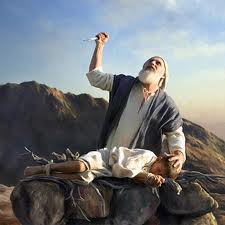
To sacrifice something is to give it away, often to prevent a larger evil or to achieve a greater benefit. In primitive cultures where the word originated, it means you make something sacred by dedicating it to the gods for their use alone. You do this typically by preventing it ever being used by anyone else, i.e. you kill it or destroy it. It may be a young child, or a prisoner, or a prized horse or farm animal, or a sword or jewelry. You invoke the gods, then kill or break the sacrifice, or throw it somewhere irretrievable like the sea or a volcano.

God said to Abraham, "Kill me a son."

Here’s a story out of rural India, reported in the Sydney Morning Herald:

A seven-year-old Indian girl was murdered in a tribal sacrifice and her liver offered to the gods to improve crop growth, police in the central state of Chhattisgarh said on Sunday.

The body of Lalita Tati was found in October a week after her family reported her missing.

“A seven-year-old girl was sacrificed by two persons superstitiously believing that the act would give a better harvest,” Narayan Das, the police chief of Bijapur district, told AFP by telephone.

So what words come to mind? “Murder… tribal… black magic… witch doctors…”? Yes, those all show up in the rest of the story as reported. But how about “Abraham… God… sacrifice…”?
Sacrifice is nothing more than an attempt to bribe the most powerful force you can conceive of, so that it will reward you instead of punishing you. It makes ‘love of God’ into a mere manifestation of the Stockholm Syndrome.
The Roman Empire, although hosting gladiatorial contests and public executions, found human sacrifice obnoxious “to the laws of gods and men”. That the three great monotheist religions trace their common ancestry to Abraham, and to his willingness to kill his son in order to appease the voices in his head, is not something that any Jew, Christian or Muslim should be proud of.

Best resources – Debunking myths

Humans have been very successful as a species through love of pattern-recognition activities and a broad search for cause-and-effect. This leads to a love of stories and constant search for ‘Meaning’. The easiest way to introduce a new concept to people is to connect it to a story, as Jesus did repeatedly through parables. The inherent danger is that, because people are programmed to seek a narrative, people prefer an incorrect model over an incomplete model. In the absence of a better explanation, they opt for the wrong explanation.

We all grow up at some point... if we live long enough...

So in the process of trying to debunk an incorrect idea, you have to be sure to provide a complete alternative explanation. You also have to be careful not to inadvertently reinforce the flawed idea – this ‘backfiring’ can be caused by various things: bad framing of the idea, or too many arguments and details, or threatening the listener’s worldview.

The Debunking Handbook, a guide to debunking misinformation, deals with these issues. It is now freely available to download, and offers practical guidelines on the most effective ways of reducing the influence of myths. The Debunking Handbook boils the concepts down into a short, simple summary, intended as a guide for communicators in all areas who encounter misinformation. It originated with climate researchers, but it has universal application.

I believe debunking myths of all kinds is important, because what we believe impacts how we make decisions. Bush foreign policy was informed with a lot of Messianic Christian mumbo-jumbo which contributed to the Iraq war as well as to anti-science policies on health care and stem-cell research. Science and government must be kept free of religion, or we end up with shorter and less fulfilling lives. But we can’t simply say ‘The Christian narrative is flawed; Jesus isn’t God, don’t be ridiculous.’ We have to provide a complete alternative story of who he was, and how we can understand his words and actions in a completely secular way.

That is what I have attempted in “The Gospel According to the Romans” – that Jesus was a Jew, and a fundamentalist Jew at that, who wanted to cleanse Israel by kicking the beardless, pig-eating, polytheist, idolatrous Romans out of Palestine and restoring the Torah as the source of law. He was connected to the Zealot uprisings which had been going on for 100 years before him and continued for another 100 years afterwards – his attempt to take over the Temple at Passover was a clear failure, and he was caught and crucified.

But this book is probably only half of what I need to say on the matter. Because Paul came along after Jesus and used him as the vehicle for creating the greatest syncretist religion the world has ever seen, blending Judaism and Mithraism with Egyptian and Greco-Roman practices to end up with the Christianity that we have today. In order to say that happened, and to be understood and believed, we need to tell it as a coherent and non-magical story – plausible even if we can’t know exactly what happened.

In short, we need a parable to debunk Jesus, Paul and Christianity.

Jesus and the Ultra-Orthodox Jew

In the news today, Israeli President Shimon Peres is calling on Israelis “to save the majority from the hands of a small minority”. Ultra-Orthodox Jews (who are exempt from military service and, rather than working, collect a government subsidy for religious studies) are increasingly resisting the secular nature of the Jewish state and trying to enforce ancient religious practices.

"Segregate women", the sign says. But surely the men are free to segregate themselves? At home? And veil themselves when they go out?

The Ultra-Orthodox demand strict gender segregation and “modest” dress for women. Recent incidents have seen schoolgirls harassed and spat at,  and women ordered to sit at the back of local buses or get off, despite court rulings that women can sit anywhere on a bus.

This issue resonates interestingly with the position of Muslim hardliners in other countries, and with the Jewish resistance to Roman rule 2,000 years ago.

Fanatics everywhere thrive on polarization. Ultra-Orthodox Jews and Al Qaeda are brothers with a common view of the universe, a view that their God, through His Infallible Book, has given them the divine duty to order the lives of entire 21st century nations in accordance with a subsistence-economy tribal past. They disagree as to which set of Semitic writings is the True Word of God, but they all loathe the Western tolerance of casual secular behavior. (Their leaders also understand that their power is increased by turning the Middle East into a religious battleground.)

When Rome ruled Palestine, the same dynamics were in play. Rome wanted a live-and-let-live religious environment where anyone could worship any god, and temples to all of them were scattered about. The more secular of the Jews were happy with this – they enjoyed the peace and improved travel and trade that the Empire brought. But the more religious of the Jews wanted to cleanse Israel of the beardless, pig-eating, polytheist idolators, and they wanted all Jews to repent and return to the Law of Moses. To them, all Jews were one family and everyone else should be evicted from the Promised Land.

Jesus was only one of a stream of would-be Messiahs who, over a 200 year period, led uprising after failed uprising against the Westerners and got crucified for their pains. Osama Bin Laden was of that mindset and he too has been executed. Secularism is gradually replacing religion around the world in a several-generations process now speeded by mass media, mass travel and the Internet. But the Ultra-Orthodox may well have a decade or two of success ahead of them.

The same things are still happening, that have been going on for 2,000 years. The Westernization of Israel is still in question.

Solstice, Stonehenge and Newgrange

The northern hemisphere’s winter solstice has been a major festival for the past several thousand years.

Newgrange at the winter solstice: the upper slot lets sunrise penetrate 60 feet into the mound.

At Newgrange in Ireland, 1,000 years before Stonehenge (and 500 years before the Pyramids of Egypt), a 60-foot passageway was built with walls and roof of stone slabs, ending in a cruciform chamber, and the whole roofed over with an enormous dirt mound 50 feet high and covering an acre of land. Normally the passageway and chamber are dark, but for a couple of days at solstice a slot over the entrance lets the rising sun flood the chamber with light for a few minutes. A lucky couple of dozen tourists, chosen by lottery during the year, are allowed in for this magical moment.

This suggests that the alignment of stones at Stonehenge was for the production of similar effects. The mound at Newgrange is still standing, but we don’t know what Stonehenge looked like. There may have been a mound at Stonehenge (there are other mounds nearby, notably Silbury Hill near Avebury), or else walls of wood and animal hides could have kept the interior dark except at the astronomically significant moments.

Thousands of years later, during the rise of the Roman Empire, the Roman year-end festival of Saturnalia began to merge with the northern neolithic ceremonies and their Celtic and Germanic descendants, and with the virgin birth at solstice of Mithras the Unconquerable Sun-god.

As early Christians looked for a way to separate Jesus from his Jewish roots and to make him broadly acceptable throughout the Roman Empire, his birth (which had probably happened in the spring) began to be celebrated at the winter solstice too.

Merry Christmas! Io Saturnalia! Happy Solstice! – In the northern hemisphere, this is the time to celebrate that the tide of darkness has turned, and that light and life are beginning to return to our world. Peace!