Scientology – a peculiarly unpleasant organization

A case against Scientology is finally coming to trial after years of obstruction by the Church.


Laura DeCrescenzo in 1996

Laura DeCrescenzo in 1996

Laura DeCrescenzo has filed suit, claiming that she was 17 when she was forced by the Church of Scientology to have an abortion against her will. At that time, according to information coming out for the October 2013 court case, she was working 112-hour weeks under a billion-year contract that she had entered when her parents were members of the Church.

The stupidity of the ideas behind Scientology is one thing, and I can live with people believing all that, even if it was created by a science fiction writer as a way of making a lot of money. But the vicious exploitation of children under its control is something else, and makes Scientology into a peculiarly unpleasant organization.

Making a secular holiday tree

For thousands of years, the winter solstice – the turning point of the year, with the end of increasing darkness and the beginning of the return of light – has been celebrated with feasts, log fires, and a tree decorated with shiny things and candles.  It’s all about light.

If you want a holiday tree, but want to make it very clear what your religious or philosophic position is, then why not let 300 or so books return temporarily to their roots (so to speak), and be a tree for a couple of weeks!

You make whatever statement your reading habits make.

You make whatever statement your reading habits make.

A holiday tree, full of light.

A holiday tree, full of light.

There are several places on the web where you can find instructions for doing this in an organized way.

We started with a circle of seven outsized books, spines out, and built up from there. At about two feet we started to fill it with pillows and cushions, and at about four feet we put an oversized book across the shrinking hole to stabilize everything.

After we wrapped 80 feet of lights round it, we inserted a bunch of white lights into a convenient crystal cone to top it off.

Happy holidays!

Religious opposition to the table fork

Back in Biblical times people ate with their fingers, typically from a shared pot. Jesus states during his Last Passover Supper that he thinks one of the Twelve disciples has betrayed him to the Romans. He only says it’s someone dipping into the pot with him, which they were all doing. In retrospect, Judas is identified and blamed.

eat with the right hand

Eat with the right hand, if sharing food

Still today in the Arab world people eat with their fingers and share food from a common pot. This is why Arabs are so much more scrupulous than Westerners about washing their hands before they eat. It’s also why they have the convention a clean (right) hand for writing, shaking hands and eating, and the left hand for, you know, wiping.

Which also increases the punishment of having a hand cut off for theft. Then what? Would you want to have someone share a meal with you, if they’ve only got one hand – for everything?

So the medieval invention of the small fork for use at the table would seem like a good idea. (Industrial-size ones for cooking had been used by the Romans and others for centuries.) But you know what religious people are like when someone wants to introduce any sort of change – “It’s not sanctioned by Scripture! It’s the work of the Devil!”

Here’s an excerpt from an interesting article, “The Uncommon Origins of the Common Fork“:

Forks for dining only started to appear in the noble courts of the Middle East and the Byzantine Empire in about the 7th century and became common among wealthy families of the regions by the 10th century. Elsewhere, including Europe, where the favored implements were the knife and the hand, the fork was conspicuously absent.

Imagine the astonishment then when in 1004 Maria Argyropoulina, Greek niece of Byzantine Emperor Basil II, showed up in Venice for her marriage to Giovanni, son of the Pietro Orseolo II, the Doge of Venice, with a case of golden forks—and then proceeded to use them at the wedding feast. They weren’t exactly a hit. She was roundly condemned by the local clergy for her decadence, with one going so far as to say, “God in His wisdom has provided man with natural forks—his fingers. Therefore it is an insult to Him to substitute artificial metal forks for them when eating.”

When Argyropoulina died of the plague two years later, Saint Peter Damian, with ill-concealed satisfaction, suggested that it was God’s punishment for her lavish ways. “Nor did she deign to touch her food with her fingers, but would command her eunuchs to cut it up into small pieces, which she would impale on a certain golden instrument with two prongs and thus carry to her mouth. . . . this woman’s vanity was hateful to Almighty God; and so, unmistakably, did He take his revenge. For He raised over her the sword of His divine justice, so that her whole body did putrefy and all her limbs began to wither.”

And still today Christian fundamentalists think that gay marriage is causing hurricanes in the US, and Muslim fundamentalists think that women’s clothing is causing earthquakes in Iran, and it’s all caused by the Devil.
And do you ever see the Devil with a hurricane or an earthquake? No! (But you see him with a fork…)

The Fish and the Parasite

Let’s talk metaphors. (“Parables”, if you’re Biblically inclined.) A person, on the basis of some intellectual analysis or subconscious revelation, starts a religion.  Think of it as a fish. The religion is successful – the fish eats and grows. All that food passing through its mouth attracts a parasite that decides to live off the fish.

Now here’s the amazing real-world example: Cymothoa exigua, the tongue-eating louse:

Cymothoa exigua

The parasite has eaten and replaced the fish’s tongue, and now does the tongue’s work for the fish.

The tongue-eating louse is a parasitic crustacean. It enters fish through the gills. The female (who grows up to an inch long) attaches herself to the base of the tongue, and the male (up to half an inch) attaches to the gill arches beneath and behind the female. The louse extracts blood through the claws on its front, causing the tongue to atrophy from lack of blood. The parasite then replaces the fish’s tongue by attaching its own body to the muscles of the tongue stub.

The fish is able to use the parasite just like a normal tongue. It seems the parasite doesn’t cause any other damage to the host fish.

Once these lice replace the tongue, some feed on the host’s blood and many others feed on fish mucus. This is the only known case of a parasite functionally replacing a host organ. There are many species of Cymothoa, but only C. exigua is known to consume and replace its host’s tongue.

So, back to the metaphor. The parasite infiltrates the fish, and makes a good life for itself by becoming the fish’s mouthpiece…

That’s how a spiritual insight evolves into an organized religion. The guy sitting on the throne may not be part of the original concept at all.

Isn’t Nature wonderful?

Justifying false expectations

Every successful religion evolves its statements of belief into greater complexity and self-contradiction, so that no matter what is under discussion, any position can be advocated, any outcome can be forecast, any alternative outcome can be explained, and any change of position can be justified – all from the same collection of text.

End-of-the-world predictions from Jesus (“This generation shall not pass away until all these things be fulfilled”) to the Millerites to Harold Camping are the best-known examples. But every unheralded event or result has to be justified as God’s Will, part of the Divine Plan, and a further reason to give more money to the Church.

And that’s how religions develop and grow.

Church of England suggests Jesus had mental problems

The Church of England, doing its best to support World Mental Health Day in October 2011, suggested that Jesus and John the Baptist – as well as characters like King Saul, Saint Paul and Saint Francis – may all have suffered from conditions that we label mental health problems today. The Church’s points appear to be that a) God works through everyone, and b) we should be tolerant and supportive of those who have such disabilities.

The Church of England suggests Jesus had mental health problems

The theological implications of suggesting that all the key figures of Christianity were nutters are still being debated. But thank you for widening the debate, Church of England!

Here’s the latest from the Daily Express, a national British daily:

http://www.express.co.uk/posts/view/341926/Jesus-Christ-may-have-suffered-from-mental-health-problems-claims-Church-of-England

Epilepsy and the origins of monotheism

Five closely related Egyptian Pharaohs shared two unusual traits – each had unusually feminized figures (large breasts and large hips), and each died young (and in fact younger than the preceding one). The former trait is suggestive of epilepsy, and the latter of a hereditary disorder. The five are Tutankhamen “the boy king”, his probable father Akhenaten, his possible uncle Smenkhkare, and before them Amenhotep III and Tuthmosis IV.

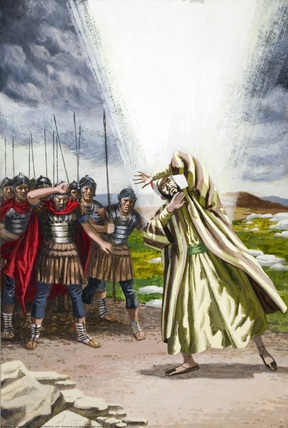
Saint Paul’s epileptic seizure – the creation of “Christianity”

In addition, two of them had powerful sun-related religious experiences: Tuthmosis IV in the middle of a sunny day, as detailed in the Dream Stele  inscription near the Sphinx in Giza; and Akhenaten, who elevated the minor sun-god Aten to be the supreme god, replacing Egyptian polytheism with what was probably the world’s first monotheist religion – the first of national significance, anyway.

Of the 40 kinds of epilepsy, the one that fits best is Temporal Lobe Epilepsy, in which seizures can be triggered by sunlight. Common symptoms include a compulsion to write, fainting, extreme religiosity, and obsessive compulsive disorder.

Akhenaten, the creator of monotheism had it. Others suspected of it include Moses, almost certainly St. Paul (who was termed epileptic by contemporaries, and whose conversion on the road to Damascus would be a classic example of such a seizure), and definitely Dostoevsky.

There has long been a recognized association between monotheism and the desert’s all-powerful sun, as there is between polytheism and the lush diversity of sun-shaded forests. And it seems that epilepsy is another component of the development and spread of the idea of the One God.

If only they’d had shades in those days, think how much grief we could have avoided!

Even the US is now 19% openly non-religious

The latest Pew Research poll tracking Americans’ religious affiliation now has “None” up to 19%, from only 6 % in 1990.

Lou Dobbs had a piece about this on July 20 in Fox Business. Not quite sure why it’s “business”, but we can thank Lou Dobbs for pointing out how mainstream atheism is becoming.

19% of Americans now openly give their Religious Affiliation as “None”

… and no, Obama didn’t call for a Day of Prayer, regarding the latest Colorado shootings. He called for a day of “prayer” (for those who pray) “and reflection” (for those who think, of course). Atheists can reflect on things like why any civilian should be allowed a weapon more powerful than a single-shot hunting rifle. Theists can go ahead and pray for whatever they want.

Atheist or agnostic?

Am I an atheist, or not? It depends on the definition of “atheist”, and on the mindset of the person asking. In Europe I label myself agnostic, because I have no understanding of why there is a Universe. But in the United States it’s easiest to say I’m an atheist, because anything short of that implies support for the idea of a personal God.

God watching TV

I find offensive the idea of a personal God who, swayed by the emotional appeal of prayers from the devout, favors one person over another. I don’t care whether they’re praying about healing an illness, or winning a ballgame, or picking the right lottery ticket – what morality is there in an omnipotent deity who would intervene in that, and not intervene in the most extreme situations of human suffering?

I find illogical the idea of a God who creates individuals and then punishes them for acting according to the nature they were given.

I find simplistic the idea that God’s Universe is focused on Earth (let alone on one particular tribe, or sect, or individual), when the Earth is only a small planet of a small star, and there could be more stars in the Universe than there are grains of sand on all the beaches of the whole world.

So I’m certain that the personal God of the average American believer doesn’t exist, and couldn’t possibly exist.

But as for exactly what force is the wellspring of the Universe, and what qualities it has, that’s where I’m a militant agnostic:

“I don’t know, and you don’t know either.”

Rome, Israel, and the Christian compromise

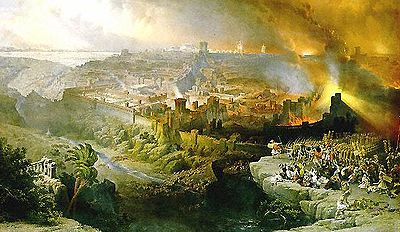
Rome and Israel were in constant conflict for the first 200 years of Rome’s occupation of Palestine. Jesus, as a highly religious Jew, was part of that conflict and was executed for it. Jerusalem was besieged and the Temple destroyed in 70. After the umpteenth uprising, the Romans finally kicked the Jews out of Palestine in 135.

Siege and Destruction of Jerusalem, 70 AD, by David Roberts

When Paul came along, he had the bizarre idea that he could meld his Jewishness and his Roman citizenship, and create a universally applicable religion. It was all done by blending and compromising, and it proved to be very successful. Here are some examples:

Israel: only one God, and no prayers or worship of anyone or anything else. Rome: thousands of gods, worship your own and those of other religions. Christian compromise: only one God… except He has three “persons”, one of which is Jesus… so it’s OK to pray to any of them… also to Jesus’ mother… well, and to any other of God’s angels, saints, etc… but it still counts as only one God.

Israel: God only cares about Israel, God’s Chosen People – ignore everyone else. Rome: local gods care about local people, so the bigger the Empire gets, the more gods care for it. Christian compromise: God cares for everyone who believes in Him, so keep making His empire bigger.

Israel: love Jerusalem, hate Rome. Rome: destroy Jerusalem, Rome is the center of power. Christian compromise: make Rome the center of the Jerusalem-focused religion.

Israel: 7-day week. Rome: 8-day week called “nine days” (inclusive reckoning). Christian compromise: 7-day week called “eight days” or “Octave” (inclusive reckoning).

Israel: Passover. Rome: Saturnalia. Christian compromise: Saturnalia traditions at Saturnalia to celebrate Jesus’ birth, Passover-type traditions at Passover to celebrate Jesus’ death.

Israel: circumcision of males mandatory. Rome: are you crazy? Christian compromise: circumcision of males voluntary.

Israel: detailed dietary and food preparation laws. Rome: eat anything. Christian compromise: no prohibitions most of the time, except Fridays and Lent.

And so on. It’s fascinating. And for a long time, it worked.