“Sacrifice” – “giving away” or “making sacred”

To sacrifice something is to give it away, often to prevent a larger evil or to achieve a greater benefit. In primitive cultures where the word originated, it means you make something sacred by dedicating it to the gods for their use alone. You do this typically by preventing it ever being used by anyone else, i.e. you kill it or destroy it. It may be a young child, or a prisoner, or a prized horse or farm animal, or a sword or jewelry. You invoke the gods, then kill or break the sacrifice, or throw it somewhere irretrievable like the sea or a volcano.

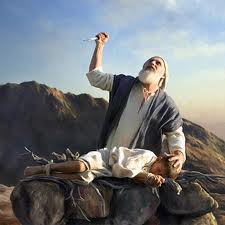
God said to Abraham, "Kill me a son."

Here’s a story out of rural India, reported in the Sydney Morning Herald:

A seven-year-old Indian girl was murdered in a tribal sacrifice and her liver offered to the gods to improve crop growth, police in the central state of Chhattisgarh said on Sunday.

The body of Lalita Tati was found in October a week after her family reported her missing.

“A seven-year-old girl was sacrificed by two persons superstitiously believing that the act would give a better harvest,” Narayan Das, the police chief of Bijapur district, told AFP by telephone.

So what words come to mind? “Murder… tribal… black magic… witch doctors…”? Yes, those all show up in the rest of the story as reported. But how about “Abraham… God… sacrifice…”?
Sacrifice is nothing more than an attempt to bribe the most powerful force you can conceive of, so that it will reward you instead of punishing you. It makes ‘love of God’ into a mere manifestation of the Stockholm Syndrome.
The Roman Empire, although hosting gladiatorial contests and public executions, found human sacrifice obnoxious “to the laws of gods and men”. That the three great monotheist religions trace their common ancestry to Abraham, and to his willingness to kill his son in order to appease the voices in his head, is not something that any Jew, Christian or Muslim should be proud of.

Best resources – Debunking myths

Humans have been very successful as a species through love of pattern-recognition activities and a broad search for cause-and-effect. This leads to a love of stories and constant search for ‘Meaning’. The easiest way to introduce a new concept to people is to connect it to a story, as Jesus did repeatedly through parables. The inherent danger is that, because people are programmed to seek a narrative, people prefer an incorrect model over an incomplete model. In the absence of a better explanation, they opt for the wrong explanation.

We all grow up at some point... if we live long enough...

So in the process of trying to debunk an incorrect idea, you have to be sure to provide a complete alternative explanation. You also have to be careful not to inadvertently reinforce the flawed idea – this ‘backfiring’ can be caused by various things: bad framing of the idea, or too many arguments and details, or threatening the listener’s worldview.

The Debunking Handbook, a guide to debunking misinformation, deals with these issues. It is now freely available to download, and offers practical guidelines on the most effective ways of reducing the influence of myths. The Debunking Handbook boils the concepts down into a short, simple summary, intended as a guide for communicators in all areas who encounter misinformation. It originated with climate researchers, but it has universal application.

I believe debunking myths of all kinds is important, because what we believe impacts how we make decisions. Bush foreign policy was informed with a lot of Messianic Christian mumbo-jumbo which contributed to the Iraq war as well as to anti-science policies on health care and stem-cell research. Science and government must be kept free of religion, or we end up with shorter and less fulfilling lives. But we can’t simply say ‘The Christian narrative is flawed; Jesus isn’t God, don’t be ridiculous.’ We have to provide a complete alternative story of who he was, and how we can understand his words and actions in a completely secular way.

That is what I have attempted in “The Gospel According to the Romans” – that Jesus was a Jew, and a fundamentalist Jew at that, who wanted to cleanse Israel by kicking the beardless, pig-eating, polytheist, idolatrous Romans out of Palestine and restoring the Torah as the source of law. He was connected to the Zealot uprisings which had been going on for 100 years before him and continued for another 100 years afterwards – his attempt to take over the Temple at Passover was a clear failure, and he was caught and crucified.

But this book is probably only half of what I need to say on the matter. Because Paul came along after Jesus and used him as the vehicle for creating the greatest syncretist religion the world has ever seen, blending Judaism and Mithraism with Egyptian and Greco-Roman practices to end up with the Christianity that we have today. In order to say that happened, and to be understood and believed, we need to tell it as a coherent and non-magical story – plausible even if we can’t know exactly what happened.

In short, we need a parable to debunk Jesus, Paul and Christianity.
Contextualizing Jesus

Churches and Sunday Schools teach the Old Testament, the New Testament, the description of the Temple, the differences between Sadducees and Pharisees, food, clothing, etc. But no mention of the Romans.

Jesus opposed those who didn't follow the Jewish Law, and the Romans executed him

High school Ancient History teaches the rise of the Roman Empire and its acquisition of all the provinces around the Mediterranean. But no mention of Jesus.

This is like telling the story of Osama Bin Laden without mentioning the Americans – and then telling the story of the Western occupation of Iraq and Afghanistan without mentioning Islam or religious insurgents!

Historians are apparently scared of dealing with historical realities that bear upon the creation of religions; the talking snakes and virgin births and going up to heaven in chariots don’t mesh coherently with the sociopolitical narrative, so historians ignore them.

And priests and theologians are equally scared of contextualizing their stories, because the stories only make sense if they exist as detached fairytale bubbles. Their stories are self-referential, detached from reality, about a preliterate world where gods and angels walk the earth and perform magic, where demons are the cause of illness or misfortune, and where life will somehow continue after the body wears out and dies.

But Jesus was a person in a particular time and place. He was a religious Jew, an acknowledged rabbi, living under the military occupation of an idolatrous, pig-eating Western superpower – the Roman Empire. The Romans had been controlling, taxing (and sometimes looting) Palestine for a hundred years, in the face of major uprisings once a generation. When you view the words and actions of Jesus in this light, a fresh and powerful picture appears, clearly hostile to the Romans.

THE GOSPEL ACCORDING TO THE ROMANS explores the life of Jesus within this historical context.