Jesus’ Healing v. Greco-Roman Medicine

Here is Jesus healing in Mark 9: 20-27.  The father of an epileptic boy, believing that the problem is a demon inhabiting him, asks Jesus to heal him. The boy is summoned.

And when the spirit saw Jesus, immediately it convulsed the boy, and he fell on the ground and rolled about, foaming at the mouth. And Jesus asked his father, “How long has this been happening to him?” And he said, “From childhood. And it has often cast him into fire and into water, to destroy him. But if you can do anything, have compassion on us and help us.” And Jesus  rebuked the unclean spirit, saying to it, “You mute and deaf spirit, I command you, come out of him and never enter him again.” And after crying out and convulsing him terribly, it came out, and the boy was like a corpse, so that most of them said, “He is dead.” But Jesus took him by the hand and lifted him up, and he arose.

Here is Greek healing, earlier than Jesus, from Wikipedia:

Ancient vaginal speculum

Another of Hippocrates’s major contributions may be found in his descriptions of the symptomatology, physical findings, surgical treatment and prognosis of thoracic empyema, i.e. suppuration of the lining of the chest cavity. His teachings remain relevant to present-day students of pulmonary medicine and surgery. Hippocrates was the first documented chest surgeon and his findings are still valid.

Hippocratic medicine was notable for its strict professionalism, discipline, and rigorous practice.The Hippocratic work On the Physician recommends that physicians always be well-kempt, honest, calm, understanding, and serious. The Hippocratic physician paid careful attention to all aspects of his practice: he followed detailed specifications for, “lighting, personnel, instruments, positioning of the patient, and techniques of bandaging and splinting” in the ancient operating room. He even kept his fingernails to a precise length.

The Romans, naturally, are better known for the engineering aspects:

The Romans invented numerous surgical instruments, including the first instruments unique to women (vaginal specula with a screw device which when turned forces a cross-bar to push the blades outward), as well as the surgical uses of forceps, scalpels, cautery, cross-bladed scissors, and the surgical needle. Romans also performed cataract surgery.

Jesus came to preach, to heal and to cast out demons;  this in the Roman Empire when it was discovering anesthetics and making major medical advances. Presumably if Jesus came to the United States today he would avoid places like Johns Hopkins and hang out with the snake handlers in the backwoods of the South.

This reduces the credibility of Jesus-as-God to zero. But it supports the idea that Jesus was a Jewish fundamentalist, working within the framework of Jewish law and tradition, and ignorant and hostile regarding all things Roman.


What ELSE was the big story in 1492?

From Europe to India, a major geopolitical event in 1492 had everyone talking –  and it had nothing to do with Columbus. Columbus was just some explorer who had discovered some islands somewhere. But the really big news was that, after nearly 800 years, the aggressive Christians had finally kicked the more cultured Muslims out of Spain.

The Great Mosque of Cordoba

Granada was conquered. Cordoba and Seville, the greatest centers of learning in Europe, where thousands of Christian scholars had traveled surreptitiously, and from which the European Renaissance had been born, were now turned into fresh hunting grounds for the Spanish Inquisition. Decrees ordered Muslims and Jews to convert or leave. Tens of thousands chose the former, hundreds of thousands the latter. Of those who converted and stayed, thousands were subsequently executed by the Inquisition under suspicion of insincerity; initially over 90% of the executions were of Jews, because the moriscos were too well-connected and too important to the government and economy to be maltreated. But after some decades the focus turned to moriscos (and Protestants), and finally all the moriscos were expelled without being allowed to take money or jewelry or anything more than they could carry.

The most advanced state in Europe was destroyed, and neither it nor the rest of Spain has ever fully recovered.

An ironic element is that, after 800 years of Islam in Spain, the Christians “were not actually expelling Arabs nor were they expelling Berbers. The huge majority of the people that were being expelled, by blood, by DNA if you will, were as Iberian as their Christian cousins in the North who were kicking them out of Peninsula”. This from British historian Professor Dwight Reynolds in a 2005 documentary.

The Muslims and Jews who were expelled took the keys to their front doors with them. Fifteen generations later, around the Mediterranean, many of those keys are still in the possession of the original families.

Jesus’ outbursts of anger

Did Jesus ever get angry?

It’s certainly not the image presented to children. Our foundational understanding of Jesus is “Gentle Jesus, meek and mild”, mixed in with Baby Jesus, Jesus healing people, Jesus feeding people, and all sorts of “God is love” stuff.

Gentle Jesus, or man of violence?

Well, but he whipped the money-changers out of the Temple. And when he was in a synagogue on the Sabbath, he looked round at the congregation “in anger” (Mark 3:5) before healing someone. And there are other places that he gets angry, yells at his disciples, etc.

So there is nothing unlikely about his being connected in with the Zealot insurrection, or in having a Sicariot and Simon Zealotes among his closest disciples.

In other early writings, contemporary with the canonical Gospels, there are accounts of Jesus’ childhood in which (along with magical stories of his making lumber longer or shorter to help Joseph with the carpentry) there are disturbingly violent incidents. In one version he pushes a boy off a roof and kills him, but brings him back to life. In another he curses a boy who has either bumped into him or thrown a stone at him, and the boy falls dead. In yet another he kills a teacher who has reprimanded him.

These extremely negative stories are not the sort that followers normally make up to glorify their deceased master. They are more likely to be reflections of rumors about his childhood that couldn’t be shaken off, and could only be palliated by adding “and then he brought him back to life”. But if you only wanted to show his early powers of healing, you wouldn’t normally start with having him doing the killing himself…

But as the bastard son of, perhaps, the Roman legionary Pantera – looking unlike Joseph – with some resentment on Joseph’s part – teased by other children because of the rumors… we can make an easy case for his having a lot of anger in him. Add in that Joseph disappears from the narrative when Jesus is 12, in the year of the failed uprising by Judas of Galilee with 2,000 Jews crucified by the Romans four miles north of Nazareth…

And we have the makings of an angry, conflicted, anti-Roman young man.

Forget the “meek and mild” – it’s nowhere in the Gospels.

Your place in the Universe – to scale

The difference between the scientific and the religious views of the world comes down to context. Those who want to believe in something unchanging can’t afford to contextualize their ideas, because our knowledge of the universe is always changing. An idea that looked reasonable to an illiterate herder (“the earth is flat”, say, or “the sun and the moon are the same size”) becomes untenable with increased information.

A child's understanding of the relative sizes of the Sun and Moon

Religious people want to hold on to old ideas, and they can only do that by refusing to place them in the new context of understanding – even when they accept the new understanding. So they develop this split world, one of mundane reality and the other of a magical world of angels and fairies. Historical people and events, if they have become important in a religious context, gradually get moved by their adherents into the magical world.

“The Gospel According to the Romans” is an attempt to undo some of this, and reconcile some major religious figures with the historical realities of their lives. In contextualizing them, their words and actions take on new meanings. We lose the magic, but we gain a richer understanding of our cultural history and identity.

It is all a part of understanding our place in the universe. And here is your place in the universe, to scale: http://t.co/uZzylwnF

It is truly amazing. Enjoy!

The Transfiguration – just a bloody meeting

The Transfiguration is one of those classic iconic and apparently pointless events in the gospels. Jesus is up a mountain with a couple of the disciples, and Moses and Elijah show up to talk with him. Jesus’ clothes shine brightly (that’s the Transfiguration) and Peter in his spontaneous fashion suggests building tabernacles (tents or huts) for them. A voice from the clouds is interpreted as saying “This is my beloved son, listen to him.”

Another unjustifiably airy-fairy Jesus story

Paintings have developed a tradition to show Jesus and the other two floating around in the air. Is there any textual justification for this? None. (Aside: This is exactly how myths develop: one person hears a story, wants it to be dramatic, fleshes the untold details out in their own mind, and then adds them as fact when they present the story – without even realizing they’re making changes.) Changes regarding a hero’s story tend to exaggerate and glorify, so you can discount some of the frills. But there’s probably a commonsense basis for the story.

Here’s how I tell it in “The Gospel According to the Romans”. First, it’s nighttime, full moon, but overcast. They go up into the mountain without Jesus telling them why. Then he tells them to hold back and goes alone into a clearing, where two Zealot leaders named (or code-named) Moses and Elijah come out and discuss their plans for the attempt to take over the Temple at Passover. (These disciples aren’t privy to this; they were the fishermen Simon Peter, James and John, not the Zealots Judas and Simon Zealotes.)

The full moon comes out from behind the clouds, and catches Jesus’ face and his white robes, making them shine dramatically. There is a roll of thunder. You can make thunder say whatever you want it to say – Eliot records it speaking Sanskrit in The Wasteland. Simon Peter babbles, not untypically.

Going back down the mountain, Jesus tells the disciples not to tell anyone about this until they’ve seen a man raised from the dead. In other words, not until he has done his Lazarus trick (which they don’t know anything about) which will be right before Passover at Jerusalem. At that point it won’t matter if anything they’ve heard gets out, the uprising to take control of the Temple will be about to happen anyway, and it will be too late for the Roman Legion to stop it…

So, what do you think? Plausible? Or you prefer the floating-around-in-the-air version?

It’s not Hamza Kashgari who is blasphemous – it’s his accusers!

On the occasion of the birthday of the Prophet Muhammad, 23-year-old poet and journalist Hamza Kashgari sent out three tweets:

Hamza Kashgari calls it like he sees it

  • On your birthday, I will say that I have loved the rebel in you, that you’ve always been a source of inspiration to me, and that I do not like the halos of divinity around you. I shall not pray for you.
  • On your birthday, I find you wherever I turn. I will say that I have loved aspects of you, hated others, and could not understand many more.
  • On your birthday, I shall not bow to you. I shall not kiss your hand. Rather, I shall shake it as equals do, and smile at you as you smile at me. I shall speak to you as a friend, no more.

This ignited a firestorm of indignation, with tens of thousands of his fellow Saudis calling for him to be tried for blasphemy and atheism, and executed. For some of the worst acting from a cleric, watch this short video.

Hamza flew to Malaysia, heading for asylum in New Zealand, but was arrested in the airport at Kuala Lumpur.

The irony is that his tweets are perfectly in line with the attitude that Muhammad himself tried to cultivate: that humans should never be deified, that neither Jesus nor Muhammad was anything but an ordinary man (though favored with prophetic gifts), and that, as he himself tried to prove, Muhammad could not perform miracles.

By the way, that’s the source of the story that ends “Well, if the mountain won’t come to Muhammad, Muhammad must go to the mountain.” Very much like King Canute shutting his flattering courtiers up by setting his chair up on the beach and telling the waves to go back, which they wouldn’t.

But the followers and the religious organizers always take over after the great man is dead, and turn him into a god to be worshiped. It happened with Buddha, with Odin, with Jesus. Muhammad put as many firewalls in the way as he could, but all too many Muslims treat Muhammad the way Christians treat Jesus, and impute outlandish miracles to him such as splitting and rejoining the moon.

Realistically, therefore, it’s the fanatical and superstitious accusers of Hamza Kashgari who are the blasphemers. The young poet should be praised for trying to keep Islam true to the wishes of its Prophet.

The Meanest Miracle – Cursing the Fig Tree

This is Jesus’ stupidest and most mean-spirited miracle, as reported in the gospels. Here’s the story:

He’s walking the four miles from Bethany to Jerusalem just before Passover (March/April). Here’s Mark: “Jesus was hungry. Seeing in the distance a fig tree in leaf, he went to find out if it had any fruit. (Ooh, look, a bonus! Proof that Jesus isn’t omniscient, and therefore isn’t God!) When he reached it, he found nothing but leaves, because it was not the season for figs. Then he said to the tree, “May no one ever eat fruit from you again.” And his disciples heard him say it. The next morning, as they went along, they saw the fig tree withered from the roots.”

Jesus curses a fig tree, and unwittingly sets up a joke.

So, he’s not omniscient, and he’s petty, and he’s vindictive, and he’s also not very bright – because in the spring there would be leaves but no fruit yet. So he curses it, and the next day it’s completely withered.

What’s the point? Christian apologists tie themselves in knots saying that he did it to symbolize that the Jewish religion, though outwardly in full leaf, is not productive and is destined to die from Jesus’ update to True Religion. But Jesus didn’t say anything about that. When the disciples said “Oh, wow!” he just told them that if they had unwavering faith that yonder mountain could be thrown into the sea, it would happen. (If any of them tried, it didn’t work.) The apologists draw their message out of thin air. They also don’t address Jesus’ hunger, ignorance, anger or stupidity.

It’s a typical Jesus miracle in these aspects:

1) It could be faked – all you have to do is have your friend Lazarus (living in Bethany) come by that evening and pull all the leaves off, and next day the disciples would be fooled into thinking that the tree had withered at Jesus’ command.

2) It’s not the sort of beneficial and glorious thing that you would have chosen if you were writing a story about a real miracle-worker. In that case, you would have Jesus bless the tree instead of curse it, and within 60 seconds it would have fruited and produced enough delicious out-of-season ripe figs to make everyone happy. (And then the apologists would say that he showed how the Jewish religion could be transformed by his blessing into something productive, etc etc.)

Somehow it’s always like that. He heals someone who says they’re lame, or blind, or suffering from devils… but does he ever regrow an amputated limb? Ha! He can restore to life a friend who says he was dead… but what about his spiritual teacher, the man who baptized him, John the Baptist? Why didn’t he put John’s head back on his shoulders, and restore him to life?

Jesus’ miracles are always street magic, designed to engage the audience while he preaches his message of repentance and the return to God… and, probably, while his followers collect contributions for the Zealot uprising.

What kind of “new religion”? Mormons and Christians

Religions never spring to life fully-formed and without any connection to the religious and cultural ideas around them. (Scientology is the nearest to an exception I can think of, but it claims not to be a religion. It is heavily indebted to 1950s science fiction, anyway.)

Sometimes a “new religion” is like the Lutherans, more of a family squabble about reform than a whole new religion. “The Bible should be translated into the local language so everyone can read it.” “No, it should stay in Latin, because we’re Romans, remember?” And so on.

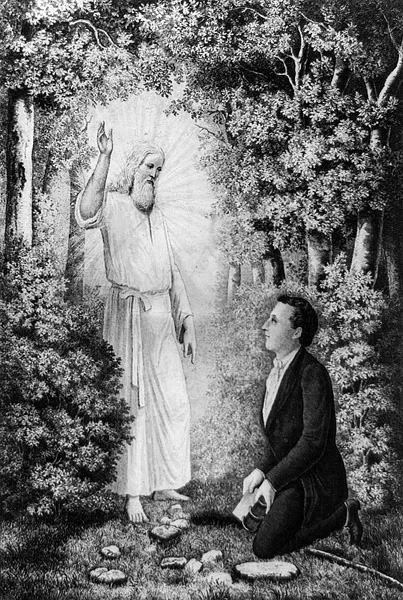
The angel "Moroni" giving Joseph Smith the "golden plates" in "Reformed Egyptian"

But sometimes you get a kid with a streak of the con artist, writing screeds of bad fantasy in an imitative style…

Joseph Smith’s impoverished farming parents tried to make extra money by treasure-digging, and the teenage Joseph claimed he could use “seer stones” for this. He would put a special stone in a white stovepipe hat, and then see the information he needed in the reflections inside the hat. (At age 20 he was tried in New York state on the charge of “glass-looking,” or pretending to find lost treasure.)

In his teens he claimed to have been visited at night by an angel named Moroni, who revealed the location of a buried book of golden plates as well as other artifacts, including a breastplate and a set of silver spectacles with lenses composed of seer stones, which had been hidden in a hill near his home.  Smith said he attempted to remove the plates the next morning but was unsuccessful because the angel prevented him.

A couple of years later he got hold of the golden plates, which the angel told him not to show to anyone, but to translate from the “Reformed Egyptian” and publish. They told the story of the Lost Tribes of Israel coming to North America and having all sorts of pseudo-Biblical events in pseudo-Biblical language, full of anachronisms like elephants, steel and silk; and then of Jesus appearing to these North Americans and essentially preparing for Americans (at least the believing ones) to be God’s Chosen People.

He subsequently translated other pages of Egyptian hieroglyphics (which no one else could in the 1840s) and determined that they were all about sacrifices and God and Abraham and so on. Unfortunately the pages have since resurfaced, and real translation shows them to be about embalming and funerary rites and Osiris. There is a Christian critique of the issue here.

So this “new religion” is not a simple reform like Lutheranism. This is one individual’s fantasy, springboarding off the Bible into whatever sounds good and will win converts. It’s not surprising that regular Christian sects don’t have much use for Mormonism – and that’s even before we get into Joseph Smith’s 34 wives, and the issue of everybody being able to evolve through several Heavens into becoming a God of their own planet, and all that jazz.

The irony is that from the point of view of Judaism, Jesus looks like a kind of argumentative reformist Luther… but St Paul’s Christianity, the Christianity that we have today, looks a hell of a lot more like Joseph Smith’s made-up Mormonism.

Spies need pockets

When you’re writing something like “The Gospel According to the Romans” with its cloaks and daggers, your hero is bound to have the need to hide various items on himself, and his adversaries are going to have weapons stashed on themselves. This would be very easy in cyberpunk, the outfits are so elaborate, with belts and buttons and flaps and pockets all over the place. But what about Ancient Rome and Israel when your clothes were a simple toga, or a basic robe, or possibly a short tunic with a belt?

Robes can certainly have pockets

And then I noticed – being in Saudi Arabia these days – that all the robes have pockets, both men’s thobes and women’s abayas. Where else can people keep their keys and cash and cell phones? How long has this been going on? What is the history of the pocket?

The most succinct yet engaging history of the pocket – though with a very European bias – comes from columnist Jeff Elder, writing in 2004:

In Europe, common people began to exchange coins for goods and services toward the end of the Middle Ages. By the 13th century, many kings, princes, dukes, bishops and free cities minted their own coins.

So people needed someplace to carry their coins. The first pockets were small purses hung on one’s belt. You might’ve seen these in Robin Hood books and movies or Renaissance costumes.

But pockets on the outside of one’s clothes were easy to pick, or swipe altogether. One slice with a knife could cut the drawstrings and your money was gone.

So people started hanging their pocket-purses inside their pants. This made it tough for criminals to get at their money. It also made it difficult for the rightful owners to get at the money. To buy something you’d virtually have to drop your trousers and moon the entire marketplace.

So many people made a simple slit that enabled them to reach through their clothes and into their purses, which were still pouches hung around their waists.

But saddling yourself up with the purse before you put on your clothes was a hassle. And in the late 1700s, tailors and family seamstresses began to sew pockets right into trousers and dresses.

In  other words, it seems unlikely that you can use pockets for hiding anything in a Roman era novel. Yes, coins were common then; but the most you can assume is that a few people kept precious things in a bag round their neck or on a belt round their waist (under their clothes), just as backpackers do today when in unsafe lands.

Oh well, no pockets anyway. So unless anyone can tell me better, it’s back to the vague claim that “he hid it in his robes”…

“Teach both theories”

Half a dozen US states currently have legislation in process to allow the teaching of religious ideas as scientific theories, to be equally weighted against actual science. Indiana, Kentucky, Louisiana, Missouri, New Hampshire, Ohio, Oklahoma and Texas have all been in the news recently with their popular attempts to turn education back to the Dark Ages when the only formal education was religion-based.

"Teach both theories", say the religious fundamentalists

Their cry is “Evolution is only a theory”. And they claim that equal weight should be given to the theories of illiterate herdsmen who thought that the earth was flat, that snakes could talk, and that every species on the planet, from polar bear to platypus, lived within walking distance of Noah’s Ark.

Very democratic of them. And, if the laws of the entire Universe were based on the opinions of the least-educated of humans, very reasonable.