Faith means never having to admit you were wrong

Jesus performed “healing miracles” all around the Galilee countryside, except in his hometown of Nazareth. The people there knew him and his tricks.

Threatening to throw Jesus off a cliff - Luke 4: 19

As one young “Christ follower” says: “After bringing Jesus out of the desert, God calls Him to preach in Nazareth where he is unable to do many miracles because of their lack of faith (Matt 13:58). But it gets worse. He then preached in the synagogue and offended the people (Mark 6:3). They were so incensed by His sermon they tried to push him off a cliff (Luke 4:14-30).”

That doesn’t stop Christians like the blogger quoted above – they just go into their Have-it-both-ways mode. Jesus as God is not the same as Jesus as man… Jesus as God is omniscient and infallible, Jesus as man is fallible and still learning… How can you tell which Jesus you’re dealing with? By the results, of course! If a miracle succeeds, it was God. If it fails, it was just the human.

This is the heart of faith: A person is in a car crash and survives – “Praise the Lord!”… but their spouse is killed – “God works in mysterious ways.”

A child is in hospital with doctors and medicine and survives some rare and often-fatal illness: “Proof that prayer works! Praise the Lord!”

Meanwhile there are 30 countries in Africa in which over 10% of children die before the age of 5. The leading causes of death for them are simple: acute respiratory infections, diarrhea, measles, malaria and, of course, malnutrition. Worldwide, according to UNICEF and the World Health Organization, 7,000,000 children a year die from preventable causes. So why do so many innocents die? “God works in mysterious ways.”

Faith means never admitting you were wrong. It’s not a good attitude for raising children, making educational policy, or running a government.

Jesus as Faith Healer

I’ve never understood exactly what Jesus is trying to demonstrate, and to whom, with regard to the Christian view of his healing miracles.

How faith healing works

If he wanted to be effective and merciful, he should have healed thousands in a big city like Jerusalem, instead of just one person on any given occasion.

If he wanted to demonstrate God’s power to the world, he should have gone to a Greek or Roman place of healing in Caesarea, and healed all the difficult cases that the doctors were struggling with.

He didn’t seem to want to do either of those things – just as a faith healer never goes to a hospital to heal the people there.

It looks suspiciously like (the Christian, unhistorical) Jesus and the faith healer only work to cure you of your love of money – “the root of all evil”.

Maybe the answer is in the name, “faith healer” – all they can really heal is your faith!

Jesus’ Healing v. Greco-Roman Medicine

Here is Jesus healing in Mark 9: 20-27.  The father of an epileptic boy, believing that the problem is a demon inhabiting him, asks Jesus to heal him. The boy is summoned.

And when the spirit saw Jesus, immediately it convulsed the boy, and he fell on the ground and rolled about, foaming at the mouth. And Jesus asked his father, “How long has this been happening to him?” And he said, “From childhood. And it has often cast him into fire and into water, to destroy him. But if you can do anything, have compassion on us and help us.” And Jesus  rebuked the unclean spirit, saying to it, “You mute and deaf spirit, I command you, come out of him and never enter him again.” And after crying out and convulsing him terribly, it came out, and the boy was like a corpse, so that most of them said, “He is dead.” But Jesus took him by the hand and lifted him up, and he arose.

Here is Greek healing, earlier than Jesus, from Wikipedia:

Ancient vaginal speculum

Another of Hippocrates’s major contributions may be found in his descriptions of the symptomatology, physical findings, surgical treatment and prognosis of thoracic empyema, i.e. suppuration of the lining of the chest cavity. His teachings remain relevant to present-day students of pulmonary medicine and surgery. Hippocrates was the first documented chest surgeon and his findings are still valid.

Hippocratic medicine was notable for its strict professionalism, discipline, and rigorous practice.The Hippocratic work On the Physician recommends that physicians always be well-kempt, honest, calm, understanding, and serious. The Hippocratic physician paid careful attention to all aspects of his practice: he followed detailed specifications for, “lighting, personnel, instruments, positioning of the patient, and techniques of bandaging and splinting” in the ancient operating room. He even kept his fingernails to a precise length.

The Romans, naturally, are better known for the engineering aspects:

The Romans invented numerous surgical instruments, including the first instruments unique to women (vaginal specula with a screw device which when turned forces a cross-bar to push the blades outward), as well as the surgical uses of forceps, scalpels, cautery, cross-bladed scissors, and the surgical needle. Romans also performed cataract surgery.

Jesus came to preach, to heal and to cast out demons;  this in the Roman Empire when it was discovering anesthetics and making major medical advances. Presumably if Jesus came to the United States today he would avoid places like Johns Hopkins and hang out with the snake handlers in the backwoods of the South.

This reduces the credibility of Jesus-as-God to zero. But it supports the idea that Jesus was a Jewish fundamentalist, working within the framework of Jewish law and tradition, and ignorant and hostile regarding all things Roman.


What ELSE was the big story in 1492?

From Europe to India, a major geopolitical event in 1492 had everyone talking –  and it had nothing to do with Columbus. Columbus was just some explorer who had discovered some islands somewhere. But the really big news was that, after nearly 800 years, the aggressive Christians had finally kicked the more cultured Muslims out of Spain.

The Great Mosque of Cordoba

Granada was conquered. Cordoba and Seville, the greatest centers of learning in Europe, where thousands of Christian scholars had traveled surreptitiously, and from which the European Renaissance had been born, were now turned into fresh hunting grounds for the Spanish Inquisition. Decrees ordered Muslims and Jews to convert or leave. Tens of thousands chose the former, hundreds of thousands the latter. Of those who converted and stayed, thousands were subsequently executed by the Inquisition under suspicion of insincerity; initially over 90% of the executions were of Jews, because the moriscos were too well-connected and too important to the government and economy to be maltreated. But after some decades the focus turned to moriscos (and Protestants), and finally all the moriscos were expelled without being allowed to take money or jewelry or anything more than they could carry.

The most advanced state in Europe was destroyed, and neither it nor the rest of Spain has ever fully recovered.

An ironic element is that, after 800 years of Islam in Spain, the Christians “were not actually expelling Arabs nor were they expelling Berbers. The huge majority of the people that were being expelled, by blood, by DNA if you will, were as Iberian as their Christian cousins in the North who were kicking them out of Peninsula”. This from British historian Professor Dwight Reynolds in a 2005 documentary.

The Muslims and Jews who were expelled took the keys to their front doors with them. Fifteen generations later, around the Mediterranean, many of those keys are still in the possession of the original families.

Jesus’ outbursts of anger

Did Jesus ever get angry?

It’s certainly not the image presented to children. Our foundational understanding of Jesus is “Gentle Jesus, meek and mild”, mixed in with Baby Jesus, Jesus healing people, Jesus feeding people, and all sorts of “God is love” stuff.

Gentle Jesus, or man of violence?

Well, but he whipped the money-changers out of the Temple. And when he was in a synagogue on the Sabbath, he looked round at the congregation “in anger” (Mark 3:5) before healing someone. And there are other places that he gets angry, yells at his disciples, etc.

So there is nothing unlikely about his being connected in with the Zealot insurrection, or in having a Sicariot and Simon Zealotes among his closest disciples.

In other early writings, contemporary with the canonical Gospels, there are accounts of Jesus’ childhood in which (along with magical stories of his making lumber longer or shorter to help Joseph with the carpentry) there are disturbingly violent incidents. In one version he pushes a boy off a roof and kills him, but brings him back to life. In another he curses a boy who has either bumped into him or thrown a stone at him, and the boy falls dead. In yet another he kills a teacher who has reprimanded him.

These extremely negative stories are not the sort that followers normally make up to glorify their deceased master. They are more likely to be reflections of rumors about his childhood that couldn’t be shaken off, and could only be palliated by adding “and then he brought him back to life”. But if you only wanted to show his early powers of healing, you wouldn’t normally start with having him doing the killing himself…

But as the bastard son of, perhaps, the Roman legionary Pantera – looking unlike Joseph – with some resentment on Joseph’s part – teased by other children because of the rumors… we can make an easy case for his having a lot of anger in him. Add in that Joseph disappears from the narrative when Jesus is 12, in the year of the failed uprising by Judas of Galilee with 2,000 Jews crucified by the Romans four miles north of Nazareth…

And we have the makings of an angry, conflicted, anti-Roman young man.

Forget the “meek and mild” – it’s nowhere in the Gospels.

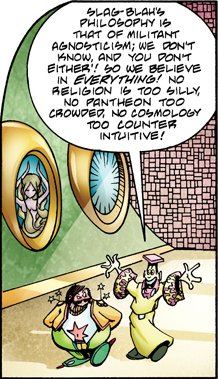
Militant agnostic: “I don’t know, and you don’t either.”

Bertrand Russell, in his 1947 “Am I an Atheist or an Agnostic?”, wrote:

“Not to be absolutely certain is, I think, one of the essential things in rationality. (…)

Militant agnosticism in action

“When one admits that nothing is certain one must, I think, also admit that some things are much more nearly certain than others. (…) Complete skepticism would, of course, be totally barren and completely useless. (…)

“As a philosopher, if I were speaking to a purely philosophic audience I should say that I ought to describe myself as an Agnostic, because I do not think that there is a conclusive argument by which to prove that there is not a God. On the other hand, if I am to convey the right impression to the ordinary man in the street I think that I ought to say that I am an Atheist, because, when I say that I cannot prove that there is not a God, I ought to add equally that I cannot prove that there are not the Homeric gods.”

And hence to his flying or cosmic Teapot, of course.

Russell’s contemporary, the British geneticist and evolutionary biologist J.B.S. Haldane, did not believe he understood the structure of the universe, or that such understanding was even with human power. As he wrote in “Possible Worlds and other papers” (1927): “the Universe is not only queerer than we suppose, but queerer than we can suppose.”

That admission of ignorance would qualify him as an agnostic. But, as he also wrote, “My practice as a scientist is atheistic. That is to say, when I set up an experiment I assume that no god, angel, or devil is going to interfere with its course; and this assumption has been justified by such success as I have achieved in my professional career. I should therefore be intellectually dishonest if I were not also atheistic in the affairs of the world.”

The farther we gaze and the closer we focus, the more we find that the Universe just keeps on going. From stars to galaxies to hypothetical multiverses in the one direction, from atoms to quarks to hypothetical strings in the other, there is no final limit to either vastness or foundational substance. More importantly, there is nothing to explain the existence of the Universe.

How can there possibly be anything? How can the Universe come from nothing? To say “God made it” just leads to asking where God came from. To say “It was born from the collapse of a previous Universe” or “It is automatically generated from the multiverse” just leads to questions of their origin, too.

A “First Cause” is as nonsensical a concept as “Before Time Began”. There are (fortunately) concepts that simply do not compute, questions that are fundamental to the nature of existence and yet are not capable of clear framing, let alone an answer. This is not new to us. They have stimulated and challenged human thought since reason began.

So it is perfectly in keeping with both today and the Greco-Roman time of Jesus to give “The Gospel According to the Romans” a skeptical protagonist with the personal creed of “Nescio et tu quoque” – “I don’t know, and you don’t either.”

Nonsensical, but irrefutable: Bertrand Russell’s Flying Teapot

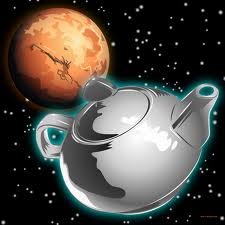
Bertrand Russell introduced the idea of claiming that there is a teapot in orbit around the sun somewhere between the Earth and Mars, as an example of an idea that cannot be refuted but which is not necessarily true. As he was writing before Sputnik and Gagarin, let alone before human debris in space, the idea was nonsensical but beyond the power of technology to disprove.

Russell's Teapot in orbit

(In time, we will develop the technology to map the solar system down to the level of orbiting teapots… and my guess is that by that time mischievous humans will indeed have launched one.)

The fact that Russell’s Teapot could not be disproved did not mean that it was a fact. A few years later he elaborated: “I do not think the existence of the Christian God any more probable than the existence of the Gods of Olympus or Valhalla. To take another illustration: nobody can prove that there is not between the Earth and Mars a china teapot revolving in an elliptical orbit, but nobody thinks this sufficiently likely to be taken into account in practice. I think the Christian God just as unlikely.”

Why a teapot? Russell was born in 1872. He was known to have been fascinated by the works of that other mathematician and logician, Lewis Carroll. In Alice In Wonderland, the Mad Hatter sings a parody:

“Twinkle, twinkle, little bat/ How I wonder what you’re at./ Up above the world you fly/ Like a teatray in the sky.”

I propose that this is the origin of the celestial teapot. In fact, I believe that it is. The idea is irrefutable. (Can I therefore require that you believe it too?)


Your place in the Universe – to scale

The difference between the scientific and the religious views of the world comes down to context. Those who want to believe in something unchanging can’t afford to contextualize their ideas, because our knowledge of the universe is always changing. An idea that looked reasonable to an illiterate herder (“the earth is flat”, say, or “the sun and the moon are the same size”) becomes untenable with increased information.

A child's understanding of the relative sizes of the Sun and Moon

Religious people want to hold on to old ideas, and they can only do that by refusing to place them in the new context of understanding – even when they accept the new understanding. So they develop this split world, one of mundane reality and the other of a magical world of angels and fairies. Historical people and events, if they have become important in a religious context, gradually get moved by their adherents into the magical world.

“The Gospel According to the Romans” is an attempt to undo some of this, and reconcile some major religious figures with the historical realities of their lives. In contextualizing them, their words and actions take on new meanings. We lose the magic, but we gain a richer understanding of our cultural history and identity.

It is all a part of understanding our place in the universe. And here is your place in the universe, to scale: http://t.co/uZzylwnF

It is truly amazing. Enjoy!

The Transfiguration – just a bloody meeting

The Transfiguration is one of those classic iconic and apparently pointless events in the gospels. Jesus is up a mountain with a couple of the disciples, and Moses and Elijah show up to talk with him. Jesus’ clothes shine brightly (that’s the Transfiguration) and Peter in his spontaneous fashion suggests building tabernacles (tents or huts) for them. A voice from the clouds is interpreted as saying “This is my beloved son, listen to him.”

Another unjustifiably airy-fairy Jesus story

Paintings have developed a tradition to show Jesus and the other two floating around in the air. Is there any textual justification for this? None. (Aside: This is exactly how myths develop: one person hears a story, wants it to be dramatic, fleshes the untold details out in their own mind, and then adds them as fact when they present the story – without even realizing they’re making changes.) Changes regarding a hero’s story tend to exaggerate and glorify, so you can discount some of the frills. But there’s probably a commonsense basis for the story.

Here’s how I tell it in “The Gospel According to the Romans”. First, it’s nighttime, full moon, but overcast. They go up into the mountain without Jesus telling them why. Then he tells them to hold back and goes alone into a clearing, where two Zealot leaders named (or code-named) Moses and Elijah come out and discuss their plans for the attempt to take over the Temple at Passover. (These disciples aren’t privy to this; they were the fishermen Simon Peter, James and John, not the Zealots Judas and Simon Zealotes.)

The full moon comes out from behind the clouds, and catches Jesus’ face and his white robes, making them shine dramatically. There is a roll of thunder. You can make thunder say whatever you want it to say – Eliot records it speaking Sanskrit in The Wasteland. Simon Peter babbles, not untypically.

Going back down the mountain, Jesus tells the disciples not to tell anyone about this until they’ve seen a man raised from the dead. In other words, not until he has done his Lazarus trick (which they don’t know anything about) which will be right before Passover at Jerusalem. At that point it won’t matter if anything they’ve heard gets out, the uprising to take control of the Temple will be about to happen anyway, and it will be too late for the Roman Legion to stop it…

So, what do you think? Plausible? Or you prefer the floating-around-in-the-air version?

It’s not Hamza Kashgari who is blasphemous – it’s his accusers!

On the occasion of the birthday of the Prophet Muhammad, 23-year-old poet and journalist Hamza Kashgari sent out three tweets:

Hamza Kashgari calls it like he sees it

  • On your birthday, I will say that I have loved the rebel in you, that you’ve always been a source of inspiration to me, and that I do not like the halos of divinity around you. I shall not pray for you.
  • On your birthday, I find you wherever I turn. I will say that I have loved aspects of you, hated others, and could not understand many more.
  • On your birthday, I shall not bow to you. I shall not kiss your hand. Rather, I shall shake it as equals do, and smile at you as you smile at me. I shall speak to you as a friend, no more.

This ignited a firestorm of indignation, with tens of thousands of his fellow Saudis calling for him to be tried for blasphemy and atheism, and executed. For some of the worst acting from a cleric, watch this short video.

Hamza flew to Malaysia, heading for asylum in New Zealand, but was arrested in the airport at Kuala Lumpur.

The irony is that his tweets are perfectly in line with the attitude that Muhammad himself tried to cultivate: that humans should never be deified, that neither Jesus nor Muhammad was anything but an ordinary man (though favored with prophetic gifts), and that, as he himself tried to prove, Muhammad could not perform miracles.

By the way, that’s the source of the story that ends “Well, if the mountain won’t come to Muhammad, Muhammad must go to the mountain.” Very much like King Canute shutting his flattering courtiers up by setting his chair up on the beach and telling the waves to go back, which they wouldn’t.

But the followers and the religious organizers always take over after the great man is dead, and turn him into a god to be worshiped. It happened with Buddha, with Odin, with Jesus. Muhammad put as many firewalls in the way as he could, but all too many Muslims treat Muhammad the way Christians treat Jesus, and impute outlandish miracles to him such as splitting and rejoining the moon.

Realistically, therefore, it’s the fanatical and superstitious accusers of Hamza Kashgari who are the blasphemers. The young poet should be praised for trying to keep Islam true to the wishes of its Prophet.