Jesus’ Message, 1: “Hear, O Israel -“

Jews traditionally identify 613 commandments from God in the Torah, from the initial commands to Adam and Eve to “Be fruitful, and multiply, and replenish the earth, and subdue it”, through “Thou shalt not kill”, to the requirement that the congregation stone a blasphemer to death. No wonder that it is claimed that no one has ever been able to keep all 613 commandments!

When Jesus was asked which of the commandments was the most important he said “The first of all the commandments is, Hear, O Israel; The Lord our God is one Lord: And thou shalt love the Lord thy God with all thy heart, and with all thy soul, and with all thy mind, and with all thy strength: this is the first commandment. And the second is like, namely this, Thou shalt love thy neighbour as thyself. There is none other commandment greater than these.”

Because these two sound so much more forceful and defined than the Ten Commandments, people brought up in the Christian tradition assume they are Jesus’ original developments to monotheism.

Yet for the first one, Jesus is merely affirming his Jewishness. He is quoting the fundamental prayer of Judaism:

“Hear, O Israel: The Lord our God is one Lord: And thou shalt love the Lord thy God with all thine heart, and with all thy soul, and with all thy might. And these words, which I command thee this day, shall be in thine heart: And thou shalt teach them diligently unto thy children, and shalt talk of them when thou sittest in thine house, and when thou walkest by the way, and when thou liest down, and when thou risest up. And thou shalt bind them for a sign upon thine hand, and they shall be as frontlets between thine eyes. And thou shalt write them upon the posts of thine house, and upon thy gates.”
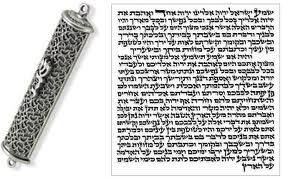
A Mezuzah for holding the text of the Shema, Deuteronomy 6:4-9

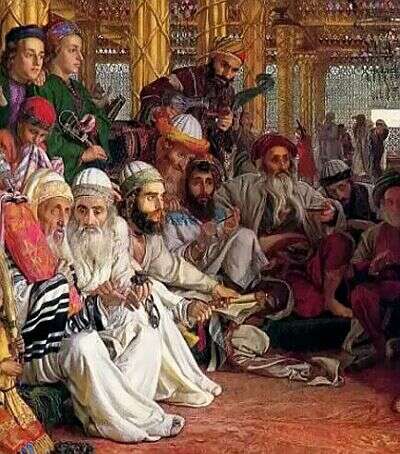
For its opening words, this is known as the Shema Yisrael (or just the Shema). It is the most important prayer, recited twice daily by observant Jews, taught to children to recite before sleep, attempted as the last words of the dying.

When you enter the home of an observant Jew you will notice a small container, a couple of inches long, fixed to the door frame. This is a mezuzah, containing the Shema.

For Jesus, as for any observant Jew, it was the single most important commandment from God.

Judas – Iscariot, Sicariot

Let’s pull some pieces together from the Gospels:

The disciples were forbidden to carry money – but Judas kept the movement’s money. He had a special relationship with Jesus, and a special place in the movement.

Zealots, being egalitarian and recognizing only God as their Lord, called each other “Friend”. Judas is the only disciple addressed as “Friend” by Jesus.

Judas led the Romans to Jesus, but not necessarily of his own free will. He died violently immediately afterward. He was found hanged (Matthew) and with his belly split open and his guts spilled out (Acts). The Romans claimed it was suicide.

Judas is called “Iscariot” in the New Testament. That name is obscure in meaning, and there have been suggestions that he must have come from the town of Karioth. Unfortunately, there is no record of exactly such a town name. In ‘The Gospel According to the Romans’ I suggest that the name is a deliberate corruption of “Sicariot”, to disguise the name of this very important person in Jesus’ story. A sica is a curved knife, the weapon of choice of urban guerrillas. A “sicariot” is a “dagger man”.

Jewish Sica

“Sicariot” was the common derogatory term for a Zealot, the armed resistance against the Roman occupation of Israel. Other terms used by the Romans were “thief” and “robber”.

When Paul tried to spread his new religion into the Roman population at large, links between Jesus and the Zealots were problematic. Distortion and misdirection were necessary in a retelling of the story from which the Romans were largely omitted. Judas was too well-known to ignore; but at least his name and his role could be shifted, from Jesus’ friend the “Sicariot”, to Jesus’ betrayer the “Iscariot”.

Who were the Zealots?

The Zealots were the armed resistance to the Roman occupation of Israel, and caused uprisings throughout a 200 year period. They terrorized collaborators, assassinated leaders, robbed caravans and killed legionaries whenever they could, operating as urban and rural guerrillas with their trademark curved dagger, the sica. They were sicariots, dagger men.

Zealots - robbers, or freedom fighters?

The Romans called them sicariots, robbers, thieves and brigands. But they would hardly call them heroes, patriots and freedom fighters, would they?

Once a generation or so a Zealot leader would arise who would lead a full-scale revolt – capture a city, massacre gentiles, loot arms and treasure, and finally be crushed when the Romans sent in a couple of Legions.

In 6 CE when Jesus was about 12, Judas of Galilee captured Sepphoris (or Zippori), the capital of Galilee only four miles from Nazareth. The Romans defeated his ragtag forces and crucified 2,000 of them. (Jesus’ father Joseph is not heard of after that event.)

After Jesus led his unsuccessful uprising in the Temple at Jerusalem, he was caught and crucified between two “thieves”. Neither theft nor blasphemy was punished with crucifixion; only rebellion was. When the Romans labeled Jesus “King of the Jews” they were echoing his claim from his ride into Jerusalem on his donkey, and clarifying why they were crucifying him. The two “thieves” were also important enough to be crucified.

A fourth was arrested and released: Barabbas, identified as “a robber”. “Bar-abbas” is a strange name – it means “son of a father”, “son of his father”, or “Son of the Father”. He was a Zealot, anyway. In “The Gospel According to the Romans” I suggest a couple of different reasons for his release.

The Zealots were active for another 100 years, until the final destruction of Jerusalem in the Bar Kokhba Revolt.

The End of the World (again)

There is something truly fascinating about the human desire for the end of the world. To believe you can predict it from the ravings of religious mystics a couple of thousand years ago… well, you have to live in such a mythic, pre-scientific world.

Judgment Day, May 21, 2011... or maybe 21 October 2011... oh what the hell.

And not only that – why do we want to believe in it? Is it that we love the shivers of future horrors? Is it that we feel we are powerless, and our idea of suicide is to bring everything down with us? Or is it a desire for justice, and laziness on our part so that we will just rely on divine forces instead of working for justice ourselves?

I wouldn’t even be on this rant if it wasn’t for the fact that yet another would-be End-of-the-world prophet has been tripping over bizarre calculations from tribal myths originating with a different people on the other side of the world some thousands of years ago, figuring that – that – that Jesus came back from the dead two thousand years ago – physically went up to some place called Heaven above the earth – has been hanging around ever since – is coming back down again…

And there are millions – maybe billions – of people who believe this stuff, or stuff very similar in their own religions…

Enjoy the day, folks!

The Dead Sea Scrolls

After the Dead Sea Scrolls were discovered in the 1940s and 1950s, scholars hoarded them jealously while trying to carve out a little piece of immortality for themselves as translators and revealers. The dribs and drabs of selective translation allowed a pacifist, even hippie, interpretation of the community at Qumran, where Essenes were deemed to have been the owners of the texts.

It was only with the appearance of an almost complete translation, including the War Scroll and details of the authoritarian and militaristic aspects of daily life that comprise 30% of the manuscripts, that it became clear that the library was not Essene. What is thought to have happened is that Essenes indeed used to live at Qumran until a severe earthquake in 31 BCE damaged many of the buildings, triggered an extensive fire, and possibly led to poisonous fumes being released from the Dead Sea. The site was abandoned for several decades.

Some of Jesus' teaching echoes scrolls found in the caves at Qumran

I propose that the remnants of Judas of Galilee’s Zealot army, crushed by the Romans in response to his violent insurrection in 6 CE, took refuge in Qumran, and that the library is theirs. That was the uprising that ended with the Romans crucifying 2,000 Jews (and incidentally, Jesus’ father Joseph is never mentioned again after that time – make of it what you will – I personally make a lot).

Regarding translations and interpretations of the Dead Sea Scrolls, I recommend the translation by Wise, Abegg and Cook (HarperCollins, 1996). Avoid anything earlier than that as being too selective and biased to be worth reading.

Roughly 40% of the material is standard-Biblical, 30% is apocryphal-Biblical, and the remaining 30% is bizarre and fascinating, with everything from formidably tough social laws (“A man who draws out his left hand to gesture during conversation is to suffer ten days’ reduced rations”) to details of a future war with the Romans, both preparations (“On the trumpets of ambush they shall write, Mysteries of God to wipe out wickedness. On the trumpets of pursuit they shall write, God has struck all Sons of Darkness, He shall not abate His anger until they are annihilated“) and the prophesied outcomes of individual battles.

It is a strange and wonderful text, showing the daily lives and background mythology of a violent fundamentalist sect.

The Four Philosophies

Judaism in the time of Jesus was monotheistic, but not monolithic. Josephus famously divided Jewish thought in four: Sadducees, Pharisees, Essenes and “the fourth philosophy”. They all awaited the Messiah, or Anointed One, a leader anointed by God who would reunite the Jewish tribes and, perhaps, rule them as King of Israel directly descended from David. How the Messiah would appear – born as a child, or descending from Heaven – was not certain. (But he would be a man, not a God or some Son of God.)

Sadducees - the pro-Roman philosophy under the Occupation

The Sadducees did not believe in a resurrection. With no real sense of an afterlife, let alone a Day of Judgment, they were inclined toward what was presently available. They were comfortable working with (or for) the Romans, and therefore were the religious and political ruling class among Jews.

The Pharisees believed that, God being just, all people would have to be resurrected so that they could be appropriately rewarded. This sentiment was more attractive to the lower classes than to the rulers, and the Pharisees were stricter than the Sadducees about social justice, adherence to the Law and not collaborating with the Romans.

The Essenes sought purity by withdrawing from everything to do with the Roman occupation – they didn’t like the idolatrous coins, let alone having to pay taxes, so they lived in isolated communities away from the cities.

And the Fourth Philosophy was that of the military resistance to the occupation: the Zealots. Heroes and patriots, or robbers and murderers, depending on your point of view, they led province-wide insurrections about once a generation for a period of 200 years – from the time the Romans occupied Palestine, until the Romans finally massacred, enslaved and deported almost the entire Jewish population.

The premise of the novel

The man we call Saint Matthew, being the tax collector “sitting at the receipt of custom” in Capernaum, is by definition a Roman agent appointed by Pontius Pilate. As such, he has the additional function of keeping an eye on the Zealots and other religious fanatics who head the insurgency against the Roman occupation. ‘Ragheads’, the Romans call them. After Jesus recruits Matthew to help purify Israel and overthrow the Romans – ‘Pigs’, the Jews call them –  Matthew continues to feed information to Pilate.

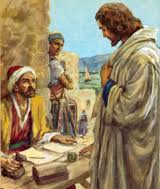
The local tax collector in Capernaum was - by definition - a Roman agent

Matthew himself tells the story. He is a Greek-speaking Jew, born and educated in Damascus, with a skeptical fascination for religion and politics. He is an irreligious opportunist and has friends on both sides in the conflict. He dines with the Roman military, spies for them, and wants Roman citizenship. But he also lives with Jesus, preaches for him, and falls in love with Mary of Bethany. Whichever way he turns he will cause the death of people he likes, and, in either camp, whoever suspects him will kill him.

By contextualizing the words and actions of Jesus within the Roman Occupation of Palestine and the repeated Jewish insurrections, a strangely modern picture emerges in ‘The Gospel According to the Romans’: a charismatic religious fundamentalist, opposing an occupying superpower.

Monotheism and Polytheism – pros and cons

Monotheism is authoritarian – if there is only one god, and only one correct way to understand his will, then there is only one correct way to act regarding the things god finds important. If there are rival suggestions of the correct way to act in these areas, both sides will feel a religious duty to force the other side to change their behavior, and preferably their opinions. This leads to religious police, religious inquisitions, religious wars.

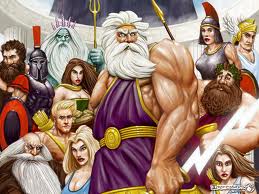
Only One God - bearded dude up in the sky with a whole bunch of what look like lesser gods

Monotheism results in a very focused society, with absolute values and unquestioning support – until a flaw appears, opposition appears, and war breaks out. Monotheism is inherently hostile to democracy and free choice.

It is easier to manage a theocracy for a population that is ethnically and culturally homogenous. The wider it grows, the more allowances have to be made, and the faster the monotheism erodes. The most effective monotheisms are cults operating in isolated compounds.

Polytheism allows the possibility of behaving in different ways, each way being appropriate for a different god. Those who want to worship Venus are not forced to live by the standards of those who worship Mars.

Lots of gods - bearded dude up in the sky with a whole bunch of lesser gods

This advantage allows a political structure that is not limited by a single religious practice to spread across unrelated cultures, adopting their gods into the pantheon of the rulers. This was part of what allowed the Roman Empire to spread so successfully, bringing the worship of Isis in to Rome as well as the worship of Jupiter out to conquered provinces. The decline and fall of the Roman Empire is connected to the replacement of polytheism by monotheism, as Gibbon pointed out.

Polytheism is not all peace and love, however. Where there is no consensus on correct social norms, war cults will want to act in a warlike fashion. Male-only cults will make life hard for women. Patrician cults will formalize aristocracy and slavery.

Mono- or poly-, it’s the theism that is the problem. Matthew, in The Gospel According to the Romans, is an interested but skeptical observer of the religions swirling around the Roman Empire.

Those pro-choice Romans

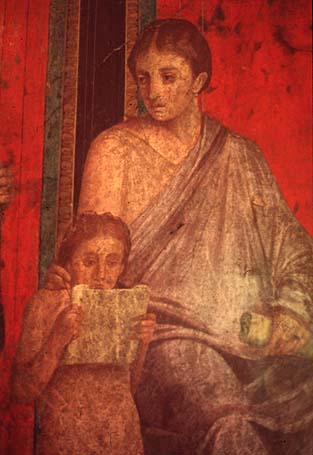
Romans kept the children they wanted, and wanted the children they kept

Romans couldn’t understand why Jews, Germans and Egyptians never ‘exposed’ children. I.e. why they never drowned or abandoned newborns that were unplanned, surplus, illegitimate or deformed – but instead decided to raise them all.

The Romans considered this very inefficient management. Contraception, abortion and infanticide were all legal, within limits. After a birth the midwife placed the newborn on the ground, and it was the father’s choice to pick it up or to abandon it. Abandoned babies were then exposed in a public place where – if they were lucky – someone else would pick them up. A newborn wasn’t a true person until it was named at 8 or 9 days.

Why keep a baby you couldn’t afford, or didn’t want? If later you wanted one, you could always buy or adopt; just as, if you wanted a particular adult, you could always adopt them as your child or arrange a marriage to bring them into the family.

Surely your family should be managed at least as carefully as your farm animals?

Calendar Conflicts

Under the Roman Occupation, the Jews continued to use their religious calendar for everyday use. Six days were just called ‘First day’, ‘Second day’, etc, with only the seventh day having its own name, and being special: the Sabbath. (The origin of the word is probably Babylonian, and dates from that Exile.) That gave them the seven-day week with a regular weekend that is so familiar to us that we tend to think of it as universal. As no work, including cooking, could be done on the Sabbath, the 6th day was the logical one for major food-shopping and food-preparation.

The Romans had neither weeks nor weekends. They had, as we do today, months of varying length that did not coincide with the moons, but they did not subdivide them into weeks. Instead, individual days were deemed lucky or unlucky, workdays or holidays, or holidays for some people but workdays for others. And there were plenty of other complications that required priests to post calendars in public places to tell people the quality of the individual days of the next year. The Kalends (first day of the month), Nones (fifth or seventh, depending on the month) and Ides (thirteenth or fifteenth) had names as being particularly important, and the other days were counted forwards or backwards from them, but you couldn’t tell much about them just from that fact.

This would be a very small weekly market, even for a village.

But the Romans did have a regular market day, standardized throughout the Empire, once every eight days. This was a legal requirement; and no legislation could come into effect until it had been publicly posted for three consecutive markets.

So, throughout the Roman province of Palestine, once every seven market days no practicing Jews would show up because it was their Sabbath. Farmers wouldn’t sell food, craftsmen couldn’t buy supplies and wouldn’t sell products, and neither Jews or Romans could buy anything for the next week. Then each side blamed the other for being inflexible.

Any Jews who chose to attend the market on those days were seen as renouncing their religion and becoming traitors to both their people and God – and the Zealots had no more qualms about killing them than about killing Romans.

Any Jews who refused to perform normal market duties on the Sabbath were seen as resisting the Roman attempt to bring uniformity, progress and stability to the whole Empire, and risked being treated as enemy combatants.

The attempt to impose the Roman calendar on the Jews was one of the key, and constant, flash-points, from the time of the Roman conquest in 63 BCE to the destruction of Jewish life in Palestine after the Bar Kokhba revolt in 135 CE.

It makes a useful early clarification of the different worldviews of the occupiers and the occupied in ‘The Gospel According to the Romans’.