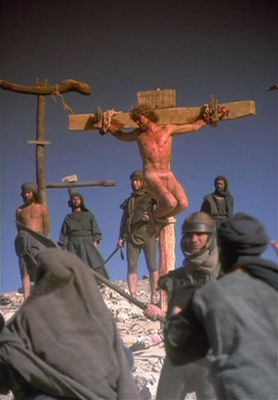
Jesus’ 2nd failed prophecy

Jesus went up to Jerusalem at Passover to proclaim himself King of Israel, and two of the prophecies he made were:

“For as Jonah was three days and three nights in the belly of the great fish, so will the Son of Man be three days and three nights in the heart of the earth.” (Matthew 12:40)

and
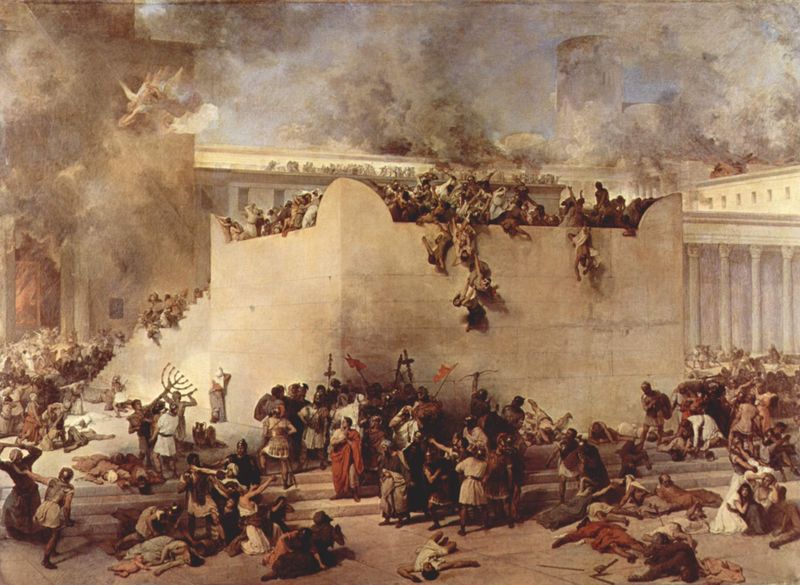
It wasn’t Jesus who destroyed the Temple, it was the Romans in 70 AD. And Jesus hasn’t bothered rebuilding it, either.

“I will destroy the Temple and rebuild it in three days.” (John 2:19)

Christians claim the first event physically happened, and the prophecy was fulfilled. Because the second event clearly didn’t happen, they claim the words were metaphorical and therefore the second prophecy was also fulfilled.

This technique allows anyone with a good sense of metaphor to be 100% accurate in predictions about anything, regardless of the outcome. Checkmate, atheists!

As for the Temple prophecy, I can think of four things it could have meant – though some are only “obvious” after the fact:

  1. I will physically destroy the Temple and physically rebuild it within three days. (That’s what his listeners thought he meant, and they taunted him with it while he was being crucified. But I think he had just been provocative and attention-seeking, i.e. genuinely metaphorical.)
  2. I will take over the Temple, get rid of the moneychangers and their idolatrous foreign coins, destroy the corrupt gang of priests that runs the place, and have a godly administration in place by Passover. (That’s what I think he meant, because that’s what he tried to do, and he got executed for it. This was a reasonable prophecy, but it failed.)
  3. I will allow myself to be killed, and I will come back to life in three days’ time, as I am my own Temple to myself. (That’s the mystical view of Paul and the Christians to justify their faith, because the takeover failed. End-of-the-world predictors do this kind of redefining all the time. And it’s unscientific gibberish.)
  4. I, being God, will destroy the Temple in 30-40 years’ time, using the Romans under Titus as my tools. Then at some point a couple of thousand years in the future I will rebuild it, using as my tools whoever ends up rebuilding it. The “three days” will mean whatever I want it to mean at that point. (C’mon, folks, work with me on this, it’s just as possible as the previous one!)

OK, so that last one is a little flippant, but that’s how the redefining works. Check out the prophecies of Nostradamus, and how each generation thinks all his verses apply to themselves. It’s a fascinating human trait.

When people want to believe something, they will mangle grammar, logic and plain common sense to satisfy themselves. But you don’t have to listen to them. Review the facts, and work it out for yourself.


Jesus’ failed prophecy

Christians say Jesus was dead and buried for three days. But Friday night to Sunday morning is only a day and two nights. A tour operator trying to sell that package as ‘three days’ would be prosecuted. So what’s up with the Christians?

Jonah, three days and three nights in the belly of the great fish

A case can be made for the Roman practice of inclusive numbering. They would have said our week was eight days, running from Sunday to Sunday. They based their own week on the public market day which was held every eighth day throughout the Roman Empire, and they therefore said the week was nine days. They were brilliant engineers, but not strong in pure mathematics.

However Roman numbering doesn’t deal with the issue of Biblical prophecy. Christians are at pains to say that Jesus was correct in all his prophecies. Here is the prophecy by Jesus that causes them to say he was buried for three days:

“For as Jonah was three days and three nights in the belly of the great fish, so will the Son of Man be three days and three nights in the heart of the earth.” (Matthew 12:40)

Christians will wriggle and wriggle to claim that late Friday plus Saturday plus early Sunday equals three days, but there is no way they can find the necessary three nights.

Clearly, if Jesus was prophesying about himself, a Sunday morning resurrection fails to meet the criteria. He failed to stay under long enough.

Sorry, but the claim of accurate prophecy must be disallowed.

If you’ve read the book, please post a review

If you’ve read The Gospel According to the Romans, you would do me a great favor (or favour) by posting a comment on Amazon.

An honest expression of opinion about the value of a book is always welcome.

A one-sentence (even one-word) review is better than nothing, although the most useful for a writer is probably to hear two things you liked and two things you didn’t like about the book. I find this also makes it easier to express the “didn’t like” side.

The place to go for the Kindle edition is http://amazon.com/dp/B006L80G8Q

or, for the paperback version, the address is apparently

http://www.amazon.com/The-Gospel-According-Romans-non-believers/dp/1456407082/?pf_rd_mnb=ATVPDKIKX0D34&pf_rd_stb=center-2&pf_rd_rat=0817NMRY4ZRQZM6P18TH&pf_rd_t3r=101&pf_rd_ptd=470938631&pf_rd_ied=507846&tag=buaazs-20&pf_rd_ptd=470938631&pf_rd_ied=507846

For the UK, of course, the addresses are identical except for .co.uk instead of .com

There are no reviews yet from the UK sites, but they post the US reviews. However the reviews are different between paperback and Kindle.

And if you haven’t read the book yet, The Kindle “look inside” will take you all the way to Chapter Three for free – map and timeline included.

Losing faith

If which religion you follow is a matter of choice, then having any religion at all is also a matter of choice. You don’t have to have one.

It's just a choice

Breaking free – it’s just a choice

What you choose to believe will be based on a combination of reason and emotion. There’s nothing wrong with that. It should a) make rational sense to you and it should b) feel good.  If you don’t have high levels of both of those at present, put your world-view on hold and look for something more satisfying. My suggestion: start with a book on comparative religion that deals with the history of religious development, and follow it up with a simple book on the history of science. (For a new non-fiction subject, try starting with a grade school book with lots of illustrations. That way you can see how other people pray, and what the first machines looked like when they were working, etc.)

Those who lose their faith (whether or not they choose a new one) don’t end in despair. When you live within a world-view that you’re comfortable with, it makes you less conflicted, less stressed, more relaxed, more able to give your attention and energy to family and friends.

There can be a troubling loss of investment in the former faith, and a natural disruption within your circle of friends. But it’s no worse than getting married, or divorced, or changing careers or countries. If you think your current situation is wrong for you, you’ll almost certainly end up happier if you actively seek to change it.

An excellent resource for anyone (of any age or stage of life) thinking about these issues is the Reddit atheism sub-group. (Warning: this is one of those places where you can easily lose several hours, though your mind will be richer for it.)

Enjoy your life. The right choice is always the one that feels most satisfying on the deepest level.

No one (well, almost no one) wants to die

The human desire to avoid death is instinctive, genetically programmed, and can only be overcome with great difficulty. People don’t think of actual “immortality”, of living “forever”, but they don’t want to die quite yet. Not this year. And if they are offered the option of somehow continuing to live on after death, in a nice place, and made young and healthy again, they will choose to believe it’s possible, unlikely though it might seem.

Rumors were always out there, inspired by hopes and dreams and visions, that there was a place on Earth where you could live forever. Maybe Dilmun (now Bahrain) where Gilgamesh sought out Utnapishtim the Faraway, survivor of the Flood… Maybe in the West, where the sun goes, beyond the Gates of Hercules, the Isle of Avalon, you can get there from the Grey Havens…

And others (more primitive in their thinking, or more advanced) say No, when you die you get put in a hole in the ground or your body is burned and that’s the end. In the time of Jesus, that was the Sadducees’ position. As wealthy and influential collaborators with the Romans, they didn’t like the idea of any Egyptian-style afterlife and assessment of their morals. But the Pharisees expected a resurrection of the body, so that God could manifest his essential justice and reward the good and punish the evil, and balance out their otherwise unfair lives.

Religious Jews of Jesus’ time certainly thought resurrection of the dead was possible. There are three stories in 1 and 2 Kings of people being restored to life: one an intervention by God after Elijah prayed; one a raising from the dead by Elisha; and the third being a dead man who was thrown into a tomb and came back to life when his body touched Elisha’s bones.

Raising the dead was therefore a good indicator of a prophet. Jesus not only claimed to have brought back the daughter of Jairus, and a young man in his own funeral procession, and his friend Lazarus, but he commanded his disciples to raise the dead (as well as heal the sick). Peter and Paul were each said to have raised a dead person on different occasions, as recorded in Acts.

And at the moment that Jesus died, Matthew records that the earth shook and tombs broke open and the bodies of many holy people were restored to life. (They were a little slower than Lazarus, because Matthew also says that they didn’t come out of their tombs until Jesus’ own resurrection, a day and a half later, when they went into Jerusalem and appeared to many people.)

So not all these stories are coherent, let alone credible, but that’s not the point. The point is that humans want to believe that they aren’t going to die. In fact when you offer a belief in the afterlife to someone for the first time, they rarely assess it on grounds of logic, but they choose what to believe regardless.

Modern thinking about an ancient problem

A classic example is the story of Radbod, ruler of Frisia from about 680 to 719. He was nearly baptized a Christian, but then refused when he was told that he wouldn’t find any of his ancestors in Heaven after his death, because they hadn’t been baptized. He said he would rather spend eternity in Hell with his pagan ancestors, than in Heaven with his enemies – especially the Franks. He chose not to be a Christian because he preferred the idea of the Germanic afterlife to the Christian one. Or because his family loyalties were more important than the wishes of God. Or because he couldn’t really tell the afterlife ideas apart, and feasting with Woden is more fun than sitting around on a cloud singing hymns of praise.

The pagan afterlife party (until it all ends in Ragnarok) is one version; the Muslim paradise for believers is another; Hindus and Buddhists see you coming back to life in a different way; Taoists and others let you keep on living as long as your descendants keep on looking after you – buying and burning the things the priests sell, paper money, paper houses.

And as science slowly puts an end to all this wishful thinking, is it any wonder that we start looking to science for genetic intervention and rejuvenation, with the fallback of cryonics as a sort of ambulance to the future if we die before the medical miracles are fully developed?

Hitler, Joshua, Genocide and God

Nobody (almost nobody) likes Adolf Hitler. Christians say he was an atheist, atheists say he was a Christian, Jews say he was a mass murderer. But we can get at his beliefs in two ways: through his actions, and through his words.

First, he was a human. As a species humans are territorial and resource-possessive. We’ve been walking out of Africa in waves for the past 100,000 years, staking a claim to the empty places we like, pushing out the inhabitants of a previous wave, defending our turf against the next wave. We use our gods as moral justification for murder, and we glorify our massacres as historic victories.

Genocidal massacres involve killing men, women and children

The Jews took over the Promised Land of Canaan in this way, with Moses telling them that God said to kill every man, woman, child, animal and tree in the targeted cities in order “that they not pollute you with their evil ways” (Deuteronomy 20: 16-18). With these cities the soldiers weren’t even allowed to abduct the virgins, they had to kill everything.

God intervened to help Moses’ successor Joshua in the conquest, sending hailstones to kill half the enemy one time, and another time stopping the sun in the sky so Joshua could finish off the enemy before dark. (It’s surprisingly hard to find corroborating evidence from other cultures, of the spinning Earth suddenly stopping, and the oceans slopping all over the land as a result, and so on.)

And so the Jews wiped out the people there and took Palestine for themselves.

Christians, Jews and atheists… who claims that this was good?

Hitler’s actions were no worse than Moses’ or Joshua’s, and for the same reason. Genocide for the sake of ethnically uncontested control of territory and resources, and for racial purity.

Christians, Jews and atheists… who claims that this was good?

“But wait,” a Christian may say, “that was acceptable in the time before Christ, but it changed with the dispensation of the New Testament. It isn’t acceptable today.”

No way, Christian! Jesus didn’t intend any changes to the Mosaic Law: “Think not that I am come to destroy the law, or the prophets: I am not come to destroy, but to fulfill. For verily I say unto you, Till heaven and earth pass, one jot or one tittle shall in no wise pass from the law, till all be fulfilled.” (Matthew 5: 17-18) Any subsequent changes are the work of Paul, not Jesus.

“No, no, wait, wait,” says the religious person. “Moses and Joshua were following the mysterious commands of God for some greater hidden purpose, which Hitler wasn’t.”

You can follow a more detailed discussion of that in a different blog here, and it brings us to the second way of looking at Hitler’s beliefs: his words. Here are 19 Christian quotations from Mein Kampf, from his speeches, and even this one:

“The Catholic Church should not deceive herself: if National Socialism does not succeed in defeating Bolshevism, then Church and Christianity in Europe too are finished. Bolshevism is the mortal enemy of the Church as much as of Fascism. …Man cannot exist without belief in God. The soldier who for three and four days lies under intense bombardment needs a religious prop.”  – Adolf Hitler in conversation with Roman Catholic Cardinal Michael von Faulhaber of Bavaria, November 4, 1936

In sum, Hitler was one of those Christians who wants his Christianity free of Jews. And if his actions were evil, so too were those of Moses, Joshua and God.

So don’t blame atheism for Hitler and the Holocaust. Blame Moses and God… or blame the species we call “humanity”.

Crucifixion by Romans

Crucifixion was designed as the ultimate in slow, painful and humiliating deaths.

Crucified naked

Naked like this, but with a lot of blood

Aspects of the punishment included that prisoners were often required to carry their  crossbeam to the place of execution for it to be attached to its stake or tree; that they were crucified completely naked (more humiliating for a Jew than a Celt, and for a woman than a man – though female crucifixions were rare); that, naked, they would undoubtedly empty their bladder and bowels over themselves in front of the crowd who came to watch.

The prisoner was tied or nailed by the wrists to the crossbeam. The feet were often nailed to the upright, one one each side, at the ankle. Frequently the prisoner had a block of wood attached to the stake or tree for them to sit on, with a spike sticking up from it to magnify their pain.

The execution could last for hours or days, depending on the weather, the prisoner’s condition (such as loss of blood from having the skin scourged off his back) and whether the legionaries guarding the crucifixion were in a hurry to go back to camp. Some ways for the soldiers to hasten death were to break the prisoner’s legs with an iron bar, to run a spear up through the stomach and chest, or even to light a smoky fire below him to asphyxiate him.

Once dead, the body was normally left in place as a warning to others, while it was eaten by crows and buzzards.

The punishment was in use by Greeks, Persians and others before the time of the Roman Empire. The Romans originally used it only for slaves, but then extended it to pirates and enemies of the state. The punishment was forbidden under Jewish religious law, which only allowed execution by stoning, burning, strangling, or decapitating the victim.

So Jesus was not crucified at the wish of Jewish authorities, or of the Jewish people. He was crucified by the Romans as an enemy of the state, which he had declared himself to be by claiming the kingship of Israel while entering Jerusalem. The Romans tacked a sign above his head reading “Jesus of Nazareth, King of the Jews”, to show what they thought of his ambitions.

Jesus was crucified between “two thieves”, but you didn’t get crucified for mere theft. However “thief” and “robber” were synonymous with “Zealot”, “sicariot” (or knifeman) and “insurgent” to the forces of the Roman Occupation. It is reasonable to assume that the “thieves” were leaders in the armed wing of the Zealot resistance – but not as prominent as Jesus, and not part of his cadre of preachers.

Jesus was stripped naked, and the legionaries diced for his clothing. He was scourged: flogged 40 times with a short cat-o’-nine-tails , each tail ending in a lead ball to lacerate and strip the skin off. He was made to carry his crossbeam to the Place of Skulls outside the city, but he collapsed on the way. After perhaps nine hours of crucifixion he called out “My God, my God, why have you deserted me?” Then he called out again, and died. Joseph of Arimathea negotiated with – or bribed – the Romans to be allowed to take Jesus down for burial, but first the Romans ran a spear up through the corpse to make sure it was dead – this was common practice, and only a dribble of blood and a watery fluid (presumably from the pericardium around the heart) came out.

And that was it. The end of just one of a 200-year series of attempts to oust the Romans from Israel. But preachers and knifemen didn’t have much chance against the Roman Empire.

Easter is finished

Easter ended a couple of years ago in our household when the children left home. Hunting for chocolate rabbits and Easter eggs in the garden, including digging through the sandpit, remained a fun event for the kids and their friends right through to college. Church, Jesus, Bible stories – they were never a part of it. This was about nature, not religion. Spring, not sin. Eostre, not Easter.Eastre, goddess of Spring

Eostre (to the Northumbrians) or Eastre (to the West Saxons) was the Anglo-Saxon goddess of spring and fertility. Eggs and bunnies. Flowers, nests, the rebirth of the world.  March/April (in northern climes only), surrounded by birds, bunnies and mad March hares.

Paul built the legend of Jesus’ resurrection from the tomb to be a Mithraic story of the Blood of the Passover Lamb (instead of the blood of the Mithraic bull) taking away the sins of the world (a Mithraic, not Jewish, concept). This echoed so fortuitously with the springtime rebirth of the world that, as Christianity spread north, it simply adopted the preexisting springtime celebrations, and kept the name Eastre and the eggs and rabbits in order to help transition the pagans into Christianity.

For our adult sanity, we drop the idea of the Resurrection. For our kids’ enjoyment, we keep only the eggs and rabbits… and the old name Easter.

Levirate Marriage – you must marry your brother’s widow

Levirate marriage (of a man to his dead brother’s widow) is required in the Bible. As the Jewish Encyclopedia states, “This custom is found among a large number of primitive peoples”. It can be useful for a woman in a society in which women have no rights or freedom. It is useful for men in patriarchal societies to give family continuity and inheritances to the children of a dead brother. It has no place in a society in which women have equal rights with men.

Onanism, in Lego

A levirate marriage is required in the Bible in certain circumstances: when a man dies childless, his brother is to marry the widow and her firstborn child will be treated as being that of the dead brother, which gives the dead man an heir. (Deuteronomy 25: 5-6) When Onan refused to follow this obligation, God killed him: “Then Judah said to Onan, ‘Go in to your brother’s wife and perform the duty of a brother-in-law to her; raise up offspring for your brother.’ But since Onan knew that the offspring would not be his, he spilled his semen on the ground whenever he went in to see his brother’s wife, so that he would not give offspring to his brother. What he did was displeasing in the sight of the Lord, and he put him to death also.” (Genesis 38: 8-10)

So ‘onanism’ as a sin isn’t masturbation as such, it is refusing to have a child by your brother’s widow. If a man refuses to fulfill this duty, “Then the elders of his town shall summon him and talk to him. If he persists in saying, “I do not want to marry her,” his brother’s widow shall go up to him in the presence of the elders, take off one of his sandals, spit in his face and say, “This is what is done to the man who will not build up his brother’s family line.” That man’s line shall be known in Israel as The Family of the Unsandaled.”(Deuteronomy 25: 9-10)

Oh, the fun we will all have, when our Presidents and Prime Ministers all start enforcing the old tribal laws about marriage!

This post comes to you courtesy of Nikolai Usack of Astral/Subastral. He normally provides music in the Milwaukee area. Here he provided the impetus for the post and the initial text.

God *requires* abortions and sterilization for infidelity. (Applies to females only)

The Book of Numbers, chapter 5 verse 11, starts a section out with the inescapable fact that this passage is not just some prophet or opinionated preacher or whatever, this is GOD speaking: “Then the LORD said to Moses:”

God laying down the Law. It tends to favor men over women. Because Moses made God in his own image.

Numbers 5: 12-19 sets the stage: if a man knows or suspects that his wife has been sleeping with someone else, then he has to take her to the priest with a “grain offering of jealousy”. The priest takes the woman to “stand before the LORD”. He unloosens her hair. He puts the jealousy offering of grain into her hands. He takes some “holy water”, and sprinkles into it some dust from the temple floor. Then he puts her under oath and says “If you’re innocent, may this bitter water not harm you.”

But if she is guilty, it is God’s command that the priest ask God to curse her and cause her to have an abortion and have her uterus collapse, as a warning to others and as a way of making sure that the husband is only raising his own children.

Numbers 5: 20-22 (from the GOD’S WORD translation, 1995)-

20 If, in fact, you have been unfaithful and have had sexual intercourse with another man,

21 may the LORD make you an example for your people to see what happens when the curse of this oath comes true: The LORD will make your uterus drop and your stomach swell.’ “Then the priest will administer the oath and the curse by saying:

22 ‘May this water that can bring a curse go into your body and make your stomach swell and your uterus drop!’ “Then the woman will say, ‘Amen, amen!’

And the priest writes the curse on a scroll, and washes the words off into the bitter “holy water”, and makes the woman drink the water, which is designed to make her abort if she is guilty and to “cause her bitter pain” and to prevent her having any further children;

28 but if the woman is not unclean and is pure, she is not guilty and will be able to have children

… but only by her loving husband, of course.

Gotta love those primitive tribes and their old time religion!