The Miracles, 4: Lazarus

When Jesus was heading to Jerusalem for Passover (because he was a Jew, remember?) he got word that his close friend Lazarus is very sick. Instead of making the one-day walk to Lazarus, he waits where he is for a couple of days, telling the disciples that Lazarus will die so that he can be resurrected to demonstrate God’s glory. Jesus has already been prophesying that people will see a “son of man” raised from the dead after three days. Now’s clearly the time for it.

Classic Mummy

Jesus shows up, finally. Yes, Lazarus has been dead for three or four days. Lazarus’ sisters Martha and Mary meet Jesus at the graveyard, there are a lot of other people there too, and Jesus has the tomb opened and calls Lazarus, who stumbles out stinking and wrapped in grave-clothes. “Many believed,” says John’s Gospel. Therefore clearly many, perhaps most, did not believe.

Why not?

Too easy to fake.

Why didn’t Jesus come earlier, except to show off what he could do?

If he could raise people from the dead, why didn’t he do it more often… and not for a close friend where there would be doubts about the veracity of it?

And Lazarus walked out of the tomb. Seriously, no one wraps a body for real like they do for horror movies. In real life you wrap the legs together, just as you wrap the arms to the body. Unless you want the body to be able to walk!

It was a bogus ‘miracle’, and not even good enough to fool all the onlookers.
The Miracles, 3 – Walking on the Water

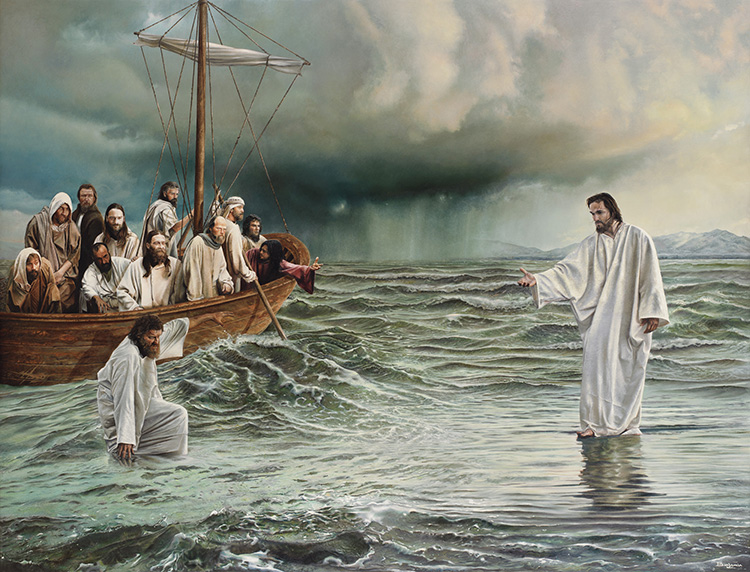
Here’s the story (Matthew 14: 22-33): the fishermen are headed for home at the end of the night, and it’s stormy, and they can’t see where they’re going. Jesus comes walking out to them on the water – Peter jumps over the side to be with him, starts to sink, and Jesus pulls him up.

Jesus walking on the water, the impetuous Peter failing again

The text gives the impression that they were well out from shore, maybe a mile, who knows. But there’s no real context for the story, as usual – no perspective, and no resolution.

The question is always whether we can find an explanation that allows for basic truth in the story (even if it’s been hyped and spun a little, or misremembered or misunderstood) without contradicting the known laws of the universe.

Consider: did Peter now walk the mile back to shore with Jesus? Or did Jesus carry him? Or did one or both get back in the boat, and they sailed in? None of these are mentioned… because none of these needed to happen.

The “sea” in the story is the Sea of Galilee, a lake 10 miles wide. Capernaum, where the fishermen lived, is naturally on this lake. The lakeshore there is low and gently sloping, part beach and part marsh. The beach is mostly rock, some sand, the water is shallow for a fair distance. Let’s assume that then, as now, people protected their boats from storms coming up the lake by building a ‘mole’, a wall of loose rocks not necessarily higher than the lake level, out into the lake.

It’s still dark, the boat’s coming in to shore in a storm, the fishermen can’t see where the beach is, let alone the mole. Jesus comes walking out on the mole to help. Peter jumps over the side of the boat onto the mole, but then loses his footing and falls in (the water may only have been a couple of feet deep), and Jesus helps him up. Then they help guide the boat to the beach, and drag it up.

Years later, when young followers who never met Jesus are asking Peter for stories about what it was like working with him, they get told a slightly exaggerated version. They get, naturally, a fisherman’s story.

Cafeteria Christians, read this:

We can quote the Bible too:

So, um, every word of the Bible is true? It’s God’s word? Then especially when it says it’s actually God speaking, I guess all you fundamentalist types have no choice but to obey.

Now you can either treat the Bible like the outdated tribal mythology that it is. Or you can say, Nope, it’s the word of God.

To you word-of-God types, then:

Gentlemen, if your wife wasn’t a virgin when you married her, God says you gotta kill her. Sorry ’bout that. But you know, it’s in the Bible.

What’s this blog all about, anyway?

This blog is a marmalade – sweet and sour boiled together, both rind and juicy bits.

Jesus was not a pacifist.

  • It’s a blog for the ideas of my novel. The novel looks at Jesus in the context of the constant uprisings against the Roman Occupation that began 100 years before his preaching, and went on for 100 years afterwards… until the Romans finally leveled Jerusalem, and killed or enslaved and deported all the Jews, and banned them from the replacement city of Aelia Capitolina.
  • It lets you read Jesus’ words and actions with the awareness that his “greatest commandment” is to recite the Shema, the fundamental Jewish prayer (“Hear, O Israel,”) – and practicing Jews do it multiple times a day. It’s Judaism 101. Jesus wanted Israel to turn back to the Covenant with God, and get rid of the idolatrous, beard-shaving, pig-eating Westerners who were marching around the country without bothering to learn the language.
  • Yes, it makes comparisons with modern Western invasions and occupations.
  • So it carries all my grudges against the Bush/Cheney/Rumsfeld/Wolfowitz/Blair destruction of Iraq in the hope of oil money and imperial glory. 100 million of us around the world had protested and pointed out that it was going to lead to nothing but death, destruction and economic catastrophe at home and abroad. And here we are.
  • It also carries the ironies of the current Westernized Israeli occupation of Palestine, and the cynical and heavy-handed Israeli destruction of the people who have been indigenous there for the past 2,000 years… a repetition of how the Jews slaughtered all the Canaanites and others who had been living in the area before Moses came along.
  • So I think Moses was a genocidal barbarian (Deuteronomy 20: 16-18).
  • And Jesus was a Jew, and more in tune with Osama bin Laden than anyone else.
  • And St. Paul was an epileptic visionary who created Christianity out of a mishmash of Judaism, Mithraism, and bits of Egyptian and Roman mythologies and practices.
  • And I have no respect for any monotheist who believes the earth was created in the past 10,000 years, or thinks the tribal legends of illiterate herdsmen have relevance for government policy today.
  • Does anyone really believe the first chapter of Genesis, when it says that God created day and night on the first day… and then made the sun and moon on the fourth day? What I believe is that we live in a universe of a billion galaxies, each with a billion suns – and someone who can’t even figure out the relationship between daylight and sunshine is to be treated seriously?
  • As for what the creative force behind a billion galaxies looks like, who knows. Call it God if you want… but where did it come from? Why is there anything at all?
  • And I love polytheist mythologies, and they speak to the soul’s images and poetry and inner health – but they’re not literally true.
  • And I loathe people who use religion as nothing but a way to make money, or to grab power. And I loathe people who use politics in that way, too. So I doubly loathe hypocritical politicians who mouth religious crap.
  • But oh how I love it all, at the same time! What a planet! Unbelievable natural beauty and works of art, and the most appalling destruction and massacres, planet-wide pollution, and greed and ignorance. But what can you expect of a planet of 7 billion heavily-armed apes? Humans are simply mind-boggling, stumbling through the dark like reckless two-year-olds.

By the way, it’s also a blog for the novel itself. With links to the trade paperback and to the Kindle edition. But don’t expect to find all the blog’s ideas in the novel – it’s just a contrarian (realistic, commonsense) retelling of an old story from the point of view of, yes, the Western occupation. And yes, Jesus was crucified. No, he didn’t come back from the dead. So, do you want to see how he did all those miracles?

Polytheism – pure mythology

Polytheism isn’t bad. Joseph Campbell can explain a lot of the benefits of seeing it as a natural part of your inner life. And the nice thing about polytheism is that you can worship your gods without believing in them. You don’t have to deal with them as facts, and disagreement about their details or their logic is no problem. They are fairy tales, but they speak to something real inside us.

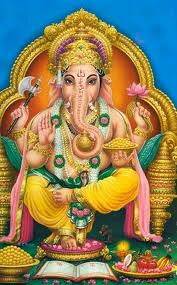
ganesha

Ganesha, Remover of Obstacles, Lord of Beginnings, patron of arts and sciences, and god of intellect and wisdom

Take Hinduism’s Ganesha. He was born with a strange head, or he was created directly from Shiva’s laughter, or a mean god burned his head off, or Shiva cut it off…  Anyway, the usual story is that Shiva cut off an elephant’s head as a quick replacement to save the boy’s life.

Then he became the god of new beginnings (which is reasonable), and of wisdom (which works for an elephant). Because he was too large to get about much, his vahana or “vehicle” is Mushika the rat or mouse. A vehicle is an animal companion/aspect of a god, much like the modern dæmons in Philip Pullman’s “Northern Lights” (or “Golden Compass” in the US). Mushika goes everywhere and finds everything out – like Odin’s ravens – and so Ganesh is also the god of paths, roads, gates, barriers, and of overcoming obstacles. And he’s the patron of arts and sciences, which relate to his knowledge and wisdom.

There’s enough in that one god for people to pick and choose which aspects they feel most connected to, and want to worship. The whole story is so preposterous that (at least outside India) it would be hard to believe as physical fact. It lives on only as a personally-resonating spiritual guide to life. Religion becomes active mythology, rather than a claimant to replace science, the way fundamentalist monotheism wants it to be.

So that’s all right then. Religion with all its richness, but without belief in its absurdities.

Oh, you still want to believe in it as a historical reality? Then I have a couple of questions:

Having cut the boy’s head off, why didn’t Shiva just stick it back on? Why did he have to go and cut another head off, and stick that on instead?

And more importantly, if the elephant’s head is on the boy’s body, who is alive? I’d say the elephant. But that’s because I think of the body as being the vehicle of the brain, nothing more.

When monotheism goes really wrong

Who would have guessed that Jesus’ fundamentalist Judaism would be hijacked by Paul as pro-Roman, and end up anti-Jewish? And who would have thought that a message of poverty and trust in God would lead to Pope Leo X…

If Heaven was a thing that money could buy, the rich would all be there...

At age 38 Giovanni de’ Medici – sick, syphilitic, stinking from open ulcers, and having bribed the Vatican’s physicians to say he had less than a month to live – was elected Pope to give the Cardinals time to decide on a real successor to Julius II. But he recovered, and his first declaration as Pope Leo X was “God has given me the papacy, now let me enjoy it.”

He turned the Vatican into a non-stop party of banquets and sex – his preferences were obscene plays, and sex with his chamberlains. To raise money, he created 1,353 new salable Vatican offices, licensed and taxed 6,800 prostitutes (for a city of 100,000 people), borrowed massively at 40% interest, and greatly extended the sale of indulgences (rich people buying forgiveness of sins so that they don’t have to spend time being cleansed in Purgatory before they can enter Heaven).

It was Leo who created one of the most famous and damaging quotes in Christian history. At a lavish Vatican banquet on Good Friday, 1514, in the company of Cardinals who recorded it, he raised a chalice of wine and toasted:

“How well we know what a profitable superstition this fable of Christ has been for us and our predecessors.”

All of this – the immorality, profligacy, and sale of indulgences – led directly to the Protestant revolt touched off by Martin Luther in October 1517.

But of course, the Roman Catholic church wouldn’t engage in anything so cynical nowadays, would it?

NOTE: The comments immediately below the clipping are NOT MINE, thank you!

Refs: http://www.bibliotecapleyades.net/vatican/esp_vatican30c.htm

http://www.nexusmagazine.com/articles/Papacy3.html

Encyclopaedia Britannica, 3rd ed., Edinburgh, 1788-97, vol. ix

and other references found within the above.

A short, simplistic history of monotheism

Three or four thousand years ago the Jews decided to only worship one god, Yahweh; and some time after that they decided that Yahweh was the only God.

Symbols of the three major monotheist religions

Two thousand years ago, under cultural pressure from Egyptian neighbors, Greek settlers and the Roman occupation, Jews were sliding in their beliefs. Jesus was one of many preachers who tried to restore the people to hardline Judaism through an emphasis on the Shema as the basic prayer: “Hear, O Israel…”

After the Romans crucified Jesus for his Messianic kingship claim, Paul came along. Paul was a Westernized Jew who wanted to spread a religion throughout the Roman Empire, and he decided to do it by blending Jewish monotheism with the polytheist rituals of Rome and Egypt and with the popular military sun-god cult of Mithras. He made Jesus into a Jewish Mithras, elevating him to a divine – or at least mythic – status, and downplaying Jesus’ physical nature.

Fourteen hundred years ago Muhammad, knowing a fair amount about some forms of Christianity as well as Judaism, preached a return to pure monotheism, and the worship of a God who is “One, and eternally sought, who neither gives birth nor is born, and there is none like Him.” Jesus is given recognition as a prophet, but fully human.

So Islam is very close to Judaism and the actual teachings of Jesus, while Paul’s “Christianity” is the odd one out. Think about it: God cannot be human; God can’t be pictured, and you shouldn’t even try; pray to God, not to any saint or any other human; oh, and don’t eat pork. Judaism and Islam agree on all those, and Christianity disagrees. That’s pretty fundamental. And clearly, Christianity isn’t really monotheism at all.

Unasked questions: Is God male or female or what?

Both men and women are made in God’s image, according to the Bible. The God of monotheism is usually thought of a man (well, usually an angry old man with a white beard). But if people (not just males) were created in his image, should it be “in her image”? “In its image”? Or what?

Hermaprodite lifts its nightie

Genesis 1: 27 “So God created man in his own image, in the image of God created he him; male and female created he them.”

Some religious apologists say that this doesn’t refer to physical attributes, but to mental or spiritual attributes. Oh, right, like that makes more sense! Now you’re saying that humans are created omnipotent, omniscient, etc.

But let’s stay with the sex issue. Is God like that child of Hermes and Aphrodite, Hermaphroditus? Does God have two fully formed sets of sex organs, or one set that is an amalgam like some humans have? If the latter, does that make hermaphrodites more godlike than the rest of us?

And while we’re at it, does God have a belly button like the rest of us? And if so, why? Is God just a blueprint for creating humans? Is that what God’s sex organs are for? And the big white beard, too? Just so He would know what He was trying to create?

So, um, what race is He? What kind of hair does he have, what color skin? Is His DNA pure homo sapiens, like Africans, or is it 4% Neanderthal like all non-Africans?

In other words, give me a break! “God created man in his own image”? Seriously? It must have meant something thousands of years ago to illiterate herders in the desert. But we’ve moved on since then. Some of us.

Is this what God's sex organs look like?

Unasked questions: Is God circumcised?

Genesis 1: 26-27 “And God said, Let us make man in our image, after our likeness: (…) So God created man in his own image, in the image of God created he him.”

Circumcision. Making yourself less like God.

Men are created with foreskins. Therefore God has a foreskin. Therefore God is uncircumcised. Therefore God is not a Jew or a Muslim. (Christians haven’t been required to be circumcised since Paul hijacked Jesus’ movement and turned it into something for Gentiles.)

So why do Jews and Muslims (and others) vandalize their likeness to God? It seems irreligious. But maybe it’s just a very small kind of self-sacrifice; God required it of Abraham’s people as a sign of the Covenant – something very personal, and less drastic than killing your own son. In which case, Halleluia!

Scientology’s wacky SciFi “creation myth”

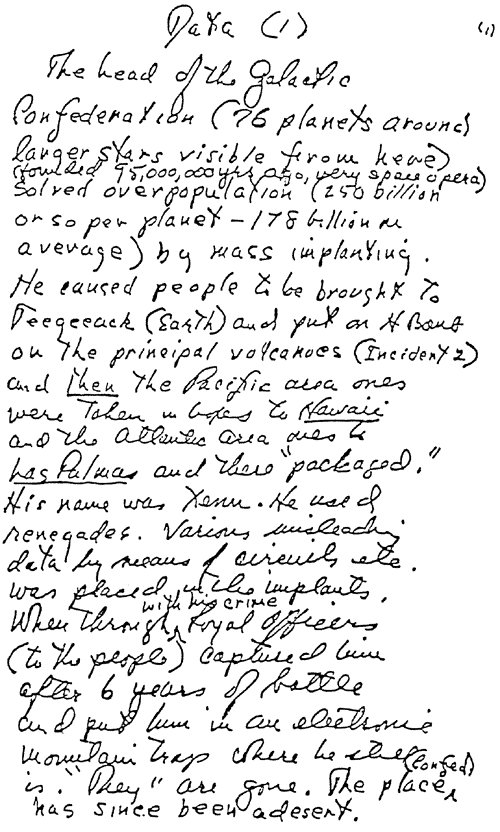
L. Ron Hubbard roughed out the story that became Scientology’s equivalent of the Garden of Eden narrative: how evil came to the Earth, and what we have to do to become pure. Read about it here.

Hubbard's notes for the oddball story that now underpins Scientology

Xenu, the Head of the Galactic Confederation, solved a massive overpopulation problem on his 75 planets some 95 million years ago by bringing people to Earth, putting them in volcanoes, and detonating H Bombs in the volcanoes. (How very 1950s!) This has emotionally scarred us (even if don’t remember it) throughout all our subsequent reincarnations, and only by remembering the details (including time and place) of traumatic events (including in past lives) can we cleanse ourselves of the trauma and return to being spiritual creatures who can control the physical world around us…

Other traumatic experiences, according to this page on The Beliefs and Teachings of Scientology, include “attempted abortions and other fetal traumas, acts of torture and violence experienced both as victim and as perpetrator, encounters with the Marcab Confederacy and various Invader Forces from spacefaring Galactic civilizations, life on earth as a clam,” etc.

Your past goes back billions of years. The cost of having Scientology help you clean it up, all the way back to the clams, may well be $500,000 or so.

Good luck.