Jesus’ Message, 3: Eternal Life

Jesus said that the two greatest commandments from God were the Shema, and to treat your fellow Jews well. When a rich young man told him (Matthew 19: 20) that he had followed these – and the Ten Commandments, and in fact all of God’s commandments – and asked what he had to do to gain eternal life, Jesus did not, repeat NOT, say anything like “Accept me as your Lord.”

Jesus said “Sell everything, give it to the poor, and follow me.”

The Pope on his thrones in his palaces thinks he is poor.

In ‘The Gospel According to the Romans’ the words would carry a different nuance: “Sell everything, give it to the Zealots, and join the insurrection against the Roman occupation.”

In any case, the young man went away sadly, because he was rich. That was when Jesus made his remark about it being easier for a camel to go through the eye of a needle, than for a rich man to get into Heaven.

And no matter which interpretation of Jesus’ words is correct, it is hard to imagine either the Pope or any televangelist being allowed in at the pearly gates.

Best guess at Jesus’ family

When she married Joseph, Mary was pregnant with Jesus by someone else. Rumor had it that the father was a Roman soldier called Pantera, but the rape (or affair) was covered up. Joseph originally intended to divorce her (Matthew 1: 19), but changed his mind and left Galilee to go back to his family in Judea for Mary to have the child.

Joseph and Mary on the way to Bethlehem

The couple subsequently had several more children. In his 30s Jesus preached in his hometown of Nazareth, and people dismissed his claims to authority, saying “Isn’t this the carpenter’s son? Isn’t his mother’s name Mary, and aren’t his brothers James, Joseph, Simon and Judas?
Aren’t all his sisters with us?” (Matthew 13: 55-56). None of Jesus’ half-brothers should be confused with other followers of his with those names, other than James who became the leader of the disciples in Jerusalem some time after Jesus’ execution.

Some Christians deny that “brothers” and “sisters” means that they were Mary’s children – though clearly from the context it’s a nuclear family. Catholic and Orthodox Christians, especially, profess the perpetual virginity of Mary, and have created a backstory of Joseph having had an earlier marriage to a woman named Salome. She died, leaving Joseph with half a dozen children for him to raise. You have to wonder why the older kids are never part of the creche scenes of the baby Jesus in the manger… Mary, Joseph, Kings, Angels, Shepherds, farm animals… but no brothers and sisters?

No, Jesus had at least six siblings, and they were all younger.

“Jesus, son of Pantera”

About 177 AD the Greek philosopher Celsus, in his book ‘The True Word’, expressed what appears to have been the consensus Jewish opinion about Jesus, that his father was a Roman soldier called Pantera. ‘Pantera’ means Panther and was a fairly common name among Roman soldiers. The rumor is repeated in the Talmud and in medieval Jewish writings where Jesus is referred to as “Yeshu ben Pantera”.
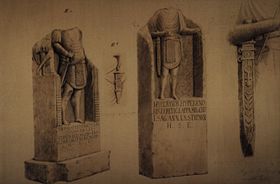
Pantera's gravestone is the one on the left

In 1859 a gravestone surfaced in Germany for a Roman soldier called Tiberius Iulius Abdes Pantera, whose unit Cohors I Sagittariorum had served in Judea before Germany – romantic historians have hypothesized this to be Jesus’ father, especially as ‘Abdes’ (‘servant of God’) suggests a Jewish background.

Tib(erius) Iul(ius) Abdes Pantera
Sidonia ann(orum) LXII
stipen(diorum) XXXX miles exs(ignifer?)
coh(orte) I sagittariorum
h(ic) s(itus) e(st)
Tiberius Iulius Abdes Pantera
from Sidon, aged 62 years
served 40 years, former standard bearer (?)
of the First Cohort of Archers
lies here

The gravestone is now in the Römerhalle museum in Bad Kreuznach, Germany.

It appears this First Cohort of Archers moved from Palestine to Dalmatia in 6 AD, and to the Rhine in 9 AD. Pantera came from Sidon, on the coast of Phoenicia just west of Galilee, presumably enlisted locally. He served in the army for 40 years until some time in the reign of Tiberius. On discharge he would have been granted citizenship by the Emperor (and been granted freedom if he had formerly been a slave), and added the Emperor’s name to his own. Tiberius ruled from 14 AD to 37 AD. Pantera’s 40 years of service would therefore have started between 27 BC and 4 BC.

As Pantera would probably have been about 18 when he enlisted, it means he was likely born between 45 BC and 22 BC. He could have been as old as 38 or as young as 15 at the time of Jesus’ conception in the summer of 7 BC.

In 6 AD when Jesus was 12, Judas of Galilee led a popular uprising that captured Sepphoris, the capital of Galilee. The uprising was crushed by the Romans some four miles north of Nazareth. It is possible (and appealing to lovers of historical irony) that Pantera and Joseph fought on opposite sides. As Joseph is never heard of again he may well have been killed in the battle, or have been among the 2,000 Jewish rebels crucified afterwards.

So Tiberius Iulius Abdes Pantera is indeed a possibility as Jesus’ father. The only thing we know for certain is that Mary’s husband Joseph wasn’t the father, and that Mary was already pregnant when they married. It could have been rape, or Mary may have been a wild young teen who fell for a handsome man in a uniform, even if he was part of an occupying army. It happens.
Monotheism and polytheism – desert and forest

Studies have pointed out that there are interesting correlations between the geographic extremes of Forest and Desert on the one hand, and a whole range of cultural predispositions on the other.

The basic claimed comparison is the table below, and the highlight is that Forests = polytheism, and Deserts = monotheism

FOREST

DESERT

Dispute resolution Non-violent Tendency to warfare
Social structure Egalitarian Stratified
Sexuality Tolerant Taboos punishable by death
Women’s rights Substantial Male-dominated
Religion Polytheism Monotheism

This is simplistic. For example, we now equate the Sahara-Asian deserts with Islam, but historically the Arabian peninsula was overwhelmingly polytheistic, right up until Muhammad began trying to change it in 610 AD. (For an extensive critique of these ideas, and of the groups that disseminate them, see Steven Dutch’s page at the University of Wisconsin – Green Bay.)

However there are two lines of thought that can support the ideas of polytheism seeming more natural in a Forest environment, and of monotheism finding an easier reception in a Desert.

  1. A Forest has abundant resources; a resource dispute can be solved by one party moving away. But the limited resources of a Desert will favor the party that uses violence to control the resources, and the need for violence will favor male power and stratified decision-making. A society dominated by a single powerful male will be more receptive to the idea of the Universe being under the control of a single powerful God.
  2. In a Forest, nature has many aspects: trees, rivers, delicious fruits, poisonous fruits, animals you can eat, animals that will eat you, patches of sun, frequent rain, and so on. Nature is diverse, and its gods are diverse. In a Desert, nature is dominated by the sun – omnipresent, all-seeing, harsh, unforgiving, and an easy symbol for the domination of life by a single God.

    The sun - the inspiration for monotheism?

So a more complete comparison might be:

FOREST

DESERT

Environment Complex Sparse
The sun Elusive, welcome Constant, unforgiving
Basic resources Abundant Limited
Dispute resolution Distraction, relocation Retribution, clan warfare
Social structure Egalitarian Stratified
Sexuality Tolerant Taboos punishable by death
Women’s rights Substantial Male-dominated
Religion Polytheism Monotheism

Does this mean that the Celts and Anglo-Saxons and Vikings coming out of the northern forests were non-violent? Hardly! But they were definitely more egalitarian, sexually tolerant and polytheist than the Latin cultures which subsequently dominated them.

You are unlikely to see Scandinavians stoning anyone to death for sexual promiscuity, or for pregnancy outside marriage.

Jesus and the dangers of being illegitimate

The issue of Jesus’ father was problematic for his attempt to be recognized as Messiah – just as it was for his parents before he was born.

Mary is described by a word which can mean either ‘virgin’ or ‘girl of marriageable age’ – but strongly carries a meaning of ‘not married’.

The Gospels state that Joseph discovered that Mary was already pregnant when he married her, and, being a just man, decided to divorce her quietly rather than make a public example of her. But, after dreams changed his mind, he chose another reasonable solution: go to a different town (Bethlehem, where his own family was from) for a few months, let her have the baby where no one knew when they had married, and then return home (Nazareth) where no one knew when the baby had been born. That way the fiction of Jesus’ legitimacy could be maintained.

Stoning people to death for sexual misconduct is an ongoing tradition of monotheism

It was important for a child to have been conceived within marriage. Even if the parents subsequently married, if the child was conceived outside marriage it was considered a bastard. The laws in Deuteronomy are clear and harsh:

  • married woman has sex with another man, both stoned to death
  • betrothed virgin raped in a town, both stoned to death (she, for not having called for help)
  • betrothed virgin raped in the countryside, only the man stoned to death
  • unbetrothed virgin raped, the rapist has to pay the victim’s father fifty silver shekels and marry her.

So, depending on quite how young Mary got pregnant, her life was in danger. Assume Joseph loved her – he needed to be creative to protect her.

The problems of illegitimacy came up again when Jesus was making his play for Messiah and King. As Deuteronomy 23:2 states: “A bastard shall not enter into the congregation of the LORD; even to his tenth generation shall he not enter into the congregation of the LORD.”

Not surprising, then, that his followers grasped at whatever unlikely explanations they could think of, in order to explain away the embarrassing rumors!

Best resources – Archaeology and History

Every week David Meadows, aka The Rogue Classicist, assembles links to every archaeology-related story that he comes across for his Explorator mailing list, sorting them into:

  • Early Humans
  • Africa
  • Ancient Near East and Egypt [This is where the Jews are… and the Romans, sometimes]
  • Ancient Greece and Rome (and Classics) [This is where the Romans are… and the Jews, sometimes]
  • Europe and the UK (+ Ireland) [Note: don’t ask me why he calls it that…]
  • Asia and the South Pacific
  • North America
  • Central and South America
  • Other Items of Interest
  • Touristy Things
  • Blogs
  • Audio/Video News
  • Crime Beat
  • Numismatica
  • Exhibitions, Auctions and Museum-Related
  • Performances and Theatre-Related [yes, David’s Canadian, if you’re wondering about the spelling]
  • Obituaries
  • Podcasts

In a good week, a single section may look like this:

EARLY HUMANS

Using ‘foodprints’ to determine the diet of early humans:
http://www.latimes.com/news/science/la-sci-hominin-diet-20111022,0,7613706.story

Pondering the short legs of Neanderthals:
http://www.physorg.com/news/2011-10-mysteries-short-legged-neandertals.html
http://www.livescience.com/16623-neanderthal-short-legs.html

We can apparently blame backbone fractures on evolution:
http://www.eurekalert.org/pub_releases/2011-10/cwru-bbf101911.php

On the evolutionary roots of ‘culture’ in humans and apes:
http://www.physorg.com/news/2011-10-culture-humans-apes-evolutionary-roots.html

A Neanderthal find from the Netherlands … so far the coverage is only in Dutch:
http://www.nu.nl/wetenschap/2643248/werktuigen-neanderthalers-gevonden-in-limburg.html
http://www.blikopnieuws.nl/bericht/135825/Honderdduizend_jaar_oude_werktuigen_Neanderthaler_gevonden.html
http://www.limburger.nl/article/20111017/REGIONIEUWS06/111019666/1021
http://www.wetenschap24.nl/nieuws/artikelen/2011/oktober/Gereedschappen-Neanderthalers-ontdekt-in-Limburg.html
http://www.hartvannederland.nl/nederland/limburg/2011/bijzondere-archeologische-vondst/

Feature on figuring out where the various ‘ape men’ fit on the family tree:
http://blogs.smithsonianmag.com/hominids/2011/10/how-africa-became-the-cradle-of-humankind/

… and the mutation which may have led to the genus homo:
http://www.nctimes.com/news/science/article_cf0b51dc-531b-5a9a-9ef1-b2cb9fbeb21a.html

More on the blades (and their implications) found in that Qesem Cave ‘production line’:
http://www.physorg.com/news/2011-10-archaeologists-blade-production-earlier-thought.html
================================================================

To subscribe to Explorator, send a blank email message to:
Explorator-subscribe@yahoogroups.com

I strongly recommend it. It ranks right at the top of my favorite reading for the week.

No room in the kataluma

In ancient farm households in many parts of the world, animals are kept under the house in the winter or at night. The advantages are that it keeps them safe, and that they provide heat for the family above.

Sheep kept under the house in a modern small farm

In the ancient Greek world, the upstairs living and dining area was called the ‘kataluma‘. This is the word used in the story of Jesus’ birth in the Gospels, but commonly translated into English as ‘inn’.

When Joseph went to visit his family in Bethlehem towards the end of Mary’s pregnancy, there was ‘no room in the kataluma‘ – and no privacy for childbirth either – so naturally Mary had the baby downstairs and put him in a manger. Again, the manger was a logical choice: off the ground, and away from the animals that were out in the fields with the shepherds (and angels…) It wasn’t winter, or the sheep would have been inside; it was the spring lambing season, or the shepherds wouldn’t have been so attentive.

A fairly substantial traditional farming house: kataluma upstairs, manger in a room underneath

And if anyone has better pictures of a kataluma, please share!

Legio X Fretensis

Legio X Fretensis (Tenth Legion of the Sea Straits) was formed around 40 BC by Octavian to fight in the civil wars after the assassination of Julius Caesar. Octavian called it “The Tenth” in honor of Caesar’s famed Tenth Legion, and it earned its nickname “of the Sea Straits” after an early battle near the Straits of Messina.

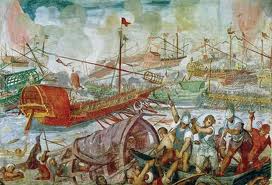
The Naval Battle of Actium, 31 BC

The Tenth Legion Fretensis fought across the ships at Actium

It consolidated this name in the naval Battle of Actium in 31 BC, when Octavian’s ships grappled the ships of Antony and Cleopatra, and the Tenth Legion was able to fight across from ship to ship. Antony and Cleopatra committed suicide, and Octavian became Caesar Augustus.

Roman Standards of Wolf and Boar

The Tenth Fretensis was stationed in and around Judea for over 400 years, at Damascus, Caesarea and latterly Aqaba. It was involved in the suppression of the ongoing Jewish insurrection against the Roman occupation, including:

  • the defeat of Judas of Galilee and the crucifixion of 2,000 rebels at Sepphoris (Zippori), four miles from Nazareth, in 6 AD
  • the siege of Jerusalem in the Great Revolt of 66-73 AD, the looting and destruction of the Temple, and the capture of Masada
  • the suppression of the Bar Kokhba Revolt in 132-135 AD, with the destruction of Jerusalem, and the enslavement, deportation and banishment of all Jews from Judea.

That other minor (but well-known) incident in the mid-30s, ending with the crucifixion of Jesus of Nazareth and two Zealot ringleaders, was trivial compared with what the Legion had to deal with a lot of the time. But that incident, of course, is the focal point of my novel “The Gospel According to the Romans”.

Roman detachment with Standards

The Tenth’s symbols were the Bull, the Ship and the Boar. The Bull, Taurus, may be from its being created sometime between April 20 and May 20 – but it certainly made an easy connection with the Mithraic religion that was spreading into the Empire from the East. The Boar was, in itself, a source of conflict with the Jewish inhabitants throughout the region – they didn’t like to see foreign troops in any case, but for them to parade around under the graven image of a pig was an extreme insult.

“Who is my Neighbor?” The Good Samaritan

Let’s assume that, as in the previous two blog posts, Jesus told his followers to obey the Shema (“Hear, O Israel…” Deuteronomy 6:4-9) and treat all “the children of thy people” well and “love thy neighbour as thyself” (Leviticus 19:18).

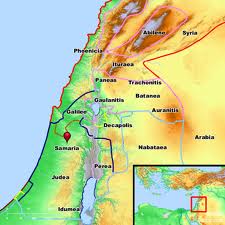
One question that arose was, Who is my neighbor? The uncertain boundary for Jesus appears to be the Samaritans – followers of a slightly different version of Mosaic Law, and without loyalties to Jerusalem or its Temple. Not Jews exactly, but almost… and living in the Jewish heartland, halfway between Jerusalem and Galilee, so that Jews and Samaritans inevitably went through each other’s territories.

Samaria, the region halfway between Galilee in the north and Jerusalem in the south

Although the Samaritans were not receptive to Jesus’ focus on the Temple at Jerusalem, he considered a charitable Samaritan to be closer to God than an uncharitable Jewish priest or Levite.

In some ways, the Samaritans appear to be in a very similar position to the Palestinians of today – monotheists, claiming descent from Abraham, respecting the Torah but following slightly different traditions, with their own non-Jewish holy sites, and with a historical right to live where they live, regardless of what Jewish fanatics think.

And in fact, some of the Palestinians of today are Samaritans. Some 700 live at Mount Gerizim and in Tel Aviv.

Mount Gerizem, West Bank, April 19, 2008. Samaritans gather around fire pits as sacrificed sheep smolder during a ritual of Passover, the annual Jewish holiday marking the liberation of Hebrews from slavery in ancient Egypt.

Jesus’ Message, 2: “Love thy neighbour…”

Jesus is quoted as saying that the second most important commandment is “Thou shalt love thy neighbour as thyself”. This may be accurate, but not the whole story.

Because the phrase isn’t among the Ten Commandments, many Christians have the impression that it’s a Jesus original, expressing love towards the whole world. When you see it in its original context, though, it has a slightly different message. Jesus was quoting Leviticus 19:18 –

“Thou shalt not avenge, nor bear any grudge against the children of thy people, but thou shalt love thy neighbour as thyself: I am the Lord.”

Love thy neighbour - Leviticus 19:18

The commandment is for Jews to love their fellow Jews. It says nothing about loving gentiles. It certainly says nothing about loving the idolatrous pig-eating beard-shaving military occupation forces, no matter how St. Paul would later try to twist the teachings of Jesus to fit his own pro-Roman agenda.

Taken together, the two greatest commandments say “Think of and obey the God of Israel constantly, and look after your fellow Jews”.

Jesus was not preaching a universal message.