The Meanest Miracle – Cursing the Fig Tree

This is Jesus’ stupidest and most mean-spirited miracle, as reported in the gospels. Here’s the story:

He’s walking the four miles from Bethany to Jerusalem just before Passover (March/April). Here’s Mark: “Jesus was hungry. Seeing in the distance a fig tree in leaf, he went to find out if it had any fruit. (Ooh, look, a bonus! Proof that Jesus isn’t omniscient, and therefore isn’t God!) When he reached it, he found nothing but leaves, because it was not the season for figs. Then he said to the tree, “May no one ever eat fruit from you again.” And his disciples heard him say it. The next morning, as they went along, they saw the fig tree withered from the roots.”

Jesus curses a fig tree, and unwittingly sets up a joke.

So, he’s not omniscient, and he’s petty, and he’s vindictive, and he’s also not very bright – because in the spring there would be leaves but no fruit yet. So he curses it, and the next day it’s completely withered.

What’s the point? Christian apologists tie themselves in knots saying that he did it to symbolize that the Jewish religion, though outwardly in full leaf, is not productive and is destined to die from Jesus’ update to True Religion. But Jesus didn’t say anything about that. When the disciples said “Oh, wow!” he just told them that if they had unwavering faith that yonder mountain could be thrown into the sea, it would happen. (If any of them tried, it didn’t work.) The apologists draw their message out of thin air. They also don’t address Jesus’ hunger, ignorance, anger or stupidity.

It’s a typical Jesus miracle in these aspects:

1) It could be faked – all you have to do is have your friend Lazarus (living in Bethany) come by that evening and pull all the leaves off, and next day the disciples would be fooled into thinking that the tree had withered at Jesus’ command.

2) It’s not the sort of beneficial and glorious thing that you would have chosen if you were writing a story about a real miracle-worker. In that case, you would have Jesus bless the tree instead of curse it, and within 60 seconds it would have fruited and produced enough delicious out-of-season ripe figs to make everyone happy. (And then the apologists would say that he showed how the Jewish religion could be transformed by his blessing into something productive, etc etc.)

Somehow it’s always like that. He heals someone who says they’re lame, or blind, or suffering from devils… but does he ever regrow an amputated limb? Ha! He can restore to life a friend who says he was dead… but what about his spiritual teacher, the man who baptized him, John the Baptist? Why didn’t he put John’s head back on his shoulders, and restore him to life?

Jesus’ miracles are always street magic, designed to engage the audience while he preaches his message of repentance and the return to God… and, probably, while his followers collect contributions for the Zealot uprising.
What kind of “new religion”? Mormons and Christians

Religions never spring to life fully-formed and without any connection to the religious and cultural ideas around them. (Scientology is the nearest to an exception I can think of, but it claims not to be a religion. It is heavily indebted to 1950s science fiction, anyway.)

Sometimes a “new religion” is like the Lutherans, more of a family squabble about reform than a whole new religion. “The Bible should be translated into the local language so everyone can read it.” “No, it should stay in Latin, because we’re Romans, remember?” And so on.

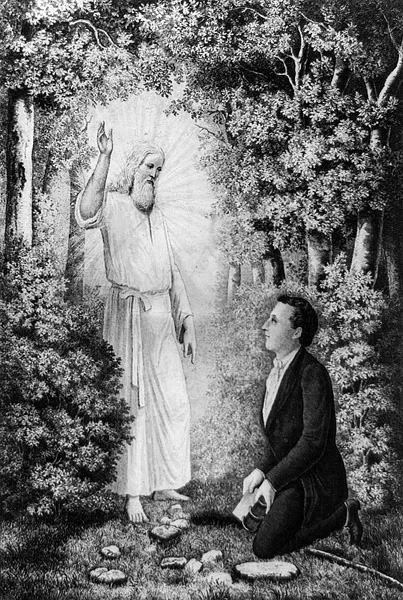
The angel "Moroni" giving Joseph Smith the "golden plates" in "Reformed Egyptian"

But sometimes you get a kid with a streak of the con artist, writing screeds of bad fantasy in an imitative style…

Joseph Smith’s impoverished farming parents tried to make extra money by treasure-digging, and the teenage Joseph claimed he could use “seer stones” for this. He would put a special stone in a white stovepipe hat, and then see the information he needed in the reflections inside the hat. (At age 20 he was tried in New York state on the charge of “glass-looking,” or pretending to find lost treasure.)

In his teens he claimed to have been visited at night by an angel named Moroni, who revealed the location of a buried book of golden plates as well as other artifacts, including a breastplate and a set of silver spectacles with lenses composed of seer stones, which had been hidden in a hill near his home.  Smith said he attempted to remove the plates the next morning but was unsuccessful because the angel prevented him.

A couple of years later he got hold of the golden plates, which the angel told him not to show to anyone, but to translate from the “Reformed Egyptian” and publish. They told the story of the Lost Tribes of Israel coming to North America and having all sorts of pseudo-Biblical events in pseudo-Biblical language, full of anachronisms like elephants, steel and silk; and then of Jesus appearing to these North Americans and essentially preparing for Americans (at least the believing ones) to be God’s Chosen People.

He subsequently translated other pages of Egyptian hieroglyphics (which no one else could in the 1840s) and determined that they were all about sacrifices and God and Abraham and so on. Unfortunately the pages have since resurfaced, and real translation shows them to be about embalming and funerary rites and Osiris. There is a Christian critique of the issue here.

So this “new religion” is not a simple reform like Lutheranism. This is one individual’s fantasy, springboarding off the Bible into whatever sounds good and will win converts. It’s not surprising that regular Christian sects don’t have much use for Mormonism – and that’s even before we get into Joseph Smith’s 34 wives, and the issue of everybody being able to evolve through several Heavens into becoming a God of their own planet, and all that jazz.

The irony is that from the point of view of Judaism, Jesus looks like a kind of argumentative reformist Luther… but St Paul’s Christianity, the Christianity that we have today, looks a hell of a lot more like Joseph Smith’s made-up Mormonism.

Would even the Romans have had 2000 pigs?

This question was asked by Greta van der Rol, an Australian writer of historical fiction (“To Die a Dry Death”) and science fiction (the “Iron Admiral” books).

When the Romans had permanent bases, they used their soldiers as builders: roads, farms, towns, aqueducts.

“When on station, the soldiers (…) always maintained a herd of cattle, sometimes herding other animals such as sheep and goats, grew grain and other crops, including vegetables, and foraged for variety.” (http://romanmilitary.net/people/food)

A Legion of 8,000 men engaged in hard labor ate a lot.

“It is estimated that just the soldiers in Britain ate over 33.5 tons of grain a day.”

Plus they liked pork and bacon!

“A soldier always marched with at least a good supply of bacon, hard tack biscuits, and sour wine.”

For hundreds of years the Romans had a Legion (or more) stationed in Palestine. They were there permanently, not on some hit-and-run Panda operation (“eats shoots and leaves”). Undoubtedly they had their own farms – and Romans did things on a very large and impressive scale. Shipping that much food around would have been foolishly expensive and inefficient, even if you had as good a port as Sebaste, built by Herod the Great at Caesarea Maritima. 

Sebaste Harbor at Caesarea Maritima

And the food would still have to been farmed somewhere.

That said, the story of the Gadarene Swine in the three Synoptic Gospels was written down a generation after Jesus’ execution, by people who had heard it from other people who in turn remembered it a little differently, with added elements of bravado (from the Zealots) and exaggeration (from the fishermen) and deliberate obfuscation (from the pro-Roman Paul).

Pigs would be a prime target for Zealots, as pigs should not have been farmed and eaten in Israel. And it would have been almost impossible not to give the Romans the nickname “pigs” – big ugly grunting unclean creatures, pig-eating and marching around under their Legion’s boar standard.

And, accurate or not, the number of 2,000 may have been a deliberate echo of the number of Jews crucified four miles from Nazareth during Jesus’ childhood, when “the Roman pigs” suppressed the uprising by Judas of Galilee.

Where were the Gadarene Swine?

The Gadarene Swine slaughter took place in the countryside around Gadara. This was one of the semi-autonomous Ten Cities (the Decapolis), in the Roman-controlled area mostly east of the River Jordan. Gadara was almost certainly at the place now called Umm Qais.

Gadara (Umm Qais), with the Sea of Galilee and, right, the Golan Heights

In the panorama we have Umm Qais in the foreground, the Sea of Galilee in the background, and the Golan Heights on the right. The gospels say that the pigs rushed over the cliff into the sea and were killed. It is not possible today to find a location on the east of the Sea of Galilee where such a fall is possible – there is a margin of flat land between the Sea and the Golan Heights, and the heights of Umm Qais are even further away.

One possibility is that the lake level may have been higher. But more likely the lake that the pigs fell into wasn’t the Sea of Galilee, but some other lake in the area.

The southern end of the Golan Heights is near vertical in places – you can see the road switchbacking down in the photo. Driving down it you will pass wrecked vehicles suspended halfway in the vertical ravines beside you. And at the bottom is a small lake.

So I suggest that the south end of the Golan Heights is the place where a herd of 2,000 pigs were kept for the Legio X Fretensis, and that Jesus and his followers chased them over the cliffs that are just to the left of that zigzag road in the picture. There may be other equally steep cliffs on the ridge of Umm Qais itself – but maybe you don’t want to have that many pigs on your doorstep. They’d be perfectly safe just across the valley, wouldn’t they? Unless some Jew came along with a chip on his shoulder about pigs and Romans…

Unasked questions: Who owned 2,000 pigs?

The oddest story in the Gospels is surely the one about the Gadarene Swine. It is so odd that many Christians don’t know it, and of those who do, many think is a parable. But it isn’t. Slightly different versions of the story (of course) are found in Matthew 8, Mark 5, and Luke 8.

Jesus killing 2,000 pigs

Jesus is in the countryside going toward Gadara (east of the River Jordan). A madman comes out of some tombs. He says his name is Legion, because he has many devils in him. Jesus commands the devils to leave him. The devils ask to go into some other being, so as not to go back to the abyss of hell. Jesus kindly sends them into a nearby herd of pigs. The 2,000 pigs rush over a cliff into the sea and are killed while the swineherds run away. The madman is cured. Jesus and whoever was with him carry on to Gadara. People come from Gadara, upset with Jesus, and tell him he isn’t welcome there. Jesus goes somewhere else, telling the healed man to talk about what he has seen.

So who would have owned 2,000 pigs? A Jew? No.

A non-Jewish farmer, maybe a Greek immigrant with a cow and an acre of land? Of course not.

Or is the answer in the madman’s name, Legion? It’s a part of the Roman Legion’s food supply, then.

In “The Gospel According to the Romans” this event is a strike by Jesus against the Romans occupying the Holy Land. A Zealot action against our friends the Legio X Fretensis. I can’t think of a more plausible interpretation.

And we have a deliberately garbled version of the story in the gospels, because the story was too well-known to be ignored. Paul’s pro-Roman revisionism did its best to disguise it.

So forget “Jesus meek and mild”. You may have seen pictures of Jesus tenderly holding a little lamb, but have you ever seen him cuddling a piglet?

Magical thinking and Jesus

Context. Without context, a star can hover over a house, because that’s the way our creative understanding works. In the context of astrophysics, that star idea is nonsensical. Without context, Jesus was a Christian and the Jews hated him. In the context of his time and place, there were no Christians. He lived in the middle of an area occupied by pig-eating, beard-shaving, idolatrous Westerners. He lived in the middle of 200 years of constant uprisings by religious fundamentalists. Reading his words in context, it is obvious that he was a Jew, he hated the Romans, most Jews loved him, and Romans hated him.

Paul's legacy: nonsensical magical thinking

The genius of Paul was in seeing that by removing context and putting everything into the mythic realm, a universal religion could be created that wasn’t tied to the foibles of its anointed fountainhead. In this case, by decontextualizing Jesus, he became no longer a Jew (John says things like “Therefore the Jews sought the more to kill him” – John 5: 18). He became no longer an adversary of Rome, no longer a Zealot, no longer gay… he becomes instead a mythic god, independent of the realities of history, independent of the laws of the universe. “Magic Jesus“, in the song by Tim Minchin.

Whether Paul understood this consciously and deliberately planned it, or whether he believed the visions from his own epileptic seizures, we may never know. But Paul is the creator of the post-Jewish “Christianity”.

The Gospels are written in an episodic way, highlighting some aspects of Jesus’ teachings, camouflaging other uncomfortable aspects, turning Jesus’ Jewishness upside down to make him more acceptable to Roman listeners and the Roman Empire, blending him with Mithras and Apollo. The Gospels swaddle him in miracles not just “from birth to death”, not even just “from womb to tomb”, but, in words originating in another context, “from the erection to the resurrection”. The very bookends of his life are so unbelievable that many people nowadays suspect he never existed at all.

So Jesus becomes a myth, a spiritual reality, an archetype. Like others before him in the preliterate world, he attains godhood. The historical person didn’t, of course – the historical person is dead and buried. But the story lives and grows and transmutes, constantly evolving to resonate more deeply with more people. All this is natural, inherent in human tendencies, and can be very useful for personal growth…

But magical thinking is a lousy basis for government policy decisions. Especially regarding the science curriculum for schools and universities.

Magical thinking and the Star of Bethlehem

The trouble with the Star of Bethlehem story is that stars are not what they appear to be to children and the uneducated. Yes, they look like fireflies or distant candles, and therefore can be imagined to float through the air like glowing fairies to hover over a house and point it out as special. Maybe they can think. Talk. Smile.

A star. (Note: not entirely credible, scientifically...)

However, being a minimum of 25,000 times the mass of our planet, this isn’t something that they can actually do. They only look like fireflies because they’re trillions of miles away. They’re pretty big, really.

Humans are designed for pattern recognition, and to seek out cause and effect, and to think visually, and to construct explanatory narratives and stories. “Sing me a song! Tell me a story! Read me a book!” A simple story is the most effective way to communicate an abstract concept – that’s why Jesus told parables. But this excellent intellectual tool of ours also has a downside: when our perception is limited or our understanding is incomplete, we use imagination to fill the gap. And our imagination springs from the dream world, not the physical world.

So we have no difficulty with the idea of Santa visiting all the world’s children in a single night. Or with the idea that, if we just get into the right frame of mind, we will be able to hear speech (in our own language!) from animals and trees. Or that we could walk around on the clouds if we could jump up there. Or that when people and animals die and get buried they are still around, you can still see them and talk with them under the right conditions. Or that we can influence the future with a rhyme or a ritual, control dice with a thought or a wish, produce rain by prayer…

We are born with that magical view of the world. It is very effective in keeping us optimistic, healthy, social and creative. Internally, it works. But externally? Sadly deficient.

Enjoy the stories that resonate with you, think about the images that feel powerful, give thanks (to the power of evolution) for the songs and landscapes that you love… but don’t conflate internal emotional power with external physical reality. Carlos Castaneda never turned into a crow, no matter how much peyote he consumed. There is no Easter Bunny. Nor angels, nor talking snakes, nor people ascending up in the air to live in “heaven”.

And regardless of how vivid your imagination is, nothing that has 25,000 times the mass of the Earth is going to hover over a house. Not in the real world. Sorry.

Unasked questions: How big was the Star of Bethlehem?

The story of the Wise Men following the star is in Matthew 2: 9 “When they had heard the king, they departed; and, lo, the star, which they saw in the east, went before them, till it came and stood over where the young child was.”

It led them, and stopped over where Jesus was.

Obviously, this star was very close to the Earth. Maybe as high as a modern skyscraper over the place Jesus was. Say 1,000 feet. If it was as far away as the Moon, it wouldn’t be leading them and then stopping over where Jesus was. It was a lot closer than the Sun is. A lot closer than the next star, which is 25,277,000,000,000 miles away (4.3 light years, yes, that’s over 25 trillion miles).

Here’s the problem: the smallest that a star can be is 80 times the size of Jupiter, and Jupiter is over 300 times the mass of the Earth. Smaller than that, and the object can’t undergo nuclear fusion. So, to be a star, it has to be at least 25,000 times as massive as the Earth, and even then it would only be a red dwarf. If you want a white star, it has to be 10 times larger still.

Unfortunately, if anything that size came anywhere near the Earth, our planet would be dragged right into it and disappear like a pebble tossed into a pond.

So either the story of “the star leading them, and then stopping over the house” is complete nonsense, or else you have to say “It wasn’t what we would call a star today – it was a light which they thought was a star, because they didn’t have our modern understanding.” Fine. And by the same reasoning you can say “The Burning Bush with the voice of God wasn’t actually a burning bush with the voice of God, it was a phenomenon that Moses didn’t understand and thought was a burning bush with the voice of God… and the vision of Jesus that Paul had wasn’t really a vision of Jesus, he just thought it was Jesus… and the thing called God all through the Bible isn’t really God, it’s just a series of experiences and phenomena that pre-scientific peoples thought was God, because they didn’t have out modern understanding.”

Congratulations, and welcome to the real world! You are now free of religion. Go in peace.

What the Romans knew of the Universe

We think, with some justification, of the Greeks as thinkers and the Romans as doers. This doesn’t mean the Romans were ignorant. They commonly used Greek slaves as teachers for their children, and Greek learning was known to educated people throughout the Roman Empire – partly because the Greeks themselves lived throughout the Empire. The Ptolemys ruling Egypt, who included Cleopatra, were Greeks.

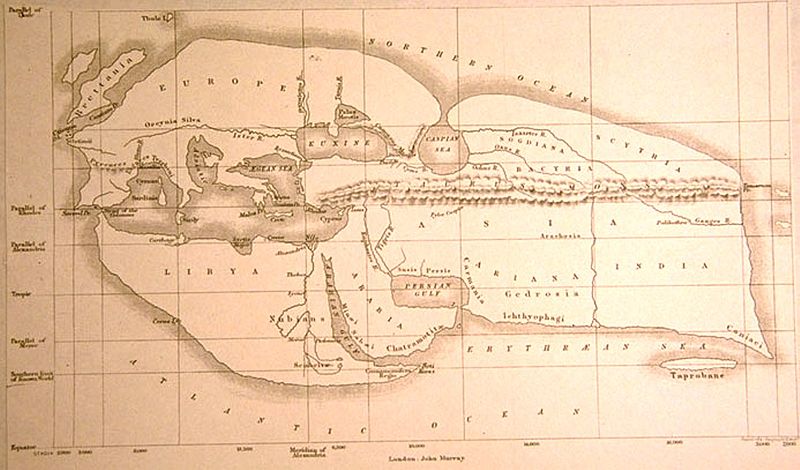
Reconstruction of Eratosthenes' map of the world

According to the history books, it was the Greeks who first suggested that our earth is a sphere. Aristotle argued this in On the Heavens around 340 BC. First, you always see the sails of a ship coming over the horizon first and only later its hull, which suggests that the surface of the ocean is curved. Second, he realized that the eclipses of the Moon were caused by the Earth casting its shadow on the moon. Third, the Greeks knew that the North Star appears higher on the northern firmament and lower in the south. Aristotle explained this correctly with the parallactic shift that occurs when moving between two observation points on a spherical object. Separately, the idea that the sun rather than the earth was the center of the universe was proposed by the Pythagoreans and by Aristarchus of Samos around 270 BC. (However, Aristotle dismissed the idea of this heliocentrism.)

Around 240 BC Eratosthenes (Libyan-born, living in Alexandria in Egypt) calculated the circumference of the earth; he knew that the sun was directly overhead at Aswan on the summer solstice; he observed from the shadow of a vertical pole that on that day the sun was a fraction over 7 degrees off from vertical in Alexandria (almost due north of Aswan); and, from generations of Pharaonic surveyors, he knew the distance between the two places: 5,000 stadia. He gave the earth’s circumference as 252,000 stadia. Depending on whether he meant the standard Greek stadium or the Egyptian stadium, he was accurate to within either 16% or 2% of the earth as it is.

He also calculated the distances to the moon and to the sun, and was reasonably correct about the moon (and possibly extremely accurate about the sun). Having created the armillary sphere when he was 20, and originated the term “geography”, and created a useful map of the known world, he still had time to be an athlete and a poet.

Uneducated people 250 years later in Palestine thought that a bright star had moved across the sky and stayed over the house in Bethlehem where a certain child was born. For them, the heavens were the physical abode of God and his messengers, a mile or two above the earth, up in the clouds with the sun, moon and stars.

Well-educated Greeks and Romans were beyond such nonsense.

The Miracles, 4: Lazarus

When Jesus was heading to Jerusalem for Passover (because he was a Jew, remember?) he got word that his close friend Lazarus is very sick. Instead of making the one-day walk to Lazarus, he waits where he is for a couple of days, telling the disciples that Lazarus will die so that he can be resurrected to demonstrate God’s glory. Jesus has already been prophesying that people will see a “son of man” raised from the dead after three days. Now’s clearly the time for it.

Classic Mummy

Jesus shows up, finally. Yes, Lazarus has been dead for three or four days. Lazarus’ sisters Martha and Mary meet Jesus at the graveyard, there are a lot of other people there too, and Jesus has the tomb opened and calls Lazarus, who stumbles out stinking and wrapped in grave-clothes. “Many believed,” says John’s Gospel. Therefore clearly many, perhaps most, did not believe.

Why not?

Too easy to fake.

Why didn’t Jesus come earlier, except to show off what he could do?

If he could raise people from the dead, why didn’t he do it more often… and not for a close friend where there would be doubts about the veracity of it?

And Lazarus walked out of the tomb. Seriously, no one wraps a body for real like they do for horror movies. In real life you wrap the legs together, just as you wrap the arms to the body. Unless you want the body to be able to walk!

It was a bogus ‘miracle’, and not even good enough to fool all the onlookers.