BC and AD… BCE and CE… AUC and AM…

Historically, people created a fresh calendar after a significant event. Sometimes that was the coronation of a new king, and everything was counted as “in the tenth year of King Henry’s reign” and so on.
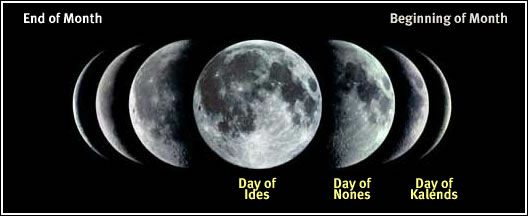
The Roman calendar was originally structured on the phases of the moon.

The Romans used AUC (“Ab Urbe Condita”, From the Founding of the City), dating everything from the founding of Rome in 753 BC. Note: not necessarily historically accurate.

Many Jews still use AM (“Anno Mundi”, In the Year of the World), dating everything from 1 Tishrei 1 AM, or Monday, 7 October 3761 BC… which is about a year before the creation of time and space on the Jewish traditional date of Creation, 25 Elul AM 1. Try to figure that one out!

The Jewish calendar's reference point is traditionally held to be about one year before the Creation of the world.

There are two problems with the standard calendar terms BC and AD, “Before Christ” and “Anno Domini – In the year of the Lord”.

The first is that many non-Christians object to referring to Jesus as either the Christ or the Lord, and aren’t impressed with using his birth as the basis for a global calendar.

The second is that Jesus was not born at midnight between 1 BC and 1 AD. Under our calendar, he was probably born in the spring of 6 BC, rendering the BC and AD terms ludicrous. Our calendar is now so thoroughly established, however, that it is easier to rename than to renumber. So now people are starting to write about our Common Era (CE) and, before that, Before Current Era (BCE).

Of course, we could just keep the initials BC and AD, and rethink the meaning of them to, say, “Before Current” and “After Dat”. I mean, really, who cares?
“Who is my Neighbor?” The Good Samaritan

Let’s assume that, as in the previous two blog posts, Jesus told his followers to obey the Shema (“Hear, O Israel…” Deuteronomy 6:4-9) and treat all “the children of thy people” well and “love thy neighbour as thyself” (Leviticus 19:18).

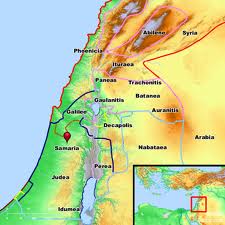
One question that arose was, Who is my neighbor? The uncertain boundary for Jesus appears to be the Samaritans – followers of a slightly different version of Mosaic Law, and without loyalties to Jerusalem or its Temple. Not Jews exactly, but almost… and living in the Jewish heartland, halfway between Jerusalem and Galilee, so that Jews and Samaritans inevitably went through each other’s territories.

Samaria, the region halfway between Galilee in the north and Jerusalem in the south

Although the Samaritans were not receptive to Jesus’ focus on the Temple at Jerusalem, he considered a charitable Samaritan to be closer to God than an uncharitable Jewish priest or Levite.

In some ways, the Samaritans appear to be in a very similar position to the Palestinians of today – monotheists, claiming descent from Abraham, respecting the Torah but following slightly different traditions, with their own non-Jewish holy sites, and with a historical right to live where they live, regardless of what Jewish fanatics think.

And in fact, some of the Palestinians of today are Samaritans. Some 700 live at Mount Gerizim and in Tel Aviv.

Mount Gerizem, West Bank, April 19, 2008. Samaritans gather around fire pits as sacrificed sheep smolder during a ritual of Passover, the annual Jewish holiday marking the liberation of Hebrews from slavery in ancient Egypt.

Jesus’ Message, 2: “Love thy neighbour…”

Jesus is quoted as saying that the second most important commandment is “Thou shalt love thy neighbour as thyself”. This may be accurate, but not the whole story.

Because the phrase isn’t among the Ten Commandments, many Christians have the impression that it’s a Jesus original, expressing love towards the whole world. When you see it in its original context, though, it has a slightly different message. Jesus was quoting Leviticus 19:18 –

“Thou shalt not avenge, nor bear any grudge against the children of thy people, but thou shalt love thy neighbour as thyself: I am the Lord.”

Love thy neighbour - Leviticus 19:18

The commandment is for Jews to love their fellow Jews. It says nothing about loving gentiles. It certainly says nothing about loving the idolatrous pig-eating beard-shaving military occupation forces, no matter how St. Paul would later try to twist the teachings of Jesus to fit his own pro-Roman agenda.

Taken together, the two greatest commandments say “Think of and obey the God of Israel constantly, and look after your fellow Jews”.

Jesus was not preaching a universal message.

Jesus’ Message, 1: “Hear, O Israel -“

Jews traditionally identify 613 commandments from God in the Torah, from the initial commands to Adam and Eve to “Be fruitful, and multiply, and replenish the earth, and subdue it”, through “Thou shalt not kill”, to the requirement that the congregation stone a blasphemer to death. No wonder that it is claimed that no one has ever been able to keep all 613 commandments!

When Jesus was asked which of the commandments was the most important he said “The first of all the commandments is, Hear, O Israel; The Lord our God is one Lord: And thou shalt love the Lord thy God with all thy heart, and with all thy soul, and with all thy mind, and with all thy strength: this is the first commandment. And the second is like, namely this, Thou shalt love thy neighbour as thyself. There is none other commandment greater than these.”

Because these two sound so much more forceful and defined than the Ten Commandments, people brought up in the Christian tradition assume they are Jesus’ original developments to monotheism.

Yet for the first one, Jesus is merely affirming his Jewishness. He is quoting the fundamental prayer of Judaism:

“Hear, O Israel: The Lord our God is one Lord: And thou shalt love the Lord thy God with all thine heart, and with all thy soul, and with all thy might. And these words, which I command thee this day, shall be in thine heart: And thou shalt teach them diligently unto thy children, and shalt talk of them when thou sittest in thine house, and when thou walkest by the way, and when thou liest down, and when thou risest up. And thou shalt bind them for a sign upon thine hand, and they shall be as frontlets between thine eyes. And thou shalt write them upon the posts of thine house, and upon thy gates.”

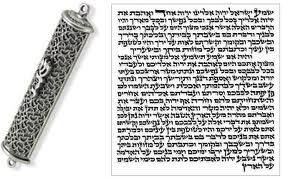
A Mezuzah for holding the text of the Shema, Deuteronomy 6:4-9

For its opening words, this is known as the Shema Yisrael (or just the Shema). It is the most important prayer, recited twice daily by observant Jews, taught to children to recite before sleep, attempted as the last words of the dying.

When you enter the home of an observant Jew you will notice a small container, a couple of inches long, fixed to the door frame. This is a mezuzah, containing the Shema.

For Jesus, as for any observant Jew, it was the single most important commandment from God.

Who were the Zealots?

The Zealots were the armed resistance to the Roman occupation of Israel, and caused uprisings throughout a 200 year period. They terrorized collaborators, assassinated leaders, robbed caravans and killed legionaries whenever they could, operating as urban and rural guerrillas with their trademark curved dagger, the sica. They were sicariots, dagger men.

Zealots - robbers, or freedom fighters?

The Romans called them sicariots, robbers, thieves and brigands. But they would hardly call them heroes, patriots and freedom fighters, would they?

Once a generation or so a Zealot leader would arise who would lead a full-scale revolt – capture a city, massacre gentiles, loot arms and treasure, and finally be crushed when the Romans sent in a couple of Legions.

In 6 CE when Jesus was about 12, Judas of Galilee captured Sepphoris (or Zippori), the capital of Galilee only four miles from Nazareth. The Romans defeated his ragtag forces and crucified 2,000 of them. (Jesus’ father Joseph is not heard of after that event.)

After Jesus led his unsuccessful uprising in the Temple at Jerusalem, he was caught and crucified between two “thieves”. Neither theft nor blasphemy was punished with crucifixion; only rebellion was. When the Romans labeled Jesus “King of the Jews” they were echoing his claim from his ride into Jerusalem on his donkey, and clarifying why they were crucifying him. The two “thieves” were also important enough to be crucified.

A fourth was arrested and released: Barabbas, identified as “a robber”. “Bar-abbas” is a strange name – it means “son of a father”, “son of his father”, or “Son of the Father”. He was a Zealot, anyway. In “The Gospel According to the Romans” I suggest a couple of different reasons for his release.

The Zealots were active for another 100 years, until the final destruction of Jerusalem in the Bar Kokhba Revolt.

The End of the World (again)

There is something truly fascinating about the human desire for the end of the world. To believe you can predict it from the ravings of religious mystics a couple of thousand years ago… well, you have to live in such a mythic, pre-scientific world.

Judgment Day, May 21, 2011... or maybe 21 October 2011... oh what the hell.

And not only that – why do we want to believe in it? Is it that we love the shivers of future horrors? Is it that we feel we are powerless, and our idea of suicide is to bring everything down with us? Or is it a desire for justice, and laziness on our part so that we will just rely on divine forces instead of working for justice ourselves?

I wouldn’t even be on this rant if it wasn’t for the fact that yet another would-be End-of-the-world prophet has been tripping over bizarre calculations from tribal myths originating with a different people on the other side of the world some thousands of years ago, figuring that – that – that Jesus came back from the dead two thousand years ago – physically went up to some place called Heaven above the earth – has been hanging around ever since – is coming back down again…

And there are millions – maybe billions – of people who believe this stuff, or stuff very similar in their own religions…

Enjoy the day, folks!

Jewish Uprisings against the Romans – after Jesus

Some time in the 30s CE, Jesus of Nazareth attempted to – at the very least – cleanse the Temple in advance of Passover, having entered Jerusalem as a Messianic claimant and would-be King. He was caught and crucified together with two Zealot leaders.

In 36 a Taheb, or Samaritan Messiah, and his followers were massacred by Pilate. Pilate was sent to Rome for trial for excessive brutality, but we don’t know the outcome.

About 45 CE, Theudas claimed to be the Messiah and raised an army of 400 men; they were slaughtered and Theudas was beheaded.

About 47 CE, Judas of Galilee’s sons Jacob and Simon were arrested and crucified by the Romans.

In the 50s, 400 followers of the Egyptian Prophet were massacred by the Romans though the Prophet himself escaped and disappeared.

The Great Revolt began in 67 with Menahem – another son of Judas of Galilee – breaking into the armory at Masada and arming the Zealots, then entering Jerusalem as King and executing the High Priest. Vespasian laid siege to Jerusalem in 68, and his son Titus captured it and looted and destroyed the Temple in 70.

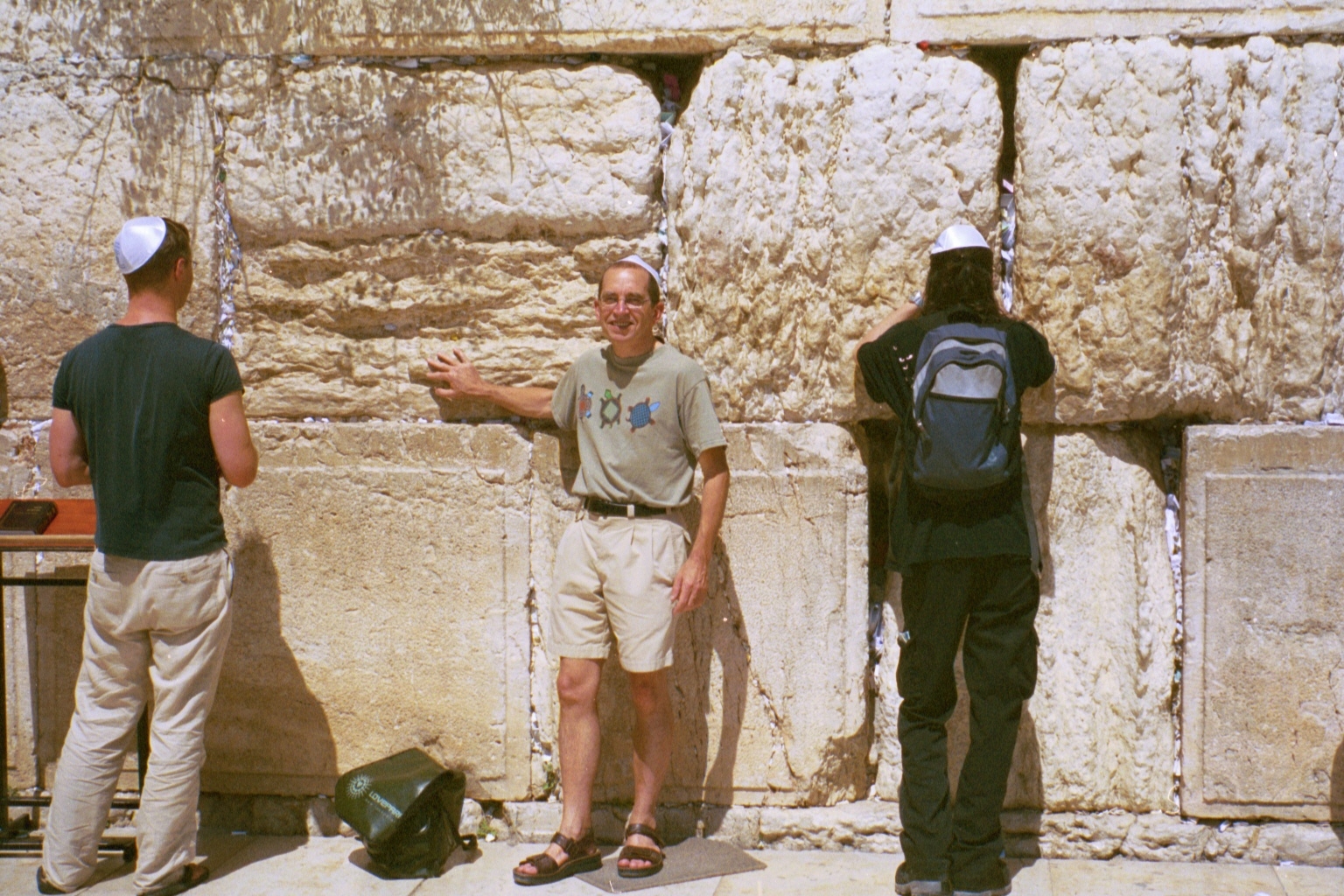
All that has been left of the Temple since 70 CE: the foundations of the Western Wall

It took the Romans a further three years to mop up the province, culminating in the capture of Masada in 73.

The Kitos War of 117 began with a massacre – this time by the Jews, of Greeks and Romans in Libya – and spread to Egypt, Cyprus and Palestine.

In the culmination of 200 years of uprisings, the Bar Kokhba Revolt saw Simon bar-Kokhba and Rabbi Akiva take control of Judea in 132 CE, with 200,000 Zealots. The Romans sent 12 Legions to retake and sack Jerusalem. 580,000 Jews were killed. Jerusalem was plowed under, the new city of Aelia Capitolina built on the site, and Judea was renamed Syria Palestine. The remaining Jews were enslaved, dispersed, and barred from Jerusalem.

Jewish Uprisings against the Romans – before Jesus

During a Jewish civil war in 63 BCE, one side paid Romans under the command of Pompey eight tons of silver and nearly a ton of gold to intervene. The Romans gradually annexed Hellenized areas like Syria, Samaria and the Decapolis, leaving Judea and Galilee as a client kingdom. Galilee, being wild and hilly, was a natural center of Jewish religious and military resistance against the idolatrous, pig-eating Westerners. Its 25-year-old governor, Herod, captured and executed the leader of the resistance, Hezekiah.

Herod was created king of Judea by Mark Antony and Octavian (later Caesar Augustus), and he kept order through ruthless suppression of dissent, including the murder of his favorite wife and several other family members. When he died in 4 BCE, at least three Messianic uprisings broke out simultaneously, led by Judas the son of Hezekiah, and Simon of Perea, and Athronges the Shepherd. Judas captured the palace at Sepphoris and looted it of weapons and treasure; he was defeated by the Romans, but escaped. Simon burned down the palace at Jericho and looted what was left; he was defeated, caught and decapitated. Athronges had some success against the Romans, and it took two years to crush his forces; we don’t know what happened to him.

The Temple in Jerusalem. Romans used the Antonia Fortress at left

In 6 CE Judas of Galilee captured and looted Sepphoris; the Romans defeated his army of Zealots and crucified 2,000 of them. Judas was thrown into the sea with a millstone round his neck. It is not certain this Judas is the son of Hezekiah – in ‘The Gospel According to the Romans’ I assume it is.

This disastrous failure of an uprising happened when Jesus of Nazareth was 12, and had been to the Temple in Jerusalem with Joseph and Mary. Nazareth is only 4 miles from Sepphoris. We don’t hear anything about Joseph after this, and we don’t know what Jesus did for the next couple of decades. Regardless of Jesus’ or Joseph’s involvement in the rebellion, these were major and catastrophic events in Jesus’ formative years.

The Four Philosophies

Judaism in the time of Jesus was monotheistic, but not monolithic. Josephus famously divided Jewish thought in four: Sadducees, Pharisees, Essenes and “the fourth philosophy”. They all awaited the Messiah, or Anointed One, a leader anointed by God who would reunite the Jewish tribes and, perhaps, rule them as King of Israel directly descended from David. How the Messiah would appear – born as a child, or descending from Heaven – was not certain. (But he would be a man, not a God or some Son of God.)

Sadducees - the pro-Roman philosophy under the Occupation

The Sadducees did not believe in a resurrection. With no real sense of an afterlife, let alone a Day of Judgment, they were inclined toward what was presently available. They were comfortable working with (or for) the Romans, and therefore were the religious and political ruling class among Jews.

The Pharisees believed that, God being just, all people would have to be resurrected so that they could be appropriately rewarded. This sentiment was more attractive to the lower classes than to the rulers, and the Pharisees were stricter than the Sadducees about social justice, adherence to the Law and not collaborating with the Romans.

The Essenes sought purity by withdrawing from everything to do with the Roman occupation – they didn’t like the idolatrous coins, let alone having to pay taxes, so they lived in isolated communities away from the cities.

And the Fourth Philosophy was that of the military resistance to the occupation: the Zealots. Heroes and patriots, or robbers and murderers, depending on your point of view, they led province-wide insurrections about once a generation for a period of 200 years – from the time the Romans occupied Palestine, until the Romans finally massacred, enslaved and deported almost the entire Jewish population.

The premise of the novel

The man we call Saint Matthew, being the tax collector “sitting at the receipt of custom” in Capernaum, is by definition a Roman agent appointed by Pontius Pilate. As such, he has the additional function of keeping an eye on the Zealots and other religious fanatics who head the insurgency against the Roman occupation. ‘Ragheads’, the Romans call them. After Jesus recruits Matthew to help purify Israel and overthrow the Romans – ‘Pigs’, the Jews call them –  Matthew continues to feed information to Pilate.

The local tax collector in Capernaum was - by definition - a Roman agent

Matthew himself tells the story. He is a Greek-speaking Jew, born and educated in Damascus, with a skeptical fascination for religion and politics. He is an irreligious opportunist and has friends on both sides in the conflict. He dines with the Roman military, spies for them, and wants Roman citizenship. But he also lives with Jesus, preaches for him, and falls in love with Mary of Bethany. Whichever way he turns he will cause the death of people he likes, and, in either camp, whoever suspects him will kill him.

By contextualizing the words and actions of Jesus within the Roman Occupation of Palestine and the repeated Jewish insurrections, a strangely modern picture emerges in ‘The Gospel According to the Romans’: a charismatic religious fundamentalist, opposing an occupying superpower.