Where were the Gadarene Swine?

The Gadarene Swine slaughter took place in the countryside around Gadara. This was one of the semi-autonomous Ten Cities (the Decapolis), in the Roman-controlled area mostly east of the River Jordan. Gadara was almost certainly at the place now called Umm Qais.

Gadara (Umm Qais), with the Sea of Galilee and, right, the Golan Heights

In the panorama we have Umm Qais in the foreground, the Sea of Galilee in the background, and the Golan Heights on the right. The gospels say that the pigs rushed over the cliff into the sea and were killed. It is not possible today to find a location on the east of the Sea of Galilee where such a fall is possible – there is a margin of flat land between the Sea and the Golan Heights, and the heights of Umm Qais are even further away.

One possibility is that the lake level may have been higher. But more likely the lake that the pigs fell into wasn’t the Sea of Galilee, but some other lake in the area.

The southern end of the Golan Heights is near vertical in places – you can see the road switchbacking down in the photo. Driving down it you will pass wrecked vehicles suspended halfway in the vertical ravines beside you. And at the bottom is a small lake.

So I suggest that the south end of the Golan Heights is the place where a herd of 2,000 pigs were kept for the Legio X Fretensis, and that Jesus and his followers chased them over the cliffs that are just to the left of that zigzag road in the picture. There may be other equally steep cliffs on the ridge of Umm Qais itself – but maybe you don’t want to have that many pigs on your doorstep. They’d be perfectly safe just across the valley, wouldn’t they? Unless some Jew came along with a chip on his shoulder about pigs and Romans…

Unasked questions: Who owned 2,000 pigs?

The oddest story in the Gospels is surely the one about the Gadarene Swine. It is so odd that many Christians don’t know it, and of those who do, many think is a parable. But it isn’t. Slightly different versions of the story (of course) are found in Matthew 8, Mark 5, and Luke 8.

Jesus killing 2,000 pigs

Jesus is in the countryside going toward Gadara (east of the River Jordan). A madman comes out of some tombs. He says his name is Legion, because he has many devils in him. Jesus commands the devils to leave him. The devils ask to go into some other being, so as not to go back to the abyss of hell. Jesus kindly sends them into a nearby herd of pigs. The 2,000 pigs rush over a cliff into the sea and are killed while the swineherds run away. The madman is cured. Jesus and whoever was with him carry on to Gadara. People come from Gadara, upset with Jesus, and tell him he isn’t welcome there. Jesus goes somewhere else, telling the healed man to talk about what he has seen.

So who would have owned 2,000 pigs? A Jew? No.

A non-Jewish farmer, maybe a Greek immigrant with a cow and an acre of land? Of course not.

Or is the answer in the madman’s name, Legion? It’s a part of the Roman Legion’s food supply, then.

In “The Gospel According to the Romans” this event is a strike by Jesus against the Romans occupying the Holy Land. A Zealot action against our friends the Legio X Fretensis. I can’t think of a more plausible interpretation.

And we have a deliberately garbled version of the story in the gospels, because the story was too well-known to be ignored. Paul’s pro-Roman revisionism did its best to disguise it.

So forget “Jesus meek and mild”. You may have seen pictures of Jesus tenderly holding a little lamb, but have you ever seen him cuddling a piglet?

Magical thinking and Jesus

Context. Without context, a star can hover over a house, because that’s the way our creative understanding works. In the context of astrophysics, that star idea is nonsensical. Without context, Jesus was a Christian and the Jews hated him. In the context of his time and place, there were no Christians. He lived in the middle of an area occupied by pig-eating, beard-shaving, idolatrous Westerners. He lived in the middle of 200 years of constant uprisings by religious fundamentalists. Reading his words in context, it is obvious that he was a Jew, he hated the Romans, most Jews loved him, and Romans hated him.

Paul's legacy: nonsensical magical thinking

The genius of Paul was in seeing that by removing context and putting everything into the mythic realm, a universal religion could be created that wasn’t tied to the foibles of its anointed fountainhead. In this case, by decontextualizing Jesus, he became no longer a Jew (John says things like “Therefore the Jews sought the more to kill him” – John 5: 18). He became no longer an adversary of Rome, no longer a Zealot, no longer gay… he becomes instead a mythic god, independent of the realities of history, independent of the laws of the universe. “Magic Jesus“, in the song by Tim Minchin.

Whether Paul understood this consciously and deliberately planned it, or whether he believed the visions from his own epileptic seizures, we may never know. But Paul is the creator of the post-Jewish “Christianity”.

The Gospels are written in an episodic way, highlighting some aspects of Jesus’ teachings, camouflaging other uncomfortable aspects, turning Jesus’ Jewishness upside down to make him more acceptable to Roman listeners and the Roman Empire, blending him with Mithras and Apollo. The Gospels swaddle him in miracles not just “from birth to death”, not even just “from womb to tomb”, but, in words originating in another context, “from the erection to the resurrection”. The very bookends of his life are so unbelievable that many people nowadays suspect he never existed at all.

So Jesus becomes a myth, a spiritual reality, an archetype. Like others before him in the preliterate world, he attains godhood. The historical person didn’t, of course – the historical person is dead and buried. But the story lives and grows and transmutes, constantly evolving to resonate more deeply with more people. All this is natural, inherent in human tendencies, and can be very useful for personal growth…

But magical thinking is a lousy basis for government policy decisions. Especially regarding the science curriculum for schools and universities.

The Miracles, 4: Lazarus

When Jesus was heading to Jerusalem for Passover (because he was a Jew, remember?) he got word that his close friend Lazarus is very sick. Instead of making the one-day walk to Lazarus, he waits where he is for a couple of days, telling the disciples that Lazarus will die so that he can be resurrected to demonstrate God’s glory. Jesus has already been prophesying that people will see a “son of man” raised from the dead after three days. Now’s clearly the time for it.

Classic Mummy

Jesus shows up, finally. Yes, Lazarus has been dead for three or four days. Lazarus’ sisters Martha and Mary meet Jesus at the graveyard, there are a lot of other people there too, and Jesus has the tomb opened and calls Lazarus, who stumbles out stinking and wrapped in grave-clothes. “Many believed,” says John’s Gospel. Therefore clearly many, perhaps most, did not believe.

Why not?

Too easy to fake.

Why didn’t Jesus come earlier, except to show off what he could do?

If he could raise people from the dead, why didn’t he do it more often… and not for a close friend where there would be doubts about the veracity of it?

And Lazarus walked out of the tomb. Seriously, no one wraps a body for real like they do for horror movies. In real life you wrap the legs together, just as you wrap the arms to the body. Unless you want the body to be able to walk!

It was a bogus ‘miracle’, and not even good enough to fool all the onlookers.

The Miracles, 3 – Walking on the Water

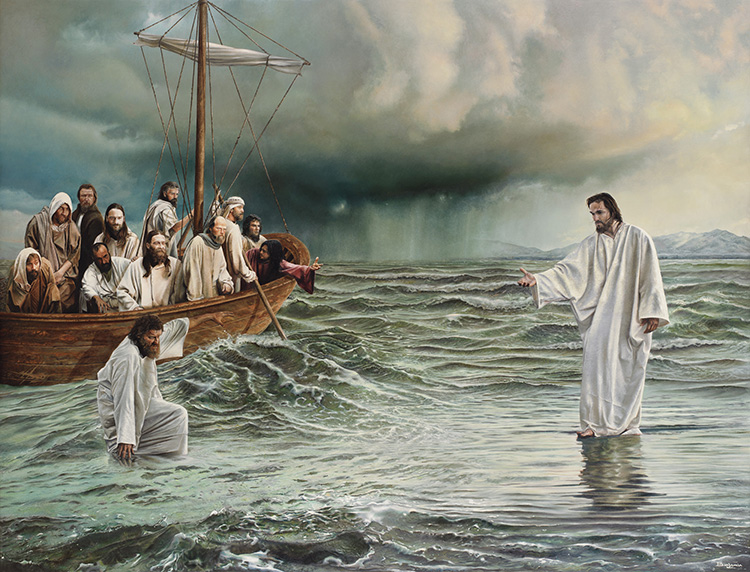
Here’s the story (Matthew 14: 22-33): the fishermen are headed for home at the end of the night, and it’s stormy, and they can’t see where they’re going. Jesus comes walking out to them on the water – Peter jumps over the side to be with him, starts to sink, and Jesus pulls him up.

Jesus walking on the water, the impetuous Peter failing again

The text gives the impression that they were well out from shore, maybe a mile, who knows. But there’s no real context for the story, as usual – no perspective, and no resolution.

The question is always whether we can find an explanation that allows for basic truth in the story (even if it’s been hyped and spun a little, or misremembered or misunderstood) without contradicting the known laws of the universe.

Consider: did Peter now walk the mile back to shore with Jesus? Or did Jesus carry him? Or did one or both get back in the boat, and they sailed in? None of these are mentioned… because none of these needed to happen.

The “sea” in the story is the Sea of Galilee, a lake 10 miles wide. Capernaum, where the fishermen lived, is naturally on this lake. The lakeshore there is low and gently sloping, part beach and part marsh. The beach is mostly rock, some sand, the water is shallow for a fair distance. Let’s assume that then, as now, people protected their boats from storms coming up the lake by building a ‘mole’, a wall of loose rocks not necessarily higher than the lake level, out into the lake.

It’s still dark, the boat’s coming in to shore in a storm, the fishermen can’t see where the beach is, let alone the mole. Jesus comes walking out on the mole to help. Peter jumps over the side of the boat onto the mole, but then loses his footing and falls in (the water may only have been a couple of feet deep), and Jesus helps him up. Then they help guide the boat to the beach, and drag it up.

Years later, when young followers who never met Jesus are asking Peter for stories about what it was like working with him, they get told a slightly exaggerated version. They get, naturally, a fisherman’s story.

What’s this blog all about, anyway?

This blog is a marmalade – sweet and sour boiled together, both rind and juicy bits.

Jesus was not a pacifist.

  • It’s a blog for the ideas of my novel. The novel looks at Jesus in the context of the constant uprisings against the Roman Occupation that began 100 years before his preaching, and went on for 100 years afterwards… until the Romans finally leveled Jerusalem, and killed or enslaved and deported all the Jews, and banned them from the replacement city of Aelia Capitolina.
  • It lets you read Jesus’ words and actions with the awareness that his “greatest commandment” is to recite the Shema, the fundamental Jewish prayer (“Hear, O Israel,”) – and practicing Jews do it multiple times a day. It’s Judaism 101. Jesus wanted Israel to turn back to the Covenant with God, and get rid of the idolatrous, beard-shaving, pig-eating Westerners who were marching around the country without bothering to learn the language.
  • Yes, it makes comparisons with modern Western invasions and occupations.
  • So it carries all my grudges against the Bush/Cheney/Rumsfeld/Wolfowitz/Blair destruction of Iraq in the hope of oil money and imperial glory. 100 million of us around the world had protested and pointed out that it was going to lead to nothing but death, destruction and economic catastrophe at home and abroad. And here we are.
  • It also carries the ironies of the current Westernized Israeli occupation of Palestine, and the cynical and heavy-handed Israeli destruction of the people who have been indigenous there for the past 2,000 years… a repetition of how the Jews slaughtered all the Canaanites and others who had been living in the area before Moses came along.
  • So I think Moses was a genocidal barbarian (Deuteronomy 20: 16-18).
  • And Jesus was a Jew, and more in tune with Osama bin Laden than anyone else.
  • And St. Paul was an epileptic visionary who created Christianity out of a mishmash of Judaism, Mithraism, and bits of Egyptian and Roman mythologies and practices.
  • And I have no respect for any monotheist who believes the earth was created in the past 10,000 years, or thinks the tribal legends of illiterate herdsmen have relevance for government policy today.
  • Does anyone really believe the first chapter of Genesis, when it says that God created day and night on the first day… and then made the sun and moon on the fourth day? What I believe is that we live in a universe of a billion galaxies, each with a billion suns – and someone who can’t even figure out the relationship between daylight and sunshine is to be treated seriously?
  • As for what the creative force behind a billion galaxies looks like, who knows. Call it God if you want… but where did it come from? Why is there anything at all?
  • And I love polytheist mythologies, and they speak to the soul’s images and poetry and inner health – but they’re not literally true.
  • And I loathe people who use religion as nothing but a way to make money, or to grab power. And I loathe people who use politics in that way, too. So I doubly loathe hypocritical politicians who mouth religious crap.
  • But oh how I love it all, at the same time! What a planet! Unbelievable natural beauty and works of art, and the most appalling destruction and massacres, planet-wide pollution, and greed and ignorance. But what can you expect of a planet of 7 billion heavily-armed apes? Humans are simply mind-boggling, stumbling through the dark like reckless two-year-olds.

By the way, it’s also a blog for the novel itself. With links to the trade paperback and to the Kindle edition. But don’t expect to find all the blog’s ideas in the novel – it’s just a contrarian (realistic, commonsense) retelling of an old story from the point of view of, yes, the Western occupation. And yes, Jesus was crucified. No, he didn’t come back from the dead. So, do you want to see how he did all those miracles?

Best resources – Debunking myths

Humans have been very successful as a species through love of pattern-recognition activities and a broad search for cause-and-effect. This leads to a love of stories and constant search for ‘Meaning’. The easiest way to introduce a new concept to people is to connect it to a story, as Jesus did repeatedly through parables. The inherent danger is that, because people are programmed to seek a narrative, people prefer an incorrect model over an incomplete model. In the absence of a better explanation, they opt for the wrong explanation.

We all grow up at some point... if we live long enough...

So in the process of trying to debunk an incorrect idea, you have to be sure to provide a complete alternative explanation. You also have to be careful not to inadvertently reinforce the flawed idea – this ‘backfiring’ can be caused by various things: bad framing of the idea, or too many arguments and details, or threatening the listener’s worldview.

The Debunking Handbook, a guide to debunking misinformation, deals with these issues. It is now freely available to download, and offers practical guidelines on the most effective ways of reducing the influence of myths. The Debunking Handbook boils the concepts down into a short, simple summary, intended as a guide for communicators in all areas who encounter misinformation. It originated with climate researchers, but it has universal application.

I believe debunking myths of all kinds is important, because what we believe impacts how we make decisions. Bush foreign policy was informed with a lot of Messianic Christian mumbo-jumbo which contributed to the Iraq war as well as to anti-science policies on health care and stem-cell research. Science and government must be kept free of religion, or we end up with shorter and less fulfilling lives. But we can’t simply say ‘The Christian narrative is flawed; Jesus isn’t God, don’t be ridiculous.’ We have to provide a complete alternative story of who he was, and how we can understand his words and actions in a completely secular way.

That is what I have attempted in “The Gospel According to the Romans” – that Jesus was a Jew, and a fundamentalist Jew at that, who wanted to cleanse Israel by kicking the beardless, pig-eating, polytheist, idolatrous Romans out of Palestine and restoring the Torah as the source of law. He was connected to the Zealot uprisings which had been going on for 100 years before him and continued for another 100 years afterwards – his attempt to take over the Temple at Passover was a clear failure, and he was caught and crucified.

But this book is probably only half of what I need to say on the matter. Because Paul came along after Jesus and used him as the vehicle for creating the greatest syncretist religion the world has ever seen, blending Judaism and Mithraism with Egyptian and Greco-Roman practices to end up with the Christianity that we have today. In order to say that happened, and to be understood and believed, we need to tell it as a coherent and non-magical story – plausible even if we can’t know exactly what happened.

In short, we need a parable to debunk Jesus, Paul and Christianity.

Unashamed commercialism…

Pantera, a Roman legionary, remains a plausible biological father for Jesus

You have only minutes left to get an interesting gift – a stocking-stuffer for an intelligent, literate, argumentative teen, say.

You could order them a copy of The Gospel According to the Romans for $14.95 here, or from Amazon.com

or you can send it to them as an e-book for 86p in the UK, or 99 cents in the US, or EUR 0,99 at one of Amazon’s main European websites (for example Germany, but you can substitute other country letters for the ‘de’), where you/they can also get a free Kindle app for reading it (look on the right-hand side)

or you can simply point them at this blog, http://robinhl.com, where they can enjoy random religious rants and sniping year-round!

(Discussion of Pantera is at https://robinhl.com/2011/11/06/jesus-son-of-pantera/, fyi. And Merry Christmas!)

The Miracles, 2 – Feeding 5,000 and feeding 4,000

Jesus mostly avoided the big cities, and instead held his mass rallies in the countryside where he was free of interference from the Romans and their Sadducee collaborators. He became a wanted man, and was constantly on the move: “The birds have their nests, and the foxes their dens, but the Son of Man has nowhere to lay his head.”

Jesus looks for pricing on a bulk volume deal.

His message was always the same: the unity of the Jewish people, the need for purification and submission to the will of God. And he made his points by stories (parables) and by vivid events (stage-managed miracles).

When he preached in the countryside he could attract crowds of up to 5,000 people. Obviously he didn’t just start talking, and have that many people show up spontaneously. These were publicized events. As at an outdoor event like Woodstock, some people would have brought food and drink with them, and others wouldn’t. But here there was nowhere to get food if you needed it.

Having preached to a large crowd, he would have a small boy come up and offer to share food – “five barley loaves and two small fishes”. He would praise the spirit of the boy, and ask everyone to sit down where they were, and for those who had brought food to share with whoever they were next to. They were all Jews, they were all God’s children, they were all one family. Jesus and the disciples and the whole crowd would share food between them as a communal celebration for one large family, and reinforce his teachings and their bonds as a single chosen people.

The miracle was in getting 5,000 people to share their food with strangers.

(And it was all done without rock music or recreational drugs.)

Was Jesus gay?

This is one of those ideas that some people find shocking and incomprehensible, and others think self-evident.

You can see what you want in Jesus

There is an excellent and detailed discussion of the issue, for and against, at the Religious Tolerance (.org) website, here. It raises all sorts of interesting questions, such as “Gay meaning orientation? Or gay meaning activities?” But to me the key issues are these:

1) Given that Jesus was a strict religious Jew, firm that marriage was sacred and indissoluble, for example – why is there no indication that he was married? It was a religious duty, a requirement, the first of God’s 613 commandments, to “Be fruitful and multiply”. Surely the Gospels would have promoted the fact.

Naked young man runs away... let's assume he was really naked...

2) Given that Jesus had individual relationships with him various followers, and loved everyone (or at least all Jews… or at least all practicing Jews… or at least all practicing Jews who he agreed with…), why is John “the disciple whom Jesus loved”? John would have been a teenager when Jesus was in his late 30s. And who is the young man with Jesus in the Garden of Gethsemane according to Mark 14: 50-52, “And they all left him and fled. And a young man followed him, with nothing but a linen cloth about his body. And they seized him, but he left the linen cloth and ran away naked.” Wtf?

People say Jesus couldn’t have been gay, because God said it was a sin. But the same God made David King of Israel, despite his relationship with Jonathan. Maybe God doesn’t really care all that much.

So, lots of questions. And probably much of what you get out of Jesus is what you choose to put in. I put in questions. In The Gospel According to the Romans I suggest Jesus might well have been gay, but it’s not an important element of the novel.