Mormon Archaeology – good luck with that!

The Mormon story is that the Ten Lost Tribes of Israel didn’t simply assimilate into other populations under the enslavements and dispersals of the great empires of ancient times (which is what most historians, Jewish and non-Jewish, believe). Instead, they made their way east to the Americas and created a civilization that Jesus teleported to after he had come back from the dead, before he rose up into the sky.

Jesus teleported over to talk with the Jewish tribes of America (say what?)

This had the advantage of prepping North America to house the United States as God’s Chosen Country, personally blessed by Jesus.

But there is a problem: no archaeological remains from the civilization detailed in the Book of Mormon.

However an interesting website shows how dedicated believers can use the power of the human brain to construct fantasies of contorted logic to meet their predetermined objectives. This page of RestoredIsrael.org appears to outline the following argument:

  1. There is a discrepancy between Scientific timelines and Biblical timelines, regarding prehistorical events.
  2. The Bible is correct, of course.
  3. The Scientific sequence is correct, but the timelines have to be adjusted to fit within the Biblical 7,000 years.
  4. We have virtually no archaeological evidence from 100,000 to 40,000 years ago, and none from the Americas.
  5. That equates to the Biblical period of 2400 BC to 2200 BC.
  6. Therefore we should not be surprised that we can find no evidence of the Ten Lost Tribes’ activities in the Americas from the Biblical period of 2400 to 2200 BC.

Do I understand this correctly? I am open to correction. I may not have grasped all the intricacies, but this looks clear enough: Mormon archaeology is pure fantasy. And that’s logical, as it’s based on a book which is pure fantasy.

Unasked questions: What happened to Joseph?

One of the signs of a great story is the listener’s question, “What happened next?” In the National Geographic for March 2012 the cover article is “The Journey of the Apostles”, detailing the lives and teachings of not just the original Twelve, but also others such as Mary Magdalene, after Jesus’ crucifixion.  We have stories about what happened to all of them, and to many others associated with Jesus. Not all the stories are believable, but where there is no fact there is plenty of speculation and legend.

Except in the case of Joseph, the (step)father of Jesus.

This is strange. If his fate was unknown, we would have legends and rumors. Search for “What happened to Joseph of Arimathea?”, for example, and you find him traveling all over the place, carrying the Holy Grail, settling in Britain, you name it. But search for “What happened to Joseph the father of Jesus?”, and you find nothing about him after his last mention in the Gospels, going up to the Temple in Jerusalem with Mary and Jesus when Jesus was 11 or 12.

Mass crucifixions after an uprising

But suppose his fate was a) not something that the early Church wanted to talk about, and b) so well-known that no one could make up an alternative narrative without having the whole thing dragged out into public discussion again. Therefore silence. No narrative, no legends, nothing.

The interesting event that happened around that time (probably later in the same year that Joseph took Jesus to Jerusalem, but the timing is uncertain) was an uprising led by Judas of Galilee with an attack on Sepphoris. (Sepphoris is the Roman name; the Hebrew name is Zippori.) This was Herod Antipas’ capital city in Galilee, 4 miles north of Nazareth. Probably a lot of men from Nazareth were in the uprising. The uprising was crushed by the Romans, and the Romans crucified 2,000 Jews outside Sepphoris.

And after that, we don’t hear anything about Joseph in the Bible, or in legends or stories.

Jesus, however, retains a remarkable father-fixation all his life, and is himself crucified after leading an attack on the Temple in Jerusalem, having tried to claim the messianic kingship of Israel.

So… what happened to Joseph? And why didn’t anyone want to talk about it in the early Church, as they tried to make Christianity acceptable throughout the Roman Empire?

Long hair, short hair

Jesus wanted the Mosaic Law upheld in all its details. “Do not think that I have come to abolish the Law or the Prophets; I have not come to abolish them but to fulfill them. I tell you the truth, until heaven and earth disappear, not the smallest letter, not the least stroke of a pen, will by any means disappear from the Law until everything is accomplished. Anyone who breaks one of the least of these commandments and teaches others to do the same will be called least in the kingdom of heaven, but whoever practices and teaches these commands will be called great in the kingdom of heaven.” (Matthew 5: 17-19)

Symptomatic of this is Jesus’ hair, always shown long in keeping with Leviticus 19:27 “Do not cut the hair at the sides of your head or clip off the edges of your beard.”

To Jesus, the Romans were pig-eating, uncircumcised, beard-shaving idolators who needed to be expelled from Israel.

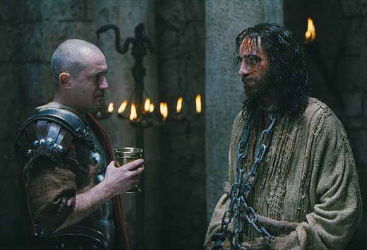
Pilate and Jesus

But Paul wanted to move away from ethnic-based Judaism to a universal religion acceptable to the whole Roman Empire. Paul’s entire outlook is Roman. He writes: “Does not the very nature of things teach you that if a man has long hair, it is a disgrace to him” (1 Corinthians 11: 14)

Paul’s Christianity is hostile to the beliefs of Jesus. The hair says it all.

New religion? New laws.

It’s normal for the founder of a new religion to produce a new code of laws. After all, the founder isn’t content with the existing social situation, or he (and it’s usually a he) wouldn’t feel the urge to create something different. The new religion will require a new definition of god/ess/es and a new definition of the appropriate and/or mandatory ways to worship them and beg things from them.

The god Shamash (seated) giving Hammurabi insignia and laws

New god(s), therefore new liturgy, new rules regarding purity… cleanliness… then food… food preparation… and of course clothing… and now we’re into the regulation of sexual relations… marriage… penalties for disobedience… Pretty soon you’re instituting the death penalty for adultery, then regulating marketplace weights and measures, and standardizing the length of cart axles so that the wheels always fit the ruts in the road.

It may not be necessary to create a whole new religion if your interest is just the laws. Especially if you have a pantheon of gods to choose between, you can simply shift the emphasis from one to the other, as Moses did in suppressing the worship of Ba’al and other gods in favor of Yahweh. But then, Moses may not have written all of those laws – it appears they kept getting added to for hundreds of years, the authors always attributing the additions to Moses attributing them to Yahweh.

Several centuries before Moses, various rulers in the area of modern Iraq such as Ur-Nammu and Hammurabi provided extensive written laws. They too invoked the gods as the true creators of the laws, increasing the authority of the laws and enhancing the status of the ruler.

So it’s an apparent anomaly that there was no new and extensive written code of laws with the birth of Christianity – neither from Jesus nor from Paul.

But Jesus had no interest in starting a new religion – he was a Jew who was trying to get all other Jews to turn back to the old ways, back to the Shema (“Hear, O Israel…”), and away from the polluting Romans.

And Paul, though he wanted to start a new religion, had no interest in new laws because he was intent on starting this new religion within the existing framework of the Roman Empire. The Romans didn’t look favorably on people who tried to override their laws.

So Christianity started out without any clear legal definition, only the tension of trying to adhere to the very different Mosaic and Roman legal structures simultaneously…

And then a few hundred years later we get Muhammad, and we’re back to divinely inspired legislation.

Faith means never having to admit you were wrong

Jesus performed “healing miracles” all around the Galilee countryside, except in his hometown of Nazareth. The people there knew him and his tricks.

Threatening to throw Jesus off a cliff - Luke 4: 19

As one young “Christ follower” says: “After bringing Jesus out of the desert, God calls Him to preach in Nazareth where he is unable to do many miracles because of their lack of faith (Matt 13:58). But it gets worse. He then preached in the synagogue and offended the people (Mark 6:3). They were so incensed by His sermon they tried to push him off a cliff (Luke 4:14-30).”

That doesn’t stop Christians like the blogger quoted above – they just go into their Have-it-both-ways mode. Jesus as God is not the same as Jesus as man… Jesus as God is omniscient and infallible, Jesus as man is fallible and still learning… How can you tell which Jesus you’re dealing with? By the results, of course! If a miracle succeeds, it was God. If it fails, it was just the human.

This is the heart of faith: A person is in a car crash and survives – “Praise the Lord!”… but their spouse is killed – “God works in mysterious ways.”

A child is in hospital with doctors and medicine and survives some rare and often-fatal illness: “Proof that prayer works! Praise the Lord!”

Meanwhile there are 30 countries in Africa in which over 10% of children die before the age of 5. The leading causes of death for them are simple: acute respiratory infections, diarrhea, measles, malaria and, of course, malnutrition. Worldwide, according to UNICEF and the World Health Organization, 7,000,000 children a year die from preventable causes. So why do so many innocents die? “God works in mysterious ways.”

Faith means never admitting you were wrong. It’s not a good attitude for raising children, making educational policy, or running a government.

Jesus as Faith Healer

I’ve never understood exactly what Jesus is trying to demonstrate, and to whom, with regard to the Christian view of his healing miracles.

How faith healing works

If he wanted to be effective and merciful, he should have healed thousands in a big city like Jerusalem, instead of just one person on any given occasion.

If he wanted to demonstrate God’s power to the world, he should have gone to a Greek or Roman place of healing in Caesarea, and healed all the difficult cases that the doctors were struggling with.

He didn’t seem to want to do either of those things – just as a faith healer never goes to a hospital to heal the people there.

It looks suspiciously like (the Christian, unhistorical) Jesus and the faith healer only work to cure you of your love of money – “the root of all evil”.

Maybe the answer is in the name, “faith healer” – all they can really heal is your faith!

Jesus’ Healing v. Greco-Roman Medicine

Here is Jesus healing in Mark 9: 20-27.  The father of an epileptic boy, believing that the problem is a demon inhabiting him, asks Jesus to heal him. The boy is summoned.

And when the spirit saw Jesus, immediately it convulsed the boy, and he fell on the ground and rolled about, foaming at the mouth. And Jesus asked his father, “How long has this been happening to him?” And he said, “From childhood. And it has often cast him into fire and into water, to destroy him. But if you can do anything, have compassion on us and help us.” And Jesus  rebuked the unclean spirit, saying to it, “You mute and deaf spirit, I command you, come out of him and never enter him again.” And after crying out and convulsing him terribly, it came out, and the boy was like a corpse, so that most of them said, “He is dead.” But Jesus took him by the hand and lifted him up, and he arose.

Here is Greek healing, earlier than Jesus, from Wikipedia:

Ancient vaginal speculum

Another of Hippocrates’s major contributions may be found in his descriptions of the symptomatology, physical findings, surgical treatment and prognosis of thoracic empyema, i.e. suppuration of the lining of the chest cavity. His teachings remain relevant to present-day students of pulmonary medicine and surgery. Hippocrates was the first documented chest surgeon and his findings are still valid.

Hippocratic medicine was notable for its strict professionalism, discipline, and rigorous practice.The Hippocratic work On the Physician recommends that physicians always be well-kempt, honest, calm, understanding, and serious. The Hippocratic physician paid careful attention to all aspects of his practice: he followed detailed specifications for, “lighting, personnel, instruments, positioning of the patient, and techniques of bandaging and splinting” in the ancient operating room. He even kept his fingernails to a precise length.

The Romans, naturally, are better known for the engineering aspects:

The Romans invented numerous surgical instruments, including the first instruments unique to women (vaginal specula with a screw device which when turned forces a cross-bar to push the blades outward), as well as the surgical uses of forceps, scalpels, cautery, cross-bladed scissors, and the surgical needle. Romans also performed cataract surgery.

Jesus came to preach, to heal and to cast out demons;  this in the Roman Empire when it was discovering anesthetics and making major medical advances. Presumably if Jesus came to the United States today he would avoid places like Johns Hopkins and hang out with the snake handlers in the backwoods of the South.

This reduces the credibility of Jesus-as-God to zero. But it supports the idea that Jesus was a Jewish fundamentalist, working within the framework of Jewish law and tradition, and ignorant and hostile regarding all things Roman.


Jesus’ outbursts of anger

Did Jesus ever get angry?

It’s certainly not the image presented to children. Our foundational understanding of Jesus is “Gentle Jesus, meek and mild”, mixed in with Baby Jesus, Jesus healing people, Jesus feeding people, and all sorts of “God is love” stuff.

Gentle Jesus, or man of violence?

Well, but he whipped the money-changers out of the Temple. And when he was in a synagogue on the Sabbath, he looked round at the congregation “in anger” (Mark 3:5) before healing someone. And there are other places that he gets angry, yells at his disciples, etc.

So there is nothing unlikely about his being connected in with the Zealot insurrection, or in having a Sicariot and Simon Zealotes among his closest disciples.

In other early writings, contemporary with the canonical Gospels, there are accounts of Jesus’ childhood in which (along with magical stories of his making lumber longer or shorter to help Joseph with the carpentry) there are disturbingly violent incidents. In one version he pushes a boy off a roof and kills him, but brings him back to life. In another he curses a boy who has either bumped into him or thrown a stone at him, and the boy falls dead. In yet another he kills a teacher who has reprimanded him.

These extremely negative stories are not the sort that followers normally make up to glorify their deceased master. They are more likely to be reflections of rumors about his childhood that couldn’t be shaken off, and could only be palliated by adding “and then he brought him back to life”. But if you only wanted to show his early powers of healing, you wouldn’t normally start with having him doing the killing himself…

But as the bastard son of, perhaps, the Roman legionary Pantera – looking unlike Joseph – with some resentment on Joseph’s part – teased by other children because of the rumors… we can make an easy case for his having a lot of anger in him. Add in that Joseph disappears from the narrative when Jesus is 12, in the year of the failed uprising by Judas of Galilee with 2,000 Jews crucified by the Romans four miles north of Nazareth…

And we have the makings of an angry, conflicted, anti-Roman young man.

Forget the “meek and mild” – it’s nowhere in the Gospels.

The Transfiguration – just a bloody meeting

The Transfiguration is one of those classic iconic and apparently pointless events in the gospels. Jesus is up a mountain with a couple of the disciples, and Moses and Elijah show up to talk with him. Jesus’ clothes shine brightly (that’s the Transfiguration) and Peter in his spontaneous fashion suggests building tabernacles (tents or huts) for them. A voice from the clouds is interpreted as saying “This is my beloved son, listen to him.”

Another unjustifiably airy-fairy Jesus story

Paintings have developed a tradition to show Jesus and the other two floating around in the air. Is there any textual justification for this? None. (Aside: This is exactly how myths develop: one person hears a story, wants it to be dramatic, fleshes the untold details out in their own mind, and then adds them as fact when they present the story – without even realizing they’re making changes.) Changes regarding a hero’s story tend to exaggerate and glorify, so you can discount some of the frills. But there’s probably a commonsense basis for the story.

Here’s how I tell it in “The Gospel According to the Romans”. First, it’s nighttime, full moon, but overcast. They go up into the mountain without Jesus telling them why. Then he tells them to hold back and goes alone into a clearing, where two Zealot leaders named (or code-named) Moses and Elijah come out and discuss their plans for the attempt to take over the Temple at Passover. (These disciples aren’t privy to this; they were the fishermen Simon Peter, James and John, not the Zealots Judas and Simon Zealotes.)

The full moon comes out from behind the clouds, and catches Jesus’ face and his white robes, making them shine dramatically. There is a roll of thunder. You can make thunder say whatever you want it to say – Eliot records it speaking Sanskrit in The Wasteland. Simon Peter babbles, not untypically.

Going back down the mountain, Jesus tells the disciples not to tell anyone about this until they’ve seen a man raised from the dead. In other words, not until he has done his Lazarus trick (which they don’t know anything about) which will be right before Passover at Jerusalem. At that point it won’t matter if anything they’ve heard gets out, the uprising to take control of the Temple will be about to happen anyway, and it will be too late for the Roman Legion to stop it…

So, what do you think? Plausible? Or you prefer the floating-around-in-the-air version?

It’s not Hamza Kashgari who is blasphemous – it’s his accusers!

On the occasion of the birthday of the Prophet Muhammad, 23-year-old poet and journalist Hamza Kashgari sent out three tweets:

Hamza Kashgari calls it like he sees it

  • On your birthday, I will say that I have loved the rebel in you, that you’ve always been a source of inspiration to me, and that I do not like the halos of divinity around you. I shall not pray for you.
  • On your birthday, I find you wherever I turn. I will say that I have loved aspects of you, hated others, and could not understand many more.
  • On your birthday, I shall not bow to you. I shall not kiss your hand. Rather, I shall shake it as equals do, and smile at you as you smile at me. I shall speak to you as a friend, no more.

This ignited a firestorm of indignation, with tens of thousands of his fellow Saudis calling for him to be tried for blasphemy and atheism, and executed. For some of the worst acting from a cleric, watch this short video.

Hamza flew to Malaysia, heading for asylum in New Zealand, but was arrested in the airport at Kuala Lumpur.

The irony is that his tweets are perfectly in line with the attitude that Muhammad himself tried to cultivate: that humans should never be deified, that neither Jesus nor Muhammad was anything but an ordinary man (though favored with prophetic gifts), and that, as he himself tried to prove, Muhammad could not perform miracles.

By the way, that’s the source of the story that ends “Well, if the mountain won’t come to Muhammad, Muhammad must go to the mountain.” Very much like King Canute shutting his flattering courtiers up by setting his chair up on the beach and telling the waves to go back, which they wouldn’t.

But the followers and the religious organizers always take over after the great man is dead, and turn him into a god to be worshiped. It happened with Buddha, with Odin, with Jesus. Muhammad put as many firewalls in the way as he could, but all too many Muslims treat Muhammad the way Christians treat Jesus, and impute outlandish miracles to him such as splitting and rejoining the moon.

Realistically, therefore, it’s the fanatical and superstitious accusers of Hamza Kashgari who are the blasphemers. The young poet should be praised for trying to keep Islam true to the wishes of its Prophet.