Solstice, Stonehenge and Newgrange

The northern hemisphere’s winter solstice has been a major festival for the past several thousand years.

Newgrange at the winter solstice: the upper slot lets sunrise penetrate 60 feet into the mound.

At Newgrange in Ireland, 1,000 years before Stonehenge (and 500 years before the Pyramids of Egypt), a 60-foot passageway was built with walls and roof of stone slabs, ending in a cruciform chamber, and the whole roofed over with an enormous dirt mound 50 feet high and covering an acre of land. Normally the passageway and chamber are dark, but for a couple of days at solstice a slot over the entrance lets the rising sun flood the chamber with light for a few minutes. A lucky couple of dozen tourists, chosen by lottery during the year, are allowed in for this magical moment.

This suggests that the alignment of stones at Stonehenge was for the production of similar effects. The mound at Newgrange is still standing, but we don’t know what Stonehenge looked like. There may have been a mound at Stonehenge (there are other mounds nearby, notably Silbury Hill near Avebury), or else walls of wood and animal hides could have kept the interior dark except at the astronomically significant moments.

Thousands of years later, during the rise of the Roman Empire, the Roman year-end festival of Saturnalia began to merge with the northern neolithic ceremonies and their Celtic and Germanic descendants, and with the virgin birth at solstice of Mithras the Unconquerable Sun-god.

As early Christians looked for a way to separate Jesus from his Jewish roots and to make him broadly acceptable throughout the Roman Empire, his birth (which had probably happened in the spring) began to be celebrated at the winter solstice too.

Merry Christmas! Io Saturnalia! Happy Solstice! – In the northern hemisphere, this is the time to celebrate that the tide of darkness has turned, and that light and life are beginning to return to our world. Peace!

Unashamed commercialism…

Pantera, a Roman legionary, remains a plausible biological father for Jesus

You have only minutes left to get an interesting gift – a stocking-stuffer for an intelligent, literate, argumentative teen, say.

You could order them a copy of The Gospel According to the Romans for $14.95 here, or from Amazon.com

or you can send it to them as an e-book for 86p in the UK, or 99 cents in the US, or EUR 0,99 at one of Amazon’s main European websites (for example Germany, but you can substitute other country letters for the ‘de’), where you/they can also get a free Kindle app for reading it (look on the right-hand side)

or you can simply point them at this blog, http://robinhl.com, where they can enjoy random religious rants and sniping year-round!

(Discussion of Pantera is at https://robinhl.com/2011/11/06/jesus-son-of-pantera/, fyi. And Merry Christmas!)

“Who is my neighbor?” and the Ten Commandments

I’ve previously posted about the key Jewish commandments, reviewed by Jesus to his followers, to obey the Shema (“Hear, O Israel…” Deuteronomy 6:4-9) and treat all “the children of thy people” well and “love thy neighbour as thyself” (Leviticus 19:18). The two greatest commandments are to obey the tribe’s God, and to be good to the tribe’s people.

Even those famous Ten Commandments are not a prescription for the human race: they are a prescription for the success of the Jewish tribe, which success is often going to be at the expenses of other tribes.

Christopher Hitchens

Christopher Hitchens has a lovely 8-minute video in which he reviews and and updates the Ten Commandments for our time. But Hitch missed the question of who is your ‘neighbor’ (“Thou shalt not covet thy neighbor’s house”, etc – “Thou shalt not bear false witness against thy neighbor”…) Neighbor means fellow Jews. It is all very tribal. That’s why it was fine for Moses to say “God says Thou shalt not kill” and then to go out slaughter the men, women and children of Palestine, now that God had given the Promised Land to the Children of Israel.

There are universal religions, and there are tribal religions. The Romans understood the former, and tried to draw in every local religion they conquered. Judaism, the religion of Moses and of Jesus, was and is tribal, and in the time of Jesus it was bitterly opposed to being swallowed up by Roman syncretism.

The Miracles, 2 – Feeding 5,000 and feeding 4,000

Jesus mostly avoided the big cities, and instead held his mass rallies in the countryside where he was free of interference from the Romans and their Sadducee collaborators. He became a wanted man, and was constantly on the move: “The birds have their nests, and the foxes their dens, but the Son of Man has nowhere to lay his head.”

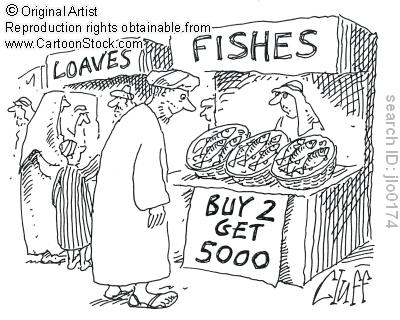
Jesus looks for pricing on a bulk volume deal.

His message was always the same: the unity of the Jewish people, the need for purification and submission to the will of God. And he made his points by stories (parables) and by vivid events (stage-managed miracles).

When he preached in the countryside he could attract crowds of up to 5,000 people. Obviously he didn’t just start talking, and have that many people show up spontaneously. These were publicized events. As at an outdoor event like Woodstock, some people would have brought food and drink with them, and others wouldn’t. But here there was nowhere to get food if you needed it.

Having preached to a large crowd, he would have a small boy come up and offer to share food – “five barley loaves and two small fishes”. He would praise the spirit of the boy, and ask everyone to sit down where they were, and for those who had brought food to share with whoever they were next to. They were all Jews, they were all God’s children, they were all one family. Jesus and the disciples and the whole crowd would share food between them as a communal celebration for one large family, and reinforce his teachings and their bonds as a single chosen people.

The miracle was in getting 5,000 people to share their food with strangers.

(And it was all done without rock music or recreational drugs.)

The Miracles, 1 – Water into Wine

Generally considered Jesus’ first miracle, “turning the water into wine” has captured popular imagination as a casual display of miraculous power – something of a party trick. Which perhaps it was.

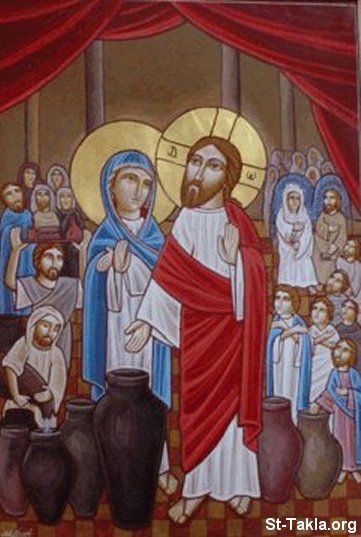
Jesus turning water into wine

Here’s the story: Jesus attends a wedding. His mother says they’ve run out of wine, can he help? She tells the servants to do whatever he says. He says to fill some pitchers with water; the liquid is then taken to the Steward of the feast, who congratulates Jesus on saving the best wine for last, i.e. this wine is better than the stuff they had earlier – normally the good stuff would be served first, before everyone is too sozzled to notice the difference.

But remember that Palestine was part of the Roman Empire by this time. Consider how Romans served wine at feasts: wine was shipped around the Empire as a concentrate, which reduced shipping costs. The wine steward at a feast had the task of adding the appropriate amount of concentrate to the jars of water, producing something that was the appropriate strength for the company and for the state of the party.

If the concentrate was already in an otherwise empty jar, which you then filled with water… Well, it would be a good party trick, especially if it came out at a good strength, and if your guests were village simpletons who weren’t used to attending Roman-style events.

Or perhaps everyone knew that it was nothing special, just a bit of fun – and that the only miracle was in having better-tasting (stronger) wine at the end of the party than at the beginning!

In The Gospel According to the Romans there is an assumption that Jesus uses street magic to provide an illusion of the miraculous, to reinforce the spiritual lessons he teaches – just as Indian holy men do today.

The Promised Land, 2 – the people already living there

Of course, a whole lot of people were already living in the Promised Land when Moses showed up with the Children of Israel. It was good land.

According to Moses, GOD had two sets of rules for warfare with cities, depending on whether the target cities were outside the Promised Land (“very far from you”), or inside it (“cities of the nations here”).

For the first ones, GOD says, offer them peace as slaves. If they accept, enslave them. If they don’t accept, then besiege the city, capture it, kill all the males, and keep the women and cattle as booty. You can afford to be this generous, because it’s outside the Promised Land.

But if the city is inside the Promised Land, you have to kill everything – men, women, children, animals – “in order to prevent them infecting you with their immoral practices”. I kid you not.

"You shall save alive nothing that breathes."

Here are the rules, from Deuteronomy 20, verses 10-15 for the first lot, 16-18 for the second.

[10] When you draw near to a city to fight against it, offer terms of peace to it.
[11] And if its answer to you is peace and it opens to you, then all the people who are found in it shall do forced labor for you and shall serve you.
[12] But if it makes no peace with you, but makes war against you, then you shall besiege it;
[13] and when the LORD your God gives it into your hand you shall put all its males to the sword,
[14] but the women and the little ones, the cattle, and everything else in the city, all its spoil, you shall take as booty for yourselves; and you shall enjoy the spoil of your enemies, which the LORD your God has given you.
[15] Thus you shall do to all the cities which are very far from you, which are not cities of the nations here.

[16] But in the cities of these peoples that the LORD your God gives you for an inheritance, you shall save alive nothing that breathes,
[17] but you shall utterly destroy them, the Hittites and the Amorites, the Canaanites and the Per’izzites, the Hivites and the Jeb’usites, as the LORD your God has commanded;
[18] that they may not teach you to do according to all their abominable practices which they have done in the service of their gods, and so to sin against the LORD your God.

Having got control of Palestine for 1500 years through genocide and ethnic cleansing, religious Jews (including Jesus, obviously) were in no mood to have the idolatrous, polytheist, pig-eating Romans come in and run the country. Their duty was to wipe the Romans out.

Unfortunately that thinking is still alive today among religious Jews. Even if Palestinians are neither idolatrous nor polytheist nor pig-eating, the more fanatical among the Jews do not see them as worshiping the same God, and want to wipe them out. But God is said to have promised the land to the descendants of Abraham – and Arabs, too, claim descent from Abraham. So the promise of the Covenant is fulfilled if Jews or Arabs live in the Promised Land… from the river of Egypt to the Euphrates.

Best resources – Archaeology and History

Every week David Meadows, aka The Rogue Classicist, assembles links to every archaeology-related story that he comes across for his Explorator mailing list, sorting them into:

  • Early Humans
  • Africa
  • Ancient Near East and Egypt [This is where the Jews are… and the Romans, sometimes]
  • Ancient Greece and Rome (and Classics) [This is where the Romans are… and the Jews, sometimes]
  • Europe and the UK (+ Ireland) [Note: don’t ask me why he calls it that…]
  • Asia and the South Pacific
  • North America
  • Central and South America
  • Other Items of Interest
  • Touristy Things
  • Blogs
  • Audio/Video News
  • Crime Beat
  • Numismatica
  • Exhibitions, Auctions and Museum-Related
  • Performances and Theatre-Related [yes, David’s Canadian, if you’re wondering about the spelling]
  • Obituaries
  • Podcasts

In a good week, a single section may look like this:

EARLY HUMANS

Using ‘foodprints’ to determine the diet of early humans:
http://www.latimes.com/news/science/la-sci-hominin-diet-20111022,0,7613706.story

Pondering the short legs of Neanderthals:
http://www.physorg.com/news/2011-10-mysteries-short-legged-neandertals.html
http://www.livescience.com/16623-neanderthal-short-legs.html

We can apparently blame backbone fractures on evolution:
http://www.eurekalert.org/pub_releases/2011-10/cwru-bbf101911.php

On the evolutionary roots of ‘culture’ in humans and apes:
http://www.physorg.com/news/2011-10-culture-humans-apes-evolutionary-roots.html

A Neanderthal find from the Netherlands … so far the coverage is only in Dutch:
http://www.nu.nl/wetenschap/2643248/werktuigen-neanderthalers-gevonden-in-limburg.html
http://www.blikopnieuws.nl/bericht/135825/Honderdduizend_jaar_oude_werktuigen_Neanderthaler_gevonden.html
http://www.limburger.nl/article/20111017/REGIONIEUWS06/111019666/1021
http://www.wetenschap24.nl/nieuws/artikelen/2011/oktober/Gereedschappen-Neanderthalers-ontdekt-in-Limburg.html
http://www.hartvannederland.nl/nederland/limburg/2011/bijzondere-archeologische-vondst/

Feature on figuring out where the various ‘ape men’ fit on the family tree:
http://blogs.smithsonianmag.com/hominids/2011/10/how-africa-became-the-cradle-of-humankind/

… and the mutation which may have led to the genus homo:
http://www.nctimes.com/news/science/article_cf0b51dc-531b-5a9a-9ef1-b2cb9fbeb21a.html

More on the blades (and their implications) found in that Qesem Cave ‘production line’:
http://www.physorg.com/news/2011-10-archaeologists-blade-production-earlier-thought.html
================================================================

To subscribe to Explorator, send a blank email message to:
Explorator-subscribe@yahoogroups.com

I strongly recommend it. It ranks right at the top of my favorite reading for the week.

BC and AD… BCE and CE… AUC and AM…

Historically, people created a fresh calendar after a significant event. Sometimes that was the coronation of a new king, and everything was counted as “in the tenth year of King Henry’s reign” and so on.

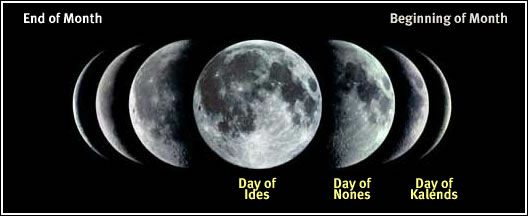
The Roman calendar was originally structured on the phases of the moon.

The Romans used AUC (“Ab Urbe Condita”, From the Founding of the City), dating everything from the founding of Rome in 753 BC. Note: not necessarily historically accurate.

Many Jews still use AM (“Anno Mundi”, In the Year of the World), dating everything from 1 Tishrei 1 AM, or Monday, 7 October 3761 BC… which is about a year before the creation of time and space on the Jewish traditional date of Creation, 25 Elul AM 1. Try to figure that one out!

The Jewish calendar's reference point is traditionally held to be about one year before the Creation of the world.

There are two problems with the standard calendar terms BC and AD, “Before Christ” and “Anno Domini – In the year of the Lord”.

The first is that many non-Christians object to referring to Jesus as either the Christ or the Lord, and aren’t impressed with using his birth as the basis for a global calendar.

The second is that Jesus was not born at midnight between 1 BC and 1 AD. Under our calendar, he was probably born in the spring of 6 BC, rendering the BC and AD terms ludicrous. Our calendar is now so thoroughly established, however, that it is easier to rename than to renumber. So now people are starting to write about our Common Era (CE) and, before that, Before Current Era (BCE).

Of course, we could just keep the initials BC and AD, and rethink the meaning of them to, say, “Before Current” and “After Dat”. I mean, really, who cares?

Legio X Fretensis

Legio X Fretensis (Tenth Legion of the Sea Straits) was formed around 40 BC by Octavian to fight in the civil wars after the assassination of Julius Caesar. Octavian called it “The Tenth” in honor of Caesar’s famed Tenth Legion, and it earned its nickname “of the Sea Straits” after an early battle near the Straits of Messina.

The Naval Battle of Actium, 31 BC

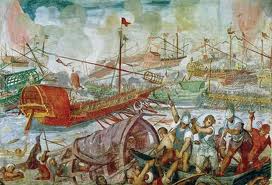
The Tenth Legion Fretensis fought across the ships at Actium

It consolidated this name in the naval Battle of Actium in 31 BC, when Octavian’s ships grappled the ships of Antony and Cleopatra, and the Tenth Legion was able to fight across from ship to ship. Antony and Cleopatra committed suicide, and Octavian became Caesar Augustus.

Roman Standards of Wolf and Boar

The Tenth Fretensis was stationed in and around Judea for over 400 years, at Damascus, Caesarea and latterly Aqaba. It was involved in the suppression of the ongoing Jewish insurrection against the Roman occupation, including:

  • the defeat of Judas of Galilee and the crucifixion of 2,000 rebels at Sepphoris (Zippori), four miles from Nazareth, in 6 AD
  • the siege of Jerusalem in the Great Revolt of 66-73 AD, the looting and destruction of the Temple, and the capture of Masada
  • the suppression of the Bar Kokhba Revolt in 132-135 AD, with the destruction of Jerusalem, and the enslavement, deportation and banishment of all Jews from Judea.

That other minor (but well-known) incident in the mid-30s, ending with the crucifixion of Jesus of Nazareth and two Zealot ringleaders, was trivial compared with what the Legion had to deal with a lot of the time. But that incident, of course, is the focal point of my novel “The Gospel According to the Romans”.

Roman detachment with Standards

The Tenth’s symbols were the Bull, the Ship and the Boar. The Bull, Taurus, may be from its being created sometime between April 20 and May 20 – but it certainly made an easy connection with the Mithraic religion that was spreading into the Empire from the East. The Boar was, in itself, a source of conflict with the Jewish inhabitants throughout the region – they didn’t like to see foreign troops in any case, but for them to parade around under the graven image of a pig was an extreme insult.

Jesus’ Message, 2: “Love thy neighbour…”

Jesus is quoted as saying that the second most important commandment is “Thou shalt love thy neighbour as thyself”. This may be accurate, but not the whole story.

Because the phrase isn’t among the Ten Commandments, many Christians have the impression that it’s a Jesus original, expressing love towards the whole world. When you see it in its original context, though, it has a slightly different message. Jesus was quoting Leviticus 19:18 –

“Thou shalt not avenge, nor bear any grudge against the children of thy people, but thou shalt love thy neighbour as thyself: I am the Lord.”

Love thy neighbour - Leviticus 19:18

The commandment is for Jews to love their fellow Jews. It says nothing about loving gentiles. It certainly says nothing about loving the idolatrous pig-eating beard-shaving military occupation forces, no matter how St. Paul would later try to twist the teachings of Jesus to fit his own pro-Roman agenda.

Taken together, the two greatest commandments say “Think of and obey the God of Israel constantly, and look after your fellow Jews”.

Jesus was not preaching a universal message.