Gabriel and the birth of Jesus

Angels had sex with Earth women, says Genesis 6: 1-4

Here’s the Christian story: The angel Gabriel came to Mary and told her she was pregnant. She hadn’t had sex with a man.

How could this be? The Old Testament provides an answer: In Genesis 6: 1-4 it is told how the angels found the daughters of men attractive and had sex with them, and produced powerful men (or heroes, or giants, depending on your preference).

So Jesus can presumably claim descent from God through Gabriel. This is all so logical. I wonder why it isn’t a standard part of the Christmas story?


“Who is my neighbor?” and the Ten Commandments

I’ve previously posted about the key Jewish commandments, reviewed by Jesus to his followers, to obey the Shema (“Hear, O Israel…” Deuteronomy 6:4-9) and treat all “the children of thy people” well and “love thy neighbour as thyself” (Leviticus 19:18). The two greatest commandments are to obey the tribe’s God, and to be good to the tribe’s people.

Even those famous Ten Commandments are not a prescription for the human race: they are a prescription for the success of the Jewish tribe, which success is often going to be at the expenses of other tribes.

Christopher Hitchens

Christopher Hitchens has a lovely 8-minute video in which he reviews and and updates the Ten Commandments for our time. But Hitch missed the question of who is your ‘neighbor’ (“Thou shalt not covet thy neighbor’s house”, etc – “Thou shalt not bear false witness against thy neighbor”…) Neighbor means fellow Jews. It is all very tribal. That’s why it was fine for Moses to say “God says Thou shalt not kill” and then to go out slaughter the men, women and children of Palestine, now that God had given the Promised Land to the Children of Israel.

There are universal religions, and there are tribal religions. The Romans understood the former, and tried to draw in every local religion they conquered. Judaism, the religion of Moses and of Jesus, was and is tribal, and in the time of Jesus it was bitterly opposed to being swallowed up by Roman syncretism.

The Miracles, 2 – Feeding 5,000 and feeding 4,000

Jesus mostly avoided the big cities, and instead held his mass rallies in the countryside where he was free of interference from the Romans and their Sadducee collaborators. He became a wanted man, and was constantly on the move: “The birds have their nests, and the foxes their dens, but the Son of Man has nowhere to lay his head.”

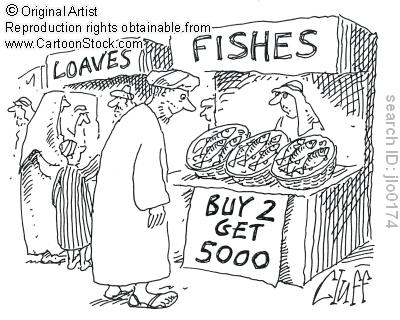
Jesus looks for pricing on a bulk volume deal.

His message was always the same: the unity of the Jewish people, the need for purification and submission to the will of God. And he made his points by stories (parables) and by vivid events (stage-managed miracles).

When he preached in the countryside he could attract crowds of up to 5,000 people. Obviously he didn’t just start talking, and have that many people show up spontaneously. These were publicized events. As at an outdoor event like Woodstock, some people would have brought food and drink with them, and others wouldn’t. But here there was nowhere to get food if you needed it.

Having preached to a large crowd, he would have a small boy come up and offer to share food – “five barley loaves and two small fishes”. He would praise the spirit of the boy, and ask everyone to sit down where they were, and for those who had brought food to share with whoever they were next to. They were all Jews, they were all God’s children, they were all one family. Jesus and the disciples and the whole crowd would share food between them as a communal celebration for one large family, and reinforce his teachings and their bonds as a single chosen people.

The miracle was in getting 5,000 people to share their food with strangers.

(And it was all done without rock music or recreational drugs.)

The Miracles, 1 – Water into Wine

Generally considered Jesus’ first miracle, “turning the water into wine” has captured popular imagination as a casual display of miraculous power – something of a party trick. Which perhaps it was.

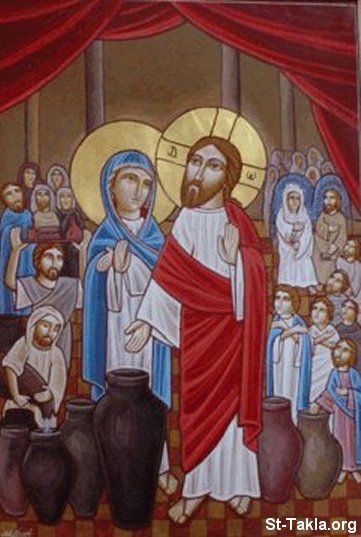
Jesus turning water into wine

Here’s the story: Jesus attends a wedding. His mother says they’ve run out of wine, can he help? She tells the servants to do whatever he says. He says to fill some pitchers with water; the liquid is then taken to the Steward of the feast, who congratulates Jesus on saving the best wine for last, i.e. this wine is better than the stuff they had earlier – normally the good stuff would be served first, before everyone is too sozzled to notice the difference.

But remember that Palestine was part of the Roman Empire by this time. Consider how Romans served wine at feasts: wine was shipped around the Empire as a concentrate, which reduced shipping costs. The wine steward at a feast had the task of adding the appropriate amount of concentrate to the jars of water, producing something that was the appropriate strength for the company and for the state of the party.

If the concentrate was already in an otherwise empty jar, which you then filled with water… Well, it would be a good party trick, especially if it came out at a good strength, and if your guests were village simpletons who weren’t used to attending Roman-style events.

Or perhaps everyone knew that it was nothing special, just a bit of fun – and that the only miracle was in having better-tasting (stronger) wine at the end of the party than at the beginning!

In The Gospel According to the Romans there is an assumption that Jesus uses street magic to provide an illusion of the miraculous, to reinforce the spiritual lessons he teaches – just as Indian holy men do today.

Best resources – Christmas, Mithras, and Paul

Merry Christmas! And the question is, if Jesus was born sometime in the spring (when the shepherds were in the fields with the sheep, and the animals’ area with the manger under the house kataluma wasn’t being used), why did Christians create a winter solstice celebration for him instead?

Paul has an epileptic seizure on the road to Damascus

The answer is that Paul caused it. Paul’s intent was to create a Judaism-based religion that would be universally acceptable; he was a Roman citizen, not just a member of a conquered nation, and he wanted his religion to be Roman as well as Jewish. Reputedly epileptic, his seizures gave rise to religious visions, the most famous being of Jesus (who he never met) guiding him along a syncretist path. Paul took popular elements of Roman, Egyptian and Persian religions, and expressed the message of his religion in whatever form was most acceptable to the Empire as a whole.

The most popular religion with the Roman military was Mithraism. It was exclusively male, a mystery cult with seven levels of initiation, and a clear-cut view of the world as the battle-ground between good and evil. It promised eternal life to its believers, and its god was Mithras, the Unconquerable Sun.

For an extensive review of the whole issue, I refer you to Ben Best’s enormous review of the roots of Christmas, from which I quote:

“Mithras was a divine being borne of a human virgin on December 25th (the Winter Solstice by the Roman Julian calendar), his birth watched and worshiped by shepherds. As an adult, Mithras healed the sick, made the lame walk, gave sight to the blind and raised the dead. Before returning to heaven at the Spring Equinox Mithras had a last supper with 12 disciples (representing the 12 signs of the Zodiac). Mithraism included Zoroastrian beliefs in the struggle between good & evil, symbolized as light & darkness. This militaristic black-and-white morality (including a final judgment affecting an afterlife of heaven or hell) probably accounted for the popularity of Mithraism among Roman soldiers. Mithraism was like an ancient fraternity: a mystery cult open only to men which had seven degrees of initiation — including the ritual of baptism and a sacred meal of bread & wine representing the body & blood of Mithras.”

The original December 25th Virgin Birth

The purple-robed priests, candles, incense, circular wafers and Queen of Heaven motifs were ideas that were familiar and attractive to Egyptians. The winter solstice greeting cards and presents, the greenery of trees and branches and garlands, the pantheon of saints to pray to – those customs were comfortable among Greeks and Romans. But the December 25th Virgin Birth (along with much else) was what would make Paul’s Christianity completely familiar and acceptable to the Roman Legions.

In The Gospel According to the Romans, the Roman military are Mithraists while Jesus and his followers are Jews. There weren’t any Christians yet, of course.

Was Jesus gay?

This is one of those ideas that some people find shocking and incomprehensible, and others think self-evident.

You can see what you want in Jesus

There is an excellent and detailed discussion of the issue, for and against, at the Religious Tolerance (.org) website, here. It raises all sorts of interesting questions, such as “Gay meaning orientation? Or gay meaning activities?” But to me the key issues are these:

1) Given that Jesus was a strict religious Jew, firm that marriage was sacred and indissoluble, for example – why is there no indication that he was married? It was a religious duty, a requirement, the first of God’s 613 commandments, to “Be fruitful and multiply”. Surely the Gospels would have promoted the fact.

Naked young man runs away... let's assume he was really naked...

2) Given that Jesus had individual relationships with him various followers, and loved everyone (or at least all Jews… or at least all practicing Jews… or at least all practicing Jews who he agreed with…), why is John “the disciple whom Jesus loved”? John would have been a teenager when Jesus was in his late 30s. And who is the young man with Jesus in the Garden of Gethsemane according to Mark 14: 50-52, “And they all left him and fled. And a young man followed him, with nothing but a linen cloth about his body. And they seized him, but he left the linen cloth and ran away naked.” Wtf?

People say Jesus couldn’t have been gay, because God said it was a sin. But the same God made David King of Israel, despite his relationship with Jonathan. Maybe God doesn’t really care all that much.

So, lots of questions. And probably much of what you get out of Jesus is what you choose to put in. I put in questions. In The Gospel According to the Romans I suggest Jesus might well have been gay, but it’s not an important element of the novel.

Things we know Jesus wasn’t

He wasn’t born December 25th. The shepherds and flocks would not have been out in the fields overnight.

He wasn’t a Christian. Christianity was the invention of St. Paul in the decades after Jesus’ execution. Jesus was a rabbi, and outspokenly strict on upholding Jewish religious laws.

Did Jesus look European, or African? Who knows...

He wasn’t a pacificist. He said “I did not come to bring peace, but a sword” and, shortly before the Romans caught him, “If you don’t have a sword, sell your cloak and buy one.” He attempted to take over the Temple in Jerusalem and he was crucified by the Romans (the punishment for armed insurrection) between two (other) Zealots.

He wasn’t born in 1 BC or 1 AD (or the legendary “Year Dot”). He was born a couple of years before Herod the Great died in 4 BC.

He wasn’t born of a virgin, if by “virgin” you mean “girl who had never had sex”. Why not? Because that doesn’t happen. Get real. The word should be more correctly translated as “young girl of marriageable age”.

As for the rest, you can read into it what you like.

Did he look like a European? Maybe – depending on who his biological father was. The Romans and Greeks were all over Palestine, and the Roman troops included Germans and Gauls. We don’t know. He might equally have looked African.

Was he gay? Maybe – he doesn’t appear to have been married, and there are various ambiguous statements and situations in the Gospels suggesting he was gay. He might have been gay, straight, bi, asexual…

What happened to his corpse? We don’t know for sure. Someone took it when it had been entombed for 36 hours (Friday evening to Sunday morning). Jewish rumor at the time was that his followers stole it.

Lots of room there to create stories about him! Have fun – I do.

Jesus’ Message, 3: Eternal Life

Jesus said that the two greatest commandments from God were the Shema, and to treat your fellow Jews well. When a rich young man told him (Matthew 19: 20) that he had followed these – and the Ten Commandments, and in fact all of God’s commandments – and asked what he had to do to gain eternal life, Jesus did not, repeat NOT, say anything like “Accept me as your Lord.”

Jesus said “Sell everything, give it to the poor, and follow me.”

The Pope on his thrones in his palaces thinks he is poor.

In ‘The Gospel According to the Romans’ the words would carry a different nuance: “Sell everything, give it to the Zealots, and join the insurrection against the Roman occupation.”

In any case, the young man went away sadly, because he was rich. That was when Jesus made his remark about it being easier for a camel to go through the eye of a needle, than for a rich man to get into Heaven.

And no matter which interpretation of Jesus’ words is correct, it is hard to imagine either the Pope or any televangelist being allowed in at the pearly gates.

Best guess at Jesus’ family

When she married Joseph, Mary was pregnant with Jesus by someone else. Rumor had it that the father was a Roman soldier called Pantera, but the rape (or affair) was covered up. Joseph originally intended to divorce her (Matthew 1: 19), but changed his mind and left Galilee to go back to his family in Judea for Mary to have the child.

Joseph and Mary on the way to Bethlehem

The couple subsequently had several more children. In his 30s Jesus preached in his hometown of Nazareth, and people dismissed his claims to authority, saying “Isn’t this the carpenter’s son? Isn’t his mother’s name Mary, and aren’t his brothers James, Joseph, Simon and Judas?
Aren’t all his sisters with us?” (Matthew 13: 55-56). None of Jesus’ half-brothers should be confused with other followers of his with those names, other than James who became the leader of the disciples in Jerusalem some time after Jesus’ execution.

Some Christians deny that “brothers” and “sisters” means that they were Mary’s children – though clearly from the context it’s a nuclear family. Catholic and Orthodox Christians, especially, profess the perpetual virginity of Mary, and have created a backstory of Joseph having had an earlier marriage to a woman named Salome. She died, leaving Joseph with half a dozen children for him to raise. You have to wonder why the older kids are never part of the creche scenes of the baby Jesus in the manger… Mary, Joseph, Kings, Angels, Shepherds, farm animals… but no brothers and sisters?

No, Jesus had at least six siblings, and they were all younger.

“Jesus, son of Pantera”

About 177 AD the Greek philosopher Celsus, in his book ‘The True Word’, expressed what appears to have been the consensus Jewish opinion about Jesus, that his father was a Roman soldier called Pantera. ‘Pantera’ means Panther and was a fairly common name among Roman soldiers. The rumor is repeated in the Talmud and in medieval Jewish writings where Jesus is referred to as “Yeshu ben Pantera”.

Pantera's gravestone is the one on the left

In 1859 a gravestone surfaced in Germany for a Roman soldier called Tiberius Iulius Abdes Pantera, whose unit Cohors I Sagittariorum had served in Judea before Germany – romantic historians have hypothesized this to be Jesus’ father, especially as ‘Abdes’ (‘servant of God’) suggests a Jewish background.

Tib(erius) Iul(ius) Abdes Pantera
Sidonia ann(orum) LXII
stipen(diorum) XXXX miles exs(ignifer?)
coh(orte) I sagittariorum
h(ic) s(itus) e(st)
Tiberius Iulius Abdes Pantera
from Sidon, aged 62 years
served 40 years, former standard bearer (?)
of the First Cohort of Archers
lies here

The gravestone is now in the Römerhalle museum in Bad Kreuznach, Germany.

It appears this First Cohort of Archers moved from Palestine to Dalmatia in 6 AD, and to the Rhine in 9 AD. Pantera came from Sidon, on the coast of Phoenicia just west of Galilee, presumably enlisted locally. He served in the army for 40 years until some time in the reign of Tiberius. On discharge he would have been granted citizenship by the Emperor (and been granted freedom if he had formerly been a slave), and added the Emperor’s name to his own. Tiberius ruled from 14 AD to 37 AD. Pantera’s 40 years of service would therefore have started between 27 BC and 4 BC.

As Pantera would probably have been about 18 when he enlisted, it means he was likely born between 45 BC and 22 BC. He could have been as old as 38 or as young as 15 at the time of Jesus’ conception in the summer of 7 BC.

In 6 AD when Jesus was 12, Judas of Galilee led a popular uprising that captured Sepphoris, the capital of Galilee. The uprising was crushed by the Romans some four miles north of Nazareth. It is possible (and appealing to lovers of historical irony) that Pantera and Joseph fought on opposite sides. As Joseph is never heard of again he may well have been killed in the battle, or have been among the 2,000 Jewish rebels crucified afterwards.

So Tiberius Iulius Abdes Pantera is indeed a possibility as Jesus’ father. The only thing we know for certain is that Mary’s husband Joseph wasn’t the father, and that Mary was already pregnant when they married. It could have been rape, or Mary may have been a wild young teen who fell for a handsome man in a uniform, even if he was part of an occupying army. It happens.